Squadron Leader Denis Peto-Shepherd
"...a shell burst directly in front of the cockpit"
 |
General experience. |
 |
This page: includes inventory and autobiographical extracts. |
Inventory of the Donation
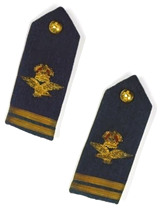
- 7 flying log books (1 empty)
- 2 notebooks
- unpublished typescript recollections of service life
- Book - Devil Take the Hindmost
- Flying jacket
- Post-war - Greatcoat, tunics, trousers, mess kit and boots
- Large collection of RAF books
Extract from the second, and unpublished part, of Denis Peto-Shepherd's autobiography, 'The Devil Take the Hindmost'. pp533-534
"While waiting, (to take-off), so that some of the crew might smoke we had settled down in the grass at a safe distance from the aircraft, eased our flying equipment and lay basking in the sun. Somebody quoted "All dressed up and nowhere to go", and in the sporadic cross-chat that followed Len sailed so close to the wind in some allusion to myself that I could not let it pass without 'disciplinary' action. "Right", I said, "Off with his trousers", and the crew delighted to take part in rarely authorised horseplay, set to with a will. Len was a wiry customer and it was some time before one of the crew emerged from the melée holding Len's trousers aloft. At that precise moment the order for take-off was given, and grabbing the trousers I tumbled into the aircraft with the crew. It was then a race against time to get off, and we flew to the target, bombed and were on our way back before I remembered that Len was still without his trousers. This was surely punishment enough, but the opportunity was too good to miss and winking heavily at Eric I pointed to the trousers and began anxiously to discuss a completely spurious failing engine. Eric played his part magnificently, and between us we painted a worsening picture of damage and impending engine failure.
Len could hear all of this on the intercom and at the first opportunity asked me rather sheepishly if he could have his trousers back. This I dismissed peremptorily on the grounds of being heavily involved with emergencies, and developed the situation with Eric to the point of doubts as to whether we could remain airborne, and warning the crew to prepare to abandon the aircraft. This did it. Len, who apparently did not see himself cutting a dash parachuting into enemy occupied territory trouser-less, became almost frantic, insisting that his personal emergency should also be considered. I must say that even Len would have had some difficulty in explaining to his captors how he came to have abandoned his aircraft without trousers, as the only logical conclusion would have been far from complimentary! It was impossible to bottle up our mirth any longer and Eric and I exploded into laughter, which of course gave the game away to Len, but by then the object was achieved. However, irrepressible Len was later to make much capital from the fact that he must have the unique distinction of being the only aircrew member to attack a target without his trousers - and in this he was probably right!
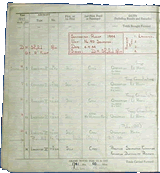
In July 1944 Peto-Shepherd flew operations in support of the British army for example over Caen, where a stalemate situation had developed. In August Denis took part in RAF operations mounted against Brunswick, Hamel and Bremen and in early September he was involved in four days of raids against Le Havre. A promotion to Squadron Leader coincided with three days of operations in support of the Market Garden campaign, beginning with a tactical attack against the Moerdijk road and rail bridges. As it became apparent that the Arnhem landings were at risk, Peto-Shepherd flew a 'Special' Operation, which involved dropping 'dummy' parachutists to cause confusion and panic. On 3 October there was an operation against the dykes at Weskepelle which protected the island of Walcheren, a German stronghold. The first wave of attacks was so effective that they could hear 617 Squadron, carrying the massive 'Tallboy' bomb, being called off. Denis was keenly aware and concerned that the attack, although successful, would have resulted in loss of Dutch lives and land.
Extract from the second, and unpublished part, of Denis Peto-Shepherd's autobiography, 'The Devil Take the Hindmost'. pp535-36
"We were flying at 12,000 feet in the clear and encountered extremely heavy and accurate A.A in the Rouen area. At this height it was very effective and flying into the cloud of hanging black puffs, knowing each one to be the centre of an invisible spreading blast of violently propelled splinters, was unnerving. Strangely the flying control cables, running as they did to the furthest extremities of the wings and fuselage, picked up the vibrations of the thudding splinters as they tore into the aircraft, and I could feel through the control column many of the hits that we were suffering.
All thought of what damage was being caused was swept from mind when a shell burst directly in front of the cockpit. I couldn't duck into the minimal shelter of the fuselage being held tight into my seat by my safety harness, but fortunately the burst was at just such a distance that it was not lethal, and this can only have been a matter of feet. It was the most incredible experience for at the moment of the burst, so close in my line of sight, I was positive that this was it and that neither of us in the cockpit was likely to survive. At that moment, time all but stood still and I saw the burst in the most amazing slow motion. At first sudden, tiny and immobile, suspended seemingly over the nose of the aircraft and only as big as my fist; it then grew, oh so slowly it seemed until it was a black-brown seething, evil and flame-gashed puff as large as a football. And then suddenly, as I watched it, the slow motion effect ceased and all hell was let loose as the seething puff exploded with terrific violence and a sickening hollow thump. We were flying directly into the splinter cloud and co-incidental with the thump the aircraft lurched and shuddered in the blast as the splinters thudded and ploughed into it.
In the general confusion of the burst one splinter passed through the windscreen, between Eric and myself, clanging into the armour plating shield behind my head. Either this splinter or accompanying glass grazed the side of my head above the eye, and as with all such cuts on the head it began to bleed profusely. I was quite unharmed, but the blood was getting into my eyes and hindering my vision. This must have looked very much worse than it was for there appeared instantly at my side an entirely 'new' and 'unsuspected' Eric, so full of concern and consideration that I began to wonder if I had in fact been injured. With an amazing gentleness, Eric swabbed the blood away to prevent it running into my eye and continued to do so whenever he felt it necessary, until it congealed of its own accord. In spite of the extensive light damage suffered by the aircraft, none of the crew was hurt. The next day I sought out Eric in his quarters to thank him for his help and concern. "Good God", he said in curt embarrassment, "I only did it because I wanted to get back!" But somehow 'Eric the hard man' was far from convincing."
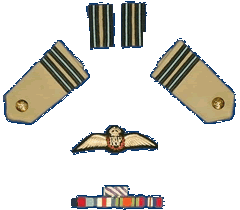
The medal ribbons in the image are (top and from left to right):
British Distinguished Flying Cross: for 'acts of courage, valour or devotion to duty performed while flying on active operations by officers and warrant officers'.
1939/45 Star: for service in operations between September 3, 1939 and August 15, 1945. Qualification period: six months operational service.
France and Germany Star: for operational service in France, Belgium, Holland or Germany between June 6, 1944 and May 8, 1945.
Defence Medal: for three years' service in the UK between September 3 1939 and May 8 1945; overseas until August 15, 1945. It could be awarded in addition to other campaign stars.
War Medal: for full-time personnel of the British armed forces, irrespective of place of service, for 28 days operational or non-operational service.
Extracts from the second, and unpublished part, of Denis Peto-Shepherd's autobiography, 'The Devil Take the Hindmost'. p622
"By the end of our operational tour we were a group of men united by one of the strongest bonds known to mankind, that of men who put to the supreme test in action stood steadfastly together. Such a knowledge of ones fellows is a precious thing, which is almost impossible to come by outside the intense experiences of war.
The more extraordinary it is that after taking part together in many momentous events of a world war, after risking death or mutilation together not once, but again and again; we shook hands in a remote Suffolk village and went our ways, to all intents and purposes, never to see one another again. We were by no means unique in so casual a parting, there are many crews who will admit to it, but I have yet to meet a crew or individual who could satisfactorily explain so vague a drifting apart. I believe that the cause may lie in the attitude of mind it was necessary to develop for fighting in the air; the numbing of feeling to minimize the personal loss of friends and acquaintances; the attempt to relegate all but the job in hand to the inconsequential, and above all the knowledge that few, if any, would survive the second tour we believed to be ahead of us after a brief break. Be that as it may, it was some forty years before we jointly corresponded or saw each other again.
|
General experience. |
|
This page: includes inventory and autobiographical extracts. |