Jack Grinham
"It was the middle of January 1945. We were supposed to have three months jungle training but I'm afraid I had to learn the hard way."
 |
In France with the Maquis |
 |
This page: behind Japanese lines in Burma |
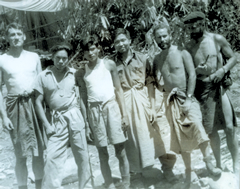
When we got back to London we were debriefed and they asked us if we would like to do the same kind of thing in South East Asia and we all said that we would. We went back to camp and had some leave before being drafted out to Bombay. After seven days travelling, we finished up at our base in Ceylon and there I was teamed up with two more officers. (Oswin Craster did not come with us immediately, he came out in a later draft and the Frenchmen went back to the French Army and I didn’t see him again until a long time after the war).
Our new team was called Mouse. There was Major Kemball and Chris Bathwaite, (later made Major), and then in Calcutta we met three Elikanese Chin agents, Basaw, Yehong and Aung Zo and that was the team – Mouse – the six of us.
We were briefed in Calcutta for our trip into the Chin Hills. The Japs had constructed a dirt road across western Burma and our intelligence wanted to know what traffic was using it, if there were any possible targets on it and any other information about it whatsoever. And, of course, the usual thing, to find out where the Japs were. We did this with some success although we could not get on to the road itself, it was too well guarded.
It was the middle of January 1945. We were supposed to have three months jungle training but I’m afraid I had to learn the hard way. A rookie Canadian crew dropping us and we were supposed to have a party meeting us at a particular place. They could not make it so we went to a different landing zone in case the first one had been compromised and we landed at eleven o’clock at night in a paddy field.
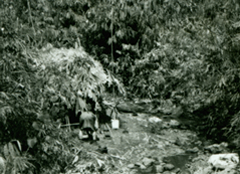
When we landed on that night, Major Kemball made friends with the local headman, a Thuji his title was, who owned the paddy field we had landed in. He didn’t like the Japanese because they were always pinching his rice, so he was very friendly and passed us on to his friends and family so we could enter the village quite safely. They knew where the Japanese were from the tracks they used, so we could move in safely to find somewhere from where we could operate. And that’s how we went on. It was hard work to say the least. It had been a bit of a dodgy dropping but we managed to get ourselves sorted out and eventually we got the proper radio and the charging equipment which we had lost on the first drop and then we became quite well established.
The countryside we were operating in was nearly all bamboo. We could only use tracks, there were no roads. We went everywhere on foot. We were heavily laden but the locals carried some of our kit. Our radio set was different from the one we used in Europe, it was a B2 set and it was in two pieces each weighing seventeen pounds in waterproof and watertight cases. There was a sixty amp twelve volt battery and then the charging equipment, not fuelled by petrol but by a portable steam generator weighing ninety pounds and we had to arrange for that to be carried. We couldn’t carry the lot, but we had to go along there with at least forty or fifty pounds on our backs. We didn’t carry anything we didn’t need, we just ditched it. The first thing I ditched was my spare pair of boots. I’ve got big feet and I ditched those as soon as I got there because I wasn’t going to carry them when I didn’t need them.
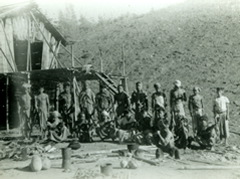
The Japanese knew we were there, but they didn’t know where and our locals were very, very good. They knew where the Japs were and the tracks they used so we managed to move quite happily and successfully from one place to another.
On one occasion when the lads had gone out, I can’t remember the name of the place, they came back and said, “There’s a hollowed out tree, like a banyan tree, with a lot of big boxes inside and in the water there are some big barrels”. These turned out to contain petrol. So we arranged for some Beaufighters to come over and they blew this lot up and it certainly set the petrol in the drums in the water on fire. That was the sort of thing we were successful at doing. Another time there was a convoy on the road. We hadn’t seen it but the locals told us where it was. It was parked against a bit of a hill that had been hollowed out. We got onto the emergency schedule and the next morning some more Beaufighters came over and plastered this thing and the hill dropped onto the convoy. We heard them come over just as it was breaking daylight.
Communication with the Chin members of our team was no bother. Basaw was a very good interpreter. Yehong had a good command of English and was a very happy sort of person. The other one was a little bit quieter, but nevertheless we were all a team and we all worked together. We never had any difficulty communicating with each other, none at all.
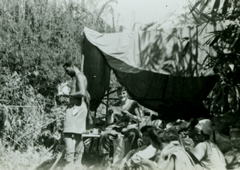
After the original drop, (which they had made such a mess of), we were very short of rations. But with the emergency drop of the charging equipment for the radio, they dropped us some American ‘K’ rations and we lived on those for a month. We used to get a supply drop once a month and we also had some local food, mostly rice. It was very, very good rice too. Occasionally we had chicken or something like that. Our drops were always at night.
The rice ration was dropped without a parachute. You had to get out of the way when a half-hundredweight bag of rice was coming your way!
We used to have quite a bit of fun sitting round the fire at night talking. ‘Jeep’ Kemball was a really well educated Irishman and a Roman Catholic. Chris Bathwaite was Roman Catholic and we used to take the Mickey out of each other. They took the Mickey out of me for being a ‘copper’, which I didn’t mind it was good fun, and we would have a bit of banter both ways. There was never any falling out, never. We just got on so well together. I can’t put it any better than that. We worked as a team and stayed as a team.
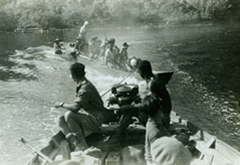
We had been dropped about 120 miles behind Jap lines. When the West Africans, and I think it was the 81st and 82nd West African Brigades, were coming down we made our way towards them. They were firing at the Japanese and when they saw us, they started to fire at us but we just went through the lines and got through safely without being hurt, but I didn’t like the bullets whizzing past my ear! We got to the brigade headquarters and the brigadier welcomed us in his very posh voice and ‘regimentality’ started again, “Officers’ quarters over there, Sergeants’ quarters over there”. We didn’t do any operations with them, we just stayed until we could get a lift down the river
We made our way to the Liaison Officer and he arranged transport for us to get back to what I call civilisation, in this particular case Calcutta. He was very good, he got us on to a Dutch coaster to Cox’s Bazaar or somewhere up there, I don’t know exactly where, and then we got a lift on a Liberator back to Calcutta. After debriefing, getting cleaned up and some decent clothes because we were absolutely in tatters, filthy and unshaven, we were kitted out again and we went on leave. We went to Poona to a Special Forces rest camp and spent quite a few weeks there. We used to go into Poona and enjoy ourselves and get a little bit drunk, because we had three months ration of booze. From there we went back to Ceylon, and then the war ended and we went back to the normal Army, which hurt a bit. We went back to the RAC depot at Poona, we were an unruly lot because of the life we had been living for the last couple of years and I finished up in Agra. I was there for a while and then I went up in the hills because of illness, and from there I got my passage home, my demob.
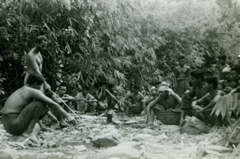
I was as green as grass when I went into the police force and I was even greener than grass when I went into the Army, and particularly when I went into the Special Forces. You had to learn as you went along, it might have been the hard way, but the comradeship made an enormous difference and it gave me an experience of life that I never thought I would have.
Looking back, it certainly improved my character. Although it didn’t do my health any good, I was not in very good health when I got back. It made me more of a man, which is the best way I can put it. I saw so much of other parts of the world and I did things that I didn’t think I was ever capable of, and all of that just made me feel more complete. I can’t put it any better than that. It was a wonderful experience.
|
In France with the Maquis |
|
This page: behind Japanese lines in Burma |