Private Arthur Barraclough
"You know the Americans are coming..."
 |
Sicily and captivity. |
 |
This page: escape and freedom. |
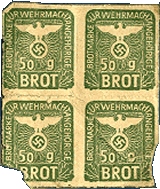
After two weeks of walking with almost nothing to eat, Arthur developed malaria again. He was taken to a Tamsweg hospital.
I received wonderful treatment. The nurses and doctors were kindness itself, and there was an elderly lady who I think had been a school teacher who came to visit... One of the things which I have never forgotten is the unbounded generosity of the occasion of when she came and very quietly and surreptitiously said to me, "I want you to have these," and she gave me some coupons - ration coupons for bread... The sad thing was that when I got out of hospital I had no opportunity of going into a baker's shop and using them at all. I still have them.
Arthur rejoined the prisoners' march across Austria. They passed the hospital and Arthur managed to contact the staff who had treated him and they gave him food which he shared with his Australian friend. They walked and walked, sleeping out under trees at night. Eventually they reached Markt Pongau camp near St Johann.
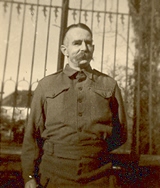
This camp was, I would say, totally inadequate and totally incapable of catering for us... When my friend and I got there every barrack room - not that I saw many - we simply could not find a square foot of floor in the barracks where we could sit down. This particular barrack room was built on a bit of sloping ground and at the lower end there - the floor of the barrack room was supported on either wooden or brick supports, and we slept underneath the floor for two or three nights. We were very hungry. The facilities for things like sanitation seemed to me to be non-existent. I remember only seeing one tap which never seemed to stop running because people were queuing to fill their billy cans or whatever with water.
Arthur attempted another escape. With his friend, he volunteered to pull a handcart into the village in order to collect supplies for the camp. Once they were out of the camp, they continued along the road with the cart-pulling party and as soon as they saw an opportunity, jumped over a wall. They stayed there until they thought all was clear but as soon as they climbed back over the wall they ran into a German officer who escorted them back to the camp.
During his captivity, Arthur had made every effort to learn the German language. His friend chose not to learn any German at all, insisting that any commands directed at him should be in his own language. During their attempted escape they had noticed a railway line and at about ten o'clock, when it was dark, decided to break out of the camp under the perimeter wire and to head for the station.
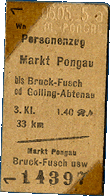
Arthur managed to buy railway tickets to Vienna, and they boarded the train. They travelled for about twenty miles to a station at Bruck. It was raining heavily as they left the station and walked along the road. They were approached and questioned by some Germans, but Arthur managed to persuade them that he was 'taking his father home'. They continued along the mountain path to the Schmittenhohe and found a little wooden farm building, they tried to enter, but on hearing German voices, crept away and hurried on their way.
Now there was a farm higher up there and I had to go and ask them if they would give us a bit of something to eat, which they did. I made a sort of veiled threat "You know the Americans are coming and if we tell them you have fed us it will be to your advantage." We had a meal and we considered that perhaps by now the area was clear of Germans. We came down once again, but once more a German Officer saw us. We met each other. There was no point in running away and what he had to say was quite unexpected, totally unexpected. He said, "I have been on the Russian front, I was wounded. I have been in hospital. I was discharged as unfit for further military service and I am now wanting to make my way to the Americans. But, if you can help me, I will help you. I will help you to get to the Americans if you will help me." We gladly acceded to this suggestion.
The three men travelled by train from Zell am See bound for Innsbruck, but stopped after Kitzbahel in the middle of nowhere. They continued on foot and reached Worgl where they were met by an approaching American armoured vehicle.
The vehicle stopped and (the driver) said, "Who the blazes...?" He was obviously confused that here was an Australian - with his big slouch hat, me in English uniform and in the middle of us was this German. We told him quickly who we were and that we were hoping to get away and that the German, having paid for the tickets, had got us to here. I did my best to ensure they didn't shoot him there, but he was taken away, presumably for interrogation, and our ways parted there.
The American said, "Do you know what day it is?" and quite frankly I was not at all sure, but I said, "Well, I think it is Wednesday," and he said, "do you know anything else?" and I said "no, what should I know?" He said, "It's VE Day!" and that was the day we met them.
We were then taken by the Americans to Innsbruck where the place seemed to be teeming with American soldiers, and we stayed in a house which they had taken over as a billet. The dear old lady who presumably lived in the house, realising I could speak German, asked me, "Would you be so kind as to ask these people, I know I can't stop them from sleeping here and living here but would you ask them not to kick the furniture about." We were told by the Americans that we should report in and go through the proper channels for returning POWs. But they did also point out that there were quite a number of German vehicles which had been left, deserted, and that many of them were quite roadworthy. We took the hint and (found) an Opel car in German livery. The Americans gave it a quick inspection. One of the chaps, who must have been a mechanic said, "the brakes need adjusting, but I will see to them for you." They checked the oil, they filled it up with petrol, they gave me a map and then we started after once again loaded our stomachs with some food. We set off, then, from Innsbruck in this car, making our way home.
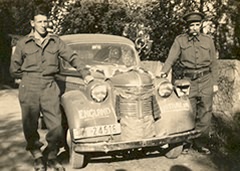
Arthur and his German car. |
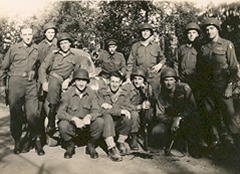
Arthur, his friend and the American soldiers with the car. |
Driving through Germany on the autobahn and then to France. As they travelled, they noticed an American staff car with a large Red Cross painted on the door and when they stopped to check directions on the map, the staff car pulled alongside. The driver, who was English, took them to his French billet and they stayed the night. He explained that he had taken a high ranking official in the Red Cross to Germany and had been deputised to bring the car back. He suggested they travel to Paris together and sell the Opel to the local doctor. They divided the money between them and left for Paris.
Arthur and his friend registered officially as returning POWs in Paris. They were taken to Dieppe and sailed to Newhaven with other returning POWs and after an overnight stay in Lewes, Arthur was given a travel pass and returned home.
After a period of compassionate leave, Arthur was transferred to The Royal Army Pay Corps. He was stationed at Ilfracombe for nine months at the Post Office Savings Bank, Army Branch. He finally left the Army on 23 July 1946.
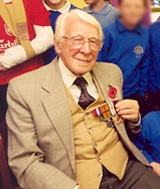
While I was on a working party in Graz, there was a German guard and he was a grand fellow. On one occasion whilst we were talking I remember very well him saying to me in a very clandestine sort of way, "you know, I have no time for The SS and no time for Hitler."
Now I have no recollection whatsoever of ever having given him my address. He certainly knew my name, but when I had been back home in Civilian life for a few months I received a letter from him...things were difficult for the Austrians after the war and my wife and I sent parcels of food.
Whilst on holiday in Austria with his wife, more than twenty years after the war, Arthur visited the guard at his home in Bregenz.
It was a heart-warming experience. I like to think that in spite of all the enmity, the destruction, the hateful atmosphere of all that happened during the war, I think of the German Officer who offered me a cigarette (when I was captured), the lady who gave me the bread coupons, the German who bought the tickets to go on the train to Innsbruck, and I think of Herr Stadlmann, the Guard, who each and individually showed the milk of human kindness.
|
Sicily and captivity. |
|
This page: escape and freedom. |