Signalman Harry Read
"The preparation for D-Day was really quite thorough, quite splendid."
 |
This page: training for D-Day with the 6th Airborne Division. |
 |
D-Day, Normandy and home to England. |
 |
Poems by Harry Read. |
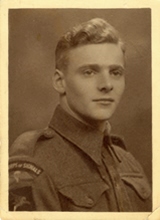
Harry Read was born in Teesville, a small town in the North Riding of Yorkshire in 1924, the third child of Robert and Florence Read.
Mine was a very happy household. My parents were devoted Salvationists and the family home was loving and secure. Materially, it was a poor home because we were caught up in the Depression which in the north east of England was very severe, resulting in a great deal of unemployment. My father was among that great number of men who were unemployed for quite long periods. That must have created all kinds of problems for my parents of which I was totally unaware because of my happy upbringing. Furthermore, nobody had much in the way of possessions because everyone was poor. All were victims of the Depression.
Harry's father had been in The Green Howards during the First World War having fought at Ypres and the Somme. He had been wounded twice being hospitalised each time.
In 1930, the family moved to Grangetown, also near Middlesbrough. When the declaration of war was made in 1939 Harry's school closed temporarily, and he decided to leave school to begin working for the war effort.
I was just fifteen and was very anxious, like most other young fellows, to get into the war but my father was quite adamant on two things. One was that he would never sign for me to join up before my eighteenth birthday and the other was that I was not to go into the infantry. They were two very important considerations he laid on me.
Harry began working at the local shipyard as an apprentice plater. He hated the work and when he learned that shipbuilding was to become a reserved occupation and that he would have to remain in the trade until the war ended, he immediately found clerical work for a firm whose trade and premises had been commandeered by the government.
I worked in the Middlesbrough office of this firm. Men, of course, were being called up for military service all the time and we youngsters found ourselves with jobs that were far and away beyond our seniority. When I was sixteen, for instance, the office in Malton, also in Yorkshire, needed someone to handle the clerical work and I was asked to go and was happy to do so. That turned out to be a very significant move.
As well as being a Boy Scout, Harry was also a Sergeant in the Air Training Corps in Cleveland. However, when he moved to Malton, the local ATC had enough NCOs and Harry knew he would have to start again 'at the bottom'.
That was an awful thing for young fellow to learn and I decided that I couldn't face that. My firm had fixed me up with lodgings in Malton and, lodging in the same house were the wife and very young daughter of a Regimental Sergeant Major of one of the units stationed in the Malton area. Quite frequently, the RSM would visit his wife and I found them to be a superb couple. They were generously minded, kind and very understanding of this sixteen-year-old lad who was away from home. When talking with the RSM - Mr Stephenson - about this business of the ATC and the fact that I didn't want to return to the bottom rung of the ATC in Malton, he asked if I had ever considered joining The Home Guard. Such a thought had never crossed my mind and I must have said something like, "Why would I want to do that?" To which he replied, "Well, when you were a Boy Scout you did Morse Code didn't you?" To my affirmative he suggested that if I joined The Home Guard it would be of value in joining the military and I could go into the Royal Signals as a wireless operator. And so the seed was sown.
Every time I went home to visit my parents I made an futile plea to my father to sign the piece of paper that would allow me to go into military service. Always he flatly refused - with some justification. There was his own experience of World War 1 of course. Also, my older brother was a commissioned officer in The Royal Artillery by this time serving in the Middle East, and my older sister was in the Women's Auxiliary Air Force. The reasoning was simple enough, why should the third child and second son become a member of the forces? So Dad steadfastly held out against me. But when I was eighteen and we both knew that his authorisation was no longer needed, I went home and the conversation ran on these lines: "Dad, at eighteen and a half I will be called up anyway, it would, therefore, be smart of me to go in now, volunteer for the Regiment I want and, at least have the chance of being what I want to be." He put his blessing on that and I immediately presented myself at the recruiting office in Blossom Street, York. That was September 1942.
The Recruiting Sergeant wrote 'Desires eventually to serve in The Royal Corps of Signals, operator, wireless and line' in red ink on Harry's application. Soon he was sent to Prestatyn, North Wales for his initial training.
Harry enjoyed most things about soldiering including the physical training not least being part of the small group being prepared for membership of the Regiment's cross-country running team. Whilst training as a wireless operator, there was an appeal for volunteers to serve with the 6th Airborne Division that was then being formed.
I thought that was a super idea! It solved a number of problems for me not least of determining where I would go when my operator training was complete.
After completing his operator training, Harry was posted to Bulford Camp on Salisbury Plain on 25th May 1943. He was among the first men there and their first task was to clean the barrack rooms in preparation for further recruits.
They had listed me as a recruit for The Air Landing Brigade, that is, the Brigade that used gliders. I was disappointed that I had been so recorded because I had volunteered specifically for parachuting. While the Army was getting its records straight I did a couple of flights in gliders which I thoroughly enjoyed. In fact, the first time I ever flew was in a glider. Then, within a matter of days - the early part of June 1943 - a group of us entrained for Chesterfield where, on arrival, we marched the twelve or thirteen miles to Hardwick Hall which had become a physical training centre to prove whether or not we could cope with all that was expected of a para.
The training at Hardwick Hall, Derbyshire, was very tough but Harry remembers relishing the challenge and enjoying the camaraderie. He received word that his father was gravely ill and was given compassionate leave to return home. His father died and, after the funeral, Harry returned to his squad at the training camp. He was given the opportunity of continuing with his original squad or being 'back-squadded'. He chose to continue but found the break in training had affected his fitness, he had to go through the aches and pains of getting relaxed muscles back to peak condition, while competing with men who had had no such break, even so, he completed the course. Training continued with jump training at Ringway - now Manchester Airport - where recruits jumped from old Whitley Bombers.
For the first few days we leapt out of mock-up aircraft on the ground and did our stuff on all the other training projects in the hangar which was all very interesting and demanding. Some fellows couldn't manage it and they were returned to their units. But it seemed all good fun to me. At that time, the standard number of jumps to qualify for the much-coveted wings was nine. If however, the weather was bad, inhibiting flying, and if reinforcements were urgently needed elsewhere, the number could be dropped to eight jumps or even seven. We were fortunate and did the full nine.
My first jump I hated. It was from a cage suspended beneath a Barrage Balloon, the balloon and cage being anchored to a truck. The balloon ascended under the control a man operating a large drum around which hundreds of feet of wire had been wound. The balloon rose slowly and steadily to 850 feet with the six men in the cage standing around the hole in the floor through which we would go. Five of us were nervous, the sixth was the instructor who exuded nonchalance, gave good advice and well-intentioned humour that didn't always work. Each in turn we had to sit at the edge of the hole and, on the word of command, push ourselves off and out. Because there is no slip-stream the jumper falls 150 feet before the parachute opens. 150 feet is not very much unless one is falling it! To be truthful, I didn't like that first jump and we had to do another almost immediately afterwards. When I had landed and rolled my chute up and walked towards the truck that had the refreshments I was saying to myself, "You are not liking this very much, Harry. No one would mind if you said you wouldn't do it again." But I was in a squad of blokes not all of whom were telling the truth because they were all saying, "Hey, what a marvellous experience, super this, super that and the other." So I said to myself "Well, maybe the next one will be different" and it was. I quite enjoyed the second one and continued to complete the course.
Fully trained, Harry received his wings and red beret. He returned to Bulford at the end of July 1943 and, after two weeks privilege jump leave, began training for D Day. This included maintaining fitness levels, shooting on ranges, unarmed combat, operating wireless sets and occasionally manning the Signal Office.
One day I was sent for and our CO told me that they had received a note concerning a recommendation that had been made in my initial training, related to the possibility of going to OCTU. "Do you wish to follow through with this?" was the question. Since the original interview I hadn't given it very much thought but, and this sounds quite stupid, I didn't wish to miss D Day. Had I opted for officer selection and the training that went with it, I would have missed the big day itself. So I said, "Thank you very much, Sir, I would rather stay where I am." I stayed, therefore, with J Section, 6th Airborne Divisional Signals. The decision did not affect unduly the course of the war but it certainly affected me.
Preparing for D Day, Harry and his unit were to jump in the presence of The Princess Royal on Salisbury Plain. The weather conditions were poor and everyone hit the ground hard, bounced, and the strong wind got into the parachutes and dragged them along the ground.
There we were being dragged along at an unseemly rate of knots, pulling like mad at the lower rigging lines to spill the air out so that we could stop and detach ourselves from the chutes. I felt my left knee objecting strongly to the force of that landing.
A couple of days later, we did a night drop that came into the category of being a little bit horrendous. It was not a good night and they were testing the efficiency of a new landing flare which meant that, intermittently, we had this massive burst of light and then pitch darkness. We did not know but our aircraft came in lower than we had expected - we jumped out OK, there was a sudden burst of light, then the accentuated darkness and, thump, we had landed. We had no way of gauging where we were in relation to the ground. Some chaps landed in a clump of trees that didn't do them much good. The leg I had already hurt I hurt further. Subsequently, I ought to have done something about the pain and possible damage, but what if they had sent me back to my unit? So I soldiered on with a leg that kept reminding me that what I was doing was not very smart. I did the route marches and everything else required of me but I was always conscious of the fact that I had a problem in my left knee.
The preparation for D Day was really quite thorough involving a variety of schemes. They were tough and rough but, by and large, enjoyable. I remember the last one we had before D Day when we were sent into the Somerset area where the ground was as near to 'D Day ground' as could be found. A jump was associated with the exercise but the weather worsened and continued to do so. The rain was torrential. We bivouacked - two fellows putting their groundsheets together for shelter and sleeping underneath the inadequate canopy - except that we didn't sleep very well because of the mud and utter discomfort. When we started off again we continued to pull the canvas trolley that held our radio set and equipment. A couple of us pulled and a third man was at the back end to help with the control because we and it kept slipping down the wet, muddy slopes. We were drenched through with the rain, more or less caked in mud and, suddenly, it occurred to me that it was my birthday. Not the best of ways to spend your twentieth birthday.
We went back to Bulford. The next few days were even more strongly focused on D Day: checking our personal weapons - In my case, a Sten Gun - ammunition, rations, the contents of our packs and our wireless sets.
The Division was given a weekend leave shortly before we were to move into the designated security areas before D Day. Those who lived too far away to be back in time decided to risk going home and, on our late return, were charged with being AWOL (Absent Without Leave) and fined three days pay. Since the Army needed us on D Day we had reckoned that we would not be punished much more severely than that.
|
This page: training for D-Day with the 6th Airborne Division. |
|
D-Day, Normandy and home to England. |
|
Poems by Harry Read. |