Cpl Geoff Steer 1/4th KOYLI
"Machine guns were cracking all the time and ricochets off the ship were like wasps buzzing round."
 |
This page: service in Normandy and Holland. |
 |
Prison camp and the long march. |
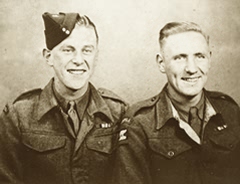
I was born in St Helens Elsecar in 1923. My father worked at Elsecar Colliery as a miner. Those were the days of getting bathed in front of the fire in a tin bath, no such thing as pit baths. In the early 1930s my father had an accident which caused complications. He died at the age of 38. We then moved house to Harley, back where my mother was born, to live with my aunt. My schooling days were spent at Barrow School, Wentworth, till leaving time when I was given a job at Wentworth Gardens. I stayed two years at the gardens, the pay was 10 shillings a week and then moved on to Newton Chambers Engineering Works.
September 3rd 1939, Sunday morning war was declared. How long would it last, some said 12 months, most people did not comment. They had been through the First World War. On that Sunday night the sirens went. Everybody was alerted and most people stayed up all night but afterwards we found out it was only a practice.
At work things changed. Mates went off to join up or were called up. Along with other workmates I was deferred till our two years were up in the Engineering Foundry. We did try to join but were sent back on two occasions. Coming home from work one night in the summer of 1940 on my pushbike, coming to the bottom of our street by the Clothiers Arms, about one hundred men were sat down on the pavement, without packs or rifles, some with just their khaki trousers on. They were absolutely shattered. These soldiers had escaped from Dunkirk. This was my first glimpse of war and the army brought to our doorstep. The soldiers were billeted in and around Elsecar, and next-door to us, so I had hours listening to their stories of the war in France. Eventually they were all recalled to their units and life settled down once again.
At work I moved from the Foundry to the Stove and Grate department making steam ovens and KH cookers for the army. The hours were long - 7 days a week and overtime every night. Meanwhile I joined the Home Guard, our LDV, while others joined the firewatchers either at work or at home. The training in the Home Guard stood me in good stead for later on in the army.
On arriving home from work I noticed an envelope on the mantelpiece marked OHMS. It said that if I signed the form enclosed, I would be deferred from the services until the end of hostilities, but I would have to go and work down the pit at Elsecar Colliery. Well, when my father passed away I made a promise to my mother that I would never go to work in the mines, so the decision was easy. I burnt the letter; hence the following letter to report to Cooper Art Gallery, Barnsley, for a medical examination for the army, which I passed A1. I got my calling-up papers and had to report to Fulwood Barracks, Preston where we had 8 weeks training on the double all day. After 3 weeks I was made a Lance Corporal and had the experience of drilling my mates on the square. As I mentioned earlier the training of the Home Guard was paying off. After the 8 weeks I was posted to Caterham to the Coldstream Guards which was the Brigade of Guards which meant square bashing for twelve weeks prior to moving to Pirbright Battle School. The first two weeks we were not allowed out of camp until we could salute properly. It was while I was there I met RSM Britton with his pacing stick. I was on my way to the Camp Barbers crossing the parade ground when he yelled out. He asked me how long I had been at the camp. I told him two days. He said that while I was there I was to conduct myself as a Guardsman at all times. Then he marched me down to the Barbers at the correct pace. What an experience.
After 3 weeks it was found that I was half an inch too short, so I was posted to Berwick on Tweed to join the KOYLIs at Magdalene Field for 18 weeks infantry training. At Berwick I met up with comrades with whom I was later to land in France. My mate, number 2 on the Bren, was Frank Williams from Birmingham. Later he was best man at my wedding and I was best man at his. Sergeant Rawson was in charge of our platoon. For eighteen weeks he was just like a father to us. We came out on top in drilling and won the one mile obstacle battle course. I was chosen as the battalion two mile runner and relay team, We finished our training at Berwick and were posted to the Hamilton Racecourse to join the 1/4th KOYLI B Company. We were ordered to pack our kit and get ready to move off. When we arrived at our destination we were told to board the ship which was the Ben a Machrie and we sailed to Rothesay, Isle of Bute, which was a submarine base during the war. Every morning we went down to the beach to board landing craft which then took us to the Ben a Machrie ready to take us to the practice landing area at Blackpool Bay further up the Isle of Bute. Every day the Navy would stand off the beach about twenty yards so we were wet to start with. The training there was rough. It was landing craft exercises ready for D Day. Two weeks we were out there, wet through every day and the final week we had to do it at night with live ammo and live shells. Returning from the Isle of Bute to Hamilton we had a week's rest and then we were off again, this time to Lowestoft for more training; river crossing, fast route marches, digging in and sleeping in slit trenches, advancing under fire and on top of that, PT every day, so that everybody was fighting fit. It was now May, and things were buzzing.
On the 5th June 1944 we signed for 200 francs, then we knew where we were going. This we received in the transit camp. The marshalling area was behind a Polish fighter aerodrome in a wood, under canvas. We passed the time away playing cards or listening to the wireless. Some of the lads had their hair shaved off to ward off lice. Shaving the head was a good idea but after we had been in action a few weeks some of them got wounded and were flown home, so the first thing they had to buy was a flat cap.
Orders came to move out and we made our way to Newhaven Dock where we boarded our LCT. We spent four or five hours on board waiting for the tide, then we were away at about 11pm. The sea was a bit rough and lots were seasick below decks. To put it mildly it was a complete shambles. I spent most of the night up on deck talking to the sailors and eating tins of treacle pudding and rice pudding. Daylight came at last and what a sight. Ships as far as you could see, in front, each side, and bringing up the rear, each altering course every 3 minutes. Everybody was told to stand to on deck. Behind the door at the front, catwalks on the side of the ship were ready to be dropped in the sea for easy access and we were told to disembark as quickly as possible. The ship would then turn round and head back.
As we neared the beaches we could see buildings in ruins and the harbour wall was breached from recent bombing by the RAF. The place was Ver-sur-Mer, Gold Beach. By now the noise was deafening, mostly from the warships and our tanks, which were landing and exploding the waterproofing which covered them. Machine guns were cracking all the time and ricochets off the ship were like wasps buzzing round. The ship stopped, the beach was 50 yards away, the doors were opened and the catwalks were lowered. Out we went in about 8 feet of water, swimming a bit. I was fully clothed, with a full pack and a Bren gun resting on the pack with pouches full of ammo. We hit the beach and we moved on up the road. Our destination was a field at Coulombes, a small village where we could change our trousers, our dry trousers were round our necks. The whole battalion had their trousers down. Off we went towards Bronay which was in contact with the enemy. We approached Dudy St Marguerite towards the main railway line from Bayeux to Caen when Jerry opened up on us from outside Audrieu before we crossed the railway line, so we were held up for a while. Then the enemy withdrew and we dug in for the night, or as it turned out, for a couple of days, while the 25 pounders and the RAF softened up Cristot. June 16th D+10 we were briefed on the battle of Cristot. We formed up in a lane near a farm with banks either side of the lane. There were dead cows rotting and the stench was terrible. It was time for the barrage to start and for B Company to move off in line through the cornfield towards Cristot. The shells from our guns seemed to be touching our steel helmets before they hit the ground. We could now see the church, or what was left of it. On our left was a farmhouse and a few Jerrys were holed up in there. They kept sniping at us as we approached the building. The Sherman tanks had now caught us up. I tapped on the side of the tank with the Bren butt. Up popped the Commander. I told him we were having trouble with the farmhouse. He fired 4 HE into it and then drove the tank straight through the building. He commented that he hadn't seen anybody when he went through the front door and out of the back. The tanks never left us right into the village. Through the corn we came. My section was bang on the village. As soon as we were on the road a sniper winged two of our section. Cristot is only a small village, 3 farms, 40 houses and a church, but we paid a high price in terms of men lost. It just goes to show the infantryman has to take the brunt of all kinds of firepower and sometimes from his own side. Speaking for myself, I never got used to day after day of shelling, small arms fire, counter-attacks, night patrols, daytime standing patrols, seeing your pals die and having to bury them. I would see another day dawn and wonder if it was my turn today.
Our next major action, on 25th June, D+19, was the 146 Brigade attack on Fontenay le Pesnil and Tessel Wood. D Company was in front and we followed behind. Someone shouted that there was a Tiger tank on the right. Once again we knocked on the tank, reported the Tiger, the Commander spotted it through binoculars, and he told us to lie down under cover. He fired 3 solid shot and 4 HE and the tank was burning all night. The co-operation of the tanks was first-class.
The battle raged on. Men were falling on each side. One of D Company was in front, walking by the side of the tanks when a mortar bomb dropped nearby. We hit the deck. We heard a scream and on getting to our feet saw a terrible sight - the lad had been hit by shrapnel through his ammo pouch where he kept his phosphorous grenades. They were all burning as these were smoke bombs. He died terribly in minutes. Times like that were very hard. We were told to dig in and consolidate our positions. Our platoon was entrenched in front of a right-angle hedgerow, which turned out to be a mistake.
The tanks stayed with us all night just in case of a counter-attack. The night was pretty quiet except for our night patrols having skirmishes with the Jerries. Imagine all the noise - being shelled, mortared, machine-gunned, covering ground as fast as you could, taking shelter, then digging a trench 6' x 2' x 6'. Then you had to stand to, waiting to see if the enemy would counter-attack. I haven't mentioned the mosquitos, in their thousands, biting you day and night. After a week we were issued with ointment to put on our hands and face.
We were standing in water so what sleep you got, it was while standing up. All the time there was an inevitable drain of casualties with new recruits taking their place. I was made up to Corporal while at Tessel Wood.
Lots of things happened at Tessel, things which occurred more or less at the same time of day. When the grub came up, the motors would bring it on to the main Fontenay road, which had about 4 inches of dust on it. Jerry could see this and would start a barrage on to the road, but the jeep always managed to get through. Making my way through the hedge I looked at the Fontenay road and saw the grub wagon. Suddenly Jerry opened up with 88s. There was a terrific bang and clouds of dust. Part of the hedge fell on top of us because when I dived in there was already a lad in the bottom fast asleep. I lay still and heard the next salvo coming, but over they went towards the road. The lad under me was going berserk. When I did manage to get out he ran back down the hill. I never saw him again, reports said he was bomb happy. The OP from the end trench came hopping past me, half his boot toe missing and toes with shrapnel wounds. He said "Never mind me, see to the others". By digging in, in front of the hedgerow, the trees brought the shells down in the trenches. We at the back were OK, the mistake was digging in, in front of the cover instead of behind. The toll was 4 dead and 2 wounded.
Major Little came across and was very upset. He asked us if we could do the honours for the dead. I dug a new trench but now you could say we were in a graveyard, with crosses each side of us.
Another disaster in our lines came one night. It was warm and we had started sleeping on top by the side of the trench with a blanket over us, when an explosion, different to shelling, tore through our section. The blankets went with the blast. We hit the trench together. Looking up, the trees were on fire along with our blankets. More explosions came, one after another. We were praying it would stop. When it did we at once put the fires out and waited for daylight which was about an hour. Sgt Ball the platoon commander and Lt Trumper were both bleeding from the ears and were taken back to HQ for treatment. Everybody was awake but not moving out of the trenches. Nobody knew what had caused the explosions. I thought "Here we go again". I told my No 2 I was going to look round and would return. Someone from down the field shouted "Watch out for unexploded anti-tank mines". The field behind our trenches was absolute carnage. I found Paybooks, identification disks and other personal belongings. It turned out the Pioneer Corps were carrying boxes of mines, detonated, through our lines to open ground in front of us. The first man was level with the two inch mortar team who were, like us, sleeping on the top, when he tripped up and the blast blew the others following him off their feet. The date was June 29, 1944. Fourteen men died. I collected their remains and they were buried in one grave. That was another episode to try your nerves.
We were told we were moving from Tessel Wood, our job was done. Taking our last look at Tessel it was now very quiet; the new soldiers of the Recce Regiment were in our positions. We loaded on the lorries and off we went to have a short rest and a change of clothes.
The Battalion was called on again to fight and we moved to a village south of the Antwerp Turnout Canal. As we advanced towards Rijkevorsel it started to rain, but it wasn't cold. B Company advanced down the main street making for the church. One of the residents gave us a cup of rum each - it was just what the doctor ordered, we never felt the rain. Looking through a shop window to the church it was perfect, about 30 feet to run and into the cemetery. We decided who would go first and I would cover with the Bren, then follow. We all crossed safely and made our way through the graveyard to the road right of the church.
We then holed up across the street in one of the semis. The family were father, mother and son. They sheltered in the cellar. Upstairs we observed to the top of the road, there were Jerries everywhere but all seemed to be watching A Company over on our right. It was just like duck shooting for about an hour, then we were running out of ammo so I said I would go back to HQ, report and bring back ammo to the section.
Crossing the road to the churchyard I met the Platoon Sergeant by the Church, reported where we were and asked for ammo, which I got in bandoliers. I made my way back through the churchyard, climbed over the railings on to the road and that was when Jerry fired the machine gun. I was hit in the calf of the leg, the seams of my trousers were clipped, I was very lucky to be alive. The shock of bullets threw me back over the fence into the graveyard. I was shaking from head to foot and numb all over. The wound was bad but I still had to take the ammo back to my section. The Sergeant said I had to go back to the Field Dressing Station but I said I had to deliver the ammo first. I had to cross the road again, but this time he was waiting with his finger on the trigger. Running across to the house he fired but was too late. I was under cover but there was no escape. It was now about lunchtime. We were still upstairs till finally they found where we were and then a real battle took place. There were five of us, four were wounded.
By about 2pm we were out of ammo so we smashed the rifles up, stripped the Bren, put the breach block up the chimney and then retired to the cellar with the civilians to await the outcome. After a while we heard voices. It was 3.30pm. We thought it was A Company but it was Jerry. We were searched and marched up the street. The Jerries we saw were nearly all pushing fifty. We were locked in a shed all night with a Jerry in attendance.
Next morning we were taken in two Jerry scout cars to Breda Hospital. There we had our wounds looked at by a surgeon. The verdict on my wound? The surgeon said one inch to the right and the bullet would have shattered the bone in two. On our way up to the first floor there were soldiers laid on stretchers all the way up the corridor. Germans, British, Canadians, Americans, all badly wounded and waiting for operations. We received no treatment at all. I still had the same field dressing on which I had put on the day before. On leaving the hospital on our way to German HQ we could see evidence of the hammering they had got by the damaged vehicles left by the roadside. We arrived at German HQ and were interrogated one at a time. All they got was name, rank and number. They were interested in the tank strength we had over the canal. That night I was taken by the Jerries to a private house and taken upstairs into a bedroom where there were three more prisoners, one British, one Italian and one Canadian. The Canadian's first name was Jim. He lived in Ontario and was a Rear-Gunner in the Canadian Air Force who was shot down during Operation Market Garden. We got to know each other pretty well, except for the Italian who could not speak a word of English. The sentries would tell you not to try and escape or we would be shot.
The next day when it was dark we were loaded into a horsedrawn cart with two guards and travelled all night over the River Waal. The bridge was still intact. Our destination was finally Amsterdam Railway Station where we met up with the 1st Airborne Division prisoners from Arnhem, hundreds of them, that's when we knew things weren't going too well.
We were loaded into cattle trucks, 68 in each truck, with straw on the floor and an empty 5 gallon drum for a toilet. There was no room to lie flat. The doors were locked and we were away. The door was never opened. The toilet drum had been emptied down the side of the door many times, the stench was awful. One more day, five in all, it seemed like a month. One lad had his 21st birthday that day and we still had the strength to sing 'Happy Birthday'. What I haven't mentioned is that for five days we had had no food or water. We arrived at Limburg station. The guards dismounted and unlocked the doors. We were told to get out and fall in, in fives. We didn't climb out, we fell out, our legs let us down. All this time Jim, the Canadian, and the Italian were still with us, so we kept together. As we marched up to the camp, at the gate, about fifty Jerries were counting us as we entered the camp. It was good to be in the fresh air again. We had progressed about fifty yards in the camp when the Jerries started running and shouting. They came past me and Jim and knocked the Italian out of the ranks. About a minute after, a short burst of machine-gun fire and he was dead.
The camp at Limburg was nothing more than a field. There were two buildings, one at the gatehouse for the German guards and the other for the Red Cross. Our first job was to register our name and rank with Geneva Conventions 1864 1949. Now the Germans had to account for us if we went missing. We who had arrived last had to go in a large marquee to sleep. There were no beds, just the grass to lie on. I might add it had been raining for two days and outside it was a foot deep in sludge and nearly as bad in the marquee. Nobody had any shaving tackle so we did look rough and I had not had a wash since Holland. In the camp in their own pens were Russians, Indians, Polish and Allied soldiers.
We queued for a wash and then went looking for food. There was soup to be had near the guardroom if you had something to put it in. We found what we wanted out of the dustbins, a tin can. Next day Jim and I went along to the Indian camp and I swapped my wrist-watch for two British parcels which I shared with Jim. We stayed in this camp for about a week then about one hundred of us were put on a train. After travelling all day and night, sometimes very slowly, we arrived at Stalag IV B. Stalag IV B was situated between Leipzig and Dresden. We were told there were about four thousand prisoners here but it was a well-organised camp with about one hundred to a hut. Compared with what we had had to put up with since being taken prisoner this was like being in a hotel. We got Red Cross parcels every week while we were in IV B. There were concerts and plays put on in different huts every night. These were first class as some of them were professional actors back in Civvy Street. There were fireplaces in the huts with ovens so you could cook something out of your parcel or warm it up. Football was played in the camp. Each hut was named after a team in England. Our hut team was Arsenal. The POWs who had been there some time had made a replica of the FA Cup out of tins and silver paper. It was perfect in every detail. We arrived about a week before Cup Final day. It was a great spectacle with a band playing before the match and at the interval we took our form out of the hut with our names on to reserve our place. The teams were Wolves and Chelsea. Wolves ran out the winners. Even the Jerries cheered, while they were patrolling outside the wire.
Every morning after roll-call we would gather in the recreation part of the hut. Then an officer would come in and guards would be put on the doors to watch out for the Jerries, while he read the news from the day before, from BBC Radio. One day we were asked if we wanted to go out to work. About twenty five of us said yes, what work was it? They told us it was a jam factory. Well, that sounded OK, so we said yes. The next day, getting our few belongings together, we said goodbye to our mates in the hut and we were marched out of camp. We boarded the train and off we went, once again a very slow journey. This was on a Friday, a day I shall never forget. It was dark when the train slowed down and stopped. We were having a bit of shut eye when the Jerries started shouting for us to get out of the train. When we opened the door we were out in the country. No station. They told us it had been bombed. Out we got and fell in, ready to move off, which we did, across the fields for about three miles till we came to some brick buildings with barbed wire around. We had arrived at our new destination. We asked if it was the jam factory, but they said no, it was a coal mine.
|
This page: service in Normandy and Holland. |
|
Prison camp and the long march. |