Lieutenant Thelma Kellgren ANC (née Reynolds)
"We ran towards the main street which was ablaze and chaotic with people screaming and running in every direction."
 |
This page: service in America, Ireland and England. |
 |
Service in North West Europe. |
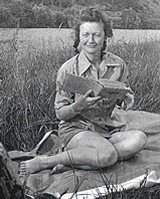
Thelma Kellgren's childhood was spent in Amesbury, a small New England town in the United States. After graduating from High School she was accepted at the Peter Bent Brigham Hospital Nursing School, affiliated to Harvard Medical School in Boston.
At 'The Brigham', Thelma was trained in general nursing and particularly in obstetrics, paediatrics and psychiatry. She particularly enjoyed a placement at the Boston Children's Hospital.
After graduation I ran a female surgical ward at the Brigham for a year but did want to work with children and to this end did a year's Diploma course at the University of Cincinnati. Upon returning to Boston I was fortunate to get a job at the Boston Children's Hospital almost at once. Wonderfully happy days. It was clear to me that I had gone in the right direction. I ran the infants' Upper Ward which dealt with children under two with medical complaints and also housed the premature baby unit.
Here at the hospital we were all very interested in the war in Europe and wondered when the USA would pull itself together and go to the aid of England - surely we would.
After ending her relationship with her fiancé, Thelma and a friend took a trip to Haiti on a banana boat, giving herself an opportunity to reassess her future. She enjoyed her holiday and returned to her nursing position at the hospital.
Visiting hour had just ended and we were settling down to feedings when the news came over the radio that the Japanese had attacked Pearl Harbor the night before and that the USA had declared war on Japan. It was the 8 December 1941... Although I had felt that we should support our friends and defend ourselves, I also thought it was complete madness.
During the first week of January we nurses who had enlisted were ordered to report to Fort Banks for physical examinations and from then on the days were like Lewis Carroll's 'Mad Hatters Tea Party'. There were meetings, discussions, vaccines, toxoids, parties, more meetings, x-rays, shopping and lots of advice. It was suddenly painful to think of leaving.
Thelma left Boston in January 1942 with a group of 50 doctors and 44 nurses, part of 5th General Hospital (Harvard University Unit). They were inducted into the Army at Wrightson, New Jersey. They were issued uniforms - capes, a suit, an overcoat and a hat, a gas mask and a helmet.
Having some experience in psychiatric nursing, Thelma was assigned to a psychiatric ward of 22 GIs who were emotionally unstable. By February, it was decided to split the Fifth General, half would go to the Pacific and Thelma and the others would serve in Europe. Taking their order papers to Brooklyn, they were told that four nurses and two doctors would be assigned to each ship in the convoy. Thelma boarded the USS Barnett, as part of the American Expeditionary Force bound for Northern Ireland.
There were at least four decks below us and I imagined life for the average GI would be a bit cramped. We girls were thoroughly spoiled and had a large cabin. We were not too busy with nursing duties to allow ourselves to be wooed and won by the US Navy - well, up to a point.
Thelma suffered from seasickness throughout the journey.
On the smooth calm days it was not too bad but the first sign of a swell and I was finished. The other three had no signs of it at all and the sight of me vomiting over the side brought me no sympathy at all. I was convinced that fresh fruit would cure me and begged the CO for an orange or two as I had heard there were some in the hold. He just laughed and said he could just envisage me leaning over the side peeling an orange and dropping the peel overboard making life easy for the submarines. "Seasickness you'll recover from - being torpedoed - not so easy."
USS Barnett arrived at Belfast Lough on 2 March 1942.
We had an early lunch on board and left the ship at 11.30am complete with gas masks, helmets and all our gear. The gear included a small crate, well wrapped and labelled Lt Thelma Reynolds ANC - Medical Supplies. It was a crate of oranges from the CO because I had begged him for an orange so repeatedly while seasick.
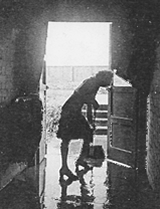
The nurses were billeted in nissen huts and started work at the 20th General Hospital. Thelma gave her oranges to the local children who received them with wonder, they had not seen oranges for years.
The hospital staff were very kind, but there was little work. During a St Patrick's Day celebration, Thelma was surprised to find herself arranging a mountain climbing date with a British Officer as she hated climbing mountains. The next day she met Lt Kellgren and enjoyed his company very much and they met each day for a week. Within a month Jonky Kellgren proposed marriage with a moonstone ring.
In May, Thelma and the nurses joined the rest of the unit at Musgrove Park and Jonky was posted to England. The 5th General became very busy, the medics treated young soldiers with various complaints, and there was a great deal of Army paperwork.
Jonky called Thelma from England telling her he was on embarkation leave from 1 June and asked her to join him.
There was no leave for Americans in Northern Ireland... I was on my knees to every Colonel, General and Sargent in the USANIF (United States Army Northern Ireland Force). A week later there came a skimpy piece of paper which said, -"Leave for a period of nine (9) days effective on or about June 1 1942 is granted to 2nd Lt. Thelma Reynolds, N 720977, 5th General Hospital. By command of Major-General Hartle." ... While I planned to catch the 10am plane for Liverpool, 1,000 bombers were pounding Cologne. Were we all quite mad? What place had personal happiness in all that?
Thelma met John MacVane of National Broadcasting Company on the plane. He was returning to London after a broadcast about the 1st Armoured Division manoeuvres and he accompanied her to Park Square West, near Regents Park, where Jonky was staying.
They quickly made their wedding plans and were married at the Registry Office at St Marylebone on 6 June. They had a celebratory lunch with Jonky's family.
John MacVane's broadcast from London on 6 June 1942
over NBC to the USA said,
"I've just come from a wedding to this broadcast. The girl
was an American Army nurse stationed in Northern Ireland and the man
was an English doctor, a Lieutenant in the Royal Army Medical Corps.
As far as I know, the girl, who comes from Boston, was the first American
Army nurse to marry an Englishman here. She asked me to be a witness
because I was the only American she knew in London and she said she
wanted one of her own countrymen to be present at the biggest moment
of her life.
The American girl knows her husband will have to go abroad soon. She will be
with the American Army in Europe for the rest of the war. So they decided that
because they were in love it was no use waiting for the end of the war. The
end may be a long way off and neither knows what will happen before it ends.
The ceremony was a brief one, but there were flowers, a corsage and even a
bottle of champagne. The bride didn't wear white. She wore the smart uniform
of the American Army nurses with a Second Lieutenant's gold bars on the shoulders.
The groom was in British Officer's khaki.
It was a war wedding, but seeing them you felt they had a lot of faith in the
future and you couldn't help feeling proud of that pretty American girl who
had only been in London a few days - proud that she had the courage to believe
in the future now - that the spectacle of war and certain separation from her
husband didn't faze her. It made you feel proud to be an American too.
Thelma returned to duty. She did not intend to tell anyone she was married, as she was sure the Army would not have given her permission and wore her wedding ring with her dog tags on a chain around her neck. However, she could not contain her excitement and within three days she was in the Commanding Officer's office making a 'full confession'.
I was the first nurse in the ETO (European Theater of Operations) to commit this dastardly crime. "Sleeping around is one thing, but MARRIAGE! Are you crazy, kid! So what do you want, an international incident? And a British Officer, my gawd - three months night duty for you, baby, until we get this paperwork sorted out. You'll probably be sent Stateside."
The letter in my 201 file from GHQ says, "No precedence - if this nurse is any good to you - keep her." They did.
Thelma had become a British subject on marriage and as there were no legal precedents for deporting a British subject, all seemed well. Her position was confirmed when she received a telegram from Jonky on 25 June.
"Everything alright - you will remain in present job. Information definite but not, repeat not, official. Your letters arriving a week late. Love Kellgren."
Jonky's posting was unexpectedly cancelled and he spent a week's leave with Thelma before returning to his unit and almost certain reposting.
Thelma was still on permanent night duty. She was kept busy by routine duties, caring for the soldiers who continued to pour in. Musgrave Park was visited by King George and Queen Elizabeth and in August, by Mrs Roosevelt.
Affairs of the heart went on apace as people became engaged and then suddenly it was all right to get married. Helen Thomas married Capt. Terry McGann, RASC in the Unit Chapel and Colonel Keeler even 'gave her away'. What a change!
In October, she was granted the authority to use the name Thelma Reynolds Kellgren as her marriage was officially recognised. A month later, the 5th General was flown to Odstock, near Salisbury in Wiltshire where they were to care for casualties returning from North Africa, Thelma suspected Jonky was in North Africa working in a Field Ambulance Unit but had no way of knowing for sure, but it was March before the wounded British and American soldiers arrived.
Whereas in Ireland the GI couldn't say a good word for the Tommy, now they were all best mates and anxious to introduce you to 'my pal from London'. Nothing like a common experience. On the orthopaedic ward we had some great patients. One was Dean Chatlain who had to cut off his leg in order to crawl away from a burning tank. He never complained - just wrote poetry. We all felt that, at last we were doing what we had come to do.
While doing the dressings one morning at dawn I had an upsetting experience. We had a lot of amputees and as I was doing a 'Tommy's' leg I was shattered to hear him say, "Sister, you're hurting me. You're not nearly so gentle as the bloke what took my leg off." Oh dear. So I said, "Oh I am sorry, I'm so sorry. I must be tired. I'll be more careful. Where did it happen?" "God knows where I was, but I remember him because he had such a funny name. Kellgren it was - don't sound English, but he were grand." I nearly fainted onto the bed beside him as I shouted, "Surely you can remember something about where you were!" I wanted to shake him, but he had no idea. After a few minutes I realised that, despite no mail for a long time, here, in its way, was good news.
Thelma enjoyed living in Wiltshire. She and her friends spent much of their free time in Salisbury. She became Mess Officer and became friends with the local shopkeepers. On one occasion she and three friends decided to spend a relaxing weekend by the sea at Bournemouth. They saw some evidence of air raids, but it was thought to be a safe area following the introduction of a radar screen and the installation of sirens.
The sun shone and the sky which also seems so low in England, was clear and blue... we lay (dreaming) quietly but were suddenly brought bolt upright by a tremendous blast. This was followed in a split second by two more explosions. Four German raiders had flown in under the radar screen, dropped their loads and were gone in a few seconds. We ran towards the main street which was ablaze and chaotic with people screaming and running in every direction. Bodies lay everywhere and Phyl and I ran to a young girl who had taken shelter in the doorway of a glass fronted shop. The poor thing was chopped to bits and there was little we could do except hold her hand as she died... a Casualty Station and an Operating Theatre were immediately set up in the ballroom of the largest hotel. Help came from everywhere and the organization was wonderful. No hysterics, no panic, no unnecessary movements. We found ourselves drawn into what felt like a well-rehearsed team. We were filled with admiration for everyone, especially the small children. Our assistance was readily welcomed as the addition of two surgeons and two nurses was a good help. We worked flat out for two days and two nights and returned to our unit in Salisbury greatly sobered. This was our closest experience of the real meaning of war.
|
This page: service in America, Ireland and England. |
|
Service in North West Europe. |