Commander Patrick Dalzel-Job
"When we went towards Bremen, people came out of their houses and waved to us as we went by and they held up their children to see us."
 |
Arctic snow and the dust of Normandy. |
 |
This page: onwards into the Reich. |
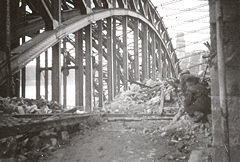
Patrick and his unit returned to England for reorganisation and further training which included another parachute course. The whole Unit went to Belgium in February 1945 and Patrick took a 'recce' group ahead of the Allies' front line into Germany to search areas in the Eifel Hills. Four days later they entered Köln, a city devastated by bomb damage, and investigated the Schmidding company there.
At the end of March, the Unit crossed the Rhine near Xanten, where they saw wreckage of many gliders that had crashed there during the airborne assault, and joined the Guards Armoured Division on the road to Bremen. The journey was arduous - many bridges had been destroyed and the approaches were usually covered by a German heavy machine gun or an anti-tank gun. Patrick's team then joined the 51st (Highland) Division. On 13 April, they discovered two farmhouses occupied by German troops.
The Royal Marines dismounted from their vehicles and attacked enthusiastically; one German soldier was killed and thirteen taken prisoner - they proved to be officer cadets...During the interrogation of the prisoners, it came out that we had earlier driven straight past their dug-in and camouflaged machine gun positions, at slow speed and within a range of a few yards. They said they had not opened fire because we looked dangerous.
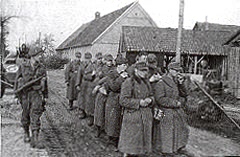
Patrick counting prisoners near Vechta.
|
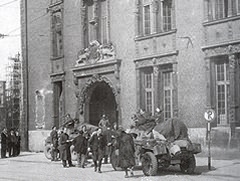
Bremen Team 4 Scout Cars at the Rathaus at 1030 hrs on 26 April 1945.
|
Early on Thursday 26 April, Patrick and his men entered Bremen. There had been fierce fighting and the team saw burning tanks in the streets but there was no gunfire or any sign of German troops. Patrick was approached by a policeman and asked to meet the acting Burgomaster to accept the formal surrender of the city of Bremen.
Patrick sent a message to 52nd Division Headquarters to inform them of the surrender, and they began to clear the city. There was still some enemy fire from the docks but Patrick managed to prevent any shell attack as he was sure they would find valuable intelligence in the shipyard and 30 AU were eventually able to examine the equipment and interrogate the technicians found there.
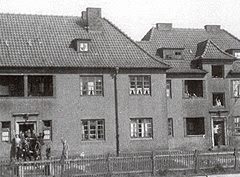
Three days after Bremen, the Unit joined the Irish Guards Armoured Division and headed northwards towards Bremerhaven. German resistance was collapsing.
My team of 30 AU celebrated the German capitulation in very modest fashion. Truthfully but rather hard-heartedly, I told the Royal Marines that some of their most arduous and difficult work was still to come, and that discipline and attention to duty were now even more important, if that were possible, than they had been during open hostilities.
On 7 May Patrick entered Bremerhaven with 51st Division. They were astonished to hear cheers from the civilians as they entered the city. 30 AU made their way to the port area to take the German destroyer Z 29, still in commission.
Patrick took a boarding party of five on a motor boat and he was informed that the destroyer's crew amounted to three hundred and twenty officers and men.
The crew was in a very dangerous mood, ranging from aggressive anger through sullen insolence to weeping hysteria. It was, as I have said, a fighting ship with an undefeated ship's company, and almost every man of them loathed this capitulation which had been imposed on them by the German authorities on the shore. Everywhere they went in the ship, (my) men were met with boos and hisses, threatening gestures, attempts to trip them in gangways, and the ominous bunching of German seamen behind their backs.
Soon, the ship was completely disarmed and secret signal documents and charts were removed from the wireless room. The German Captain was ordered to take it alongside the quay.
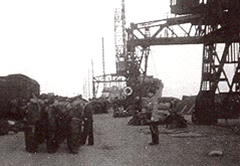
Taking over German Destroyer Z29
|
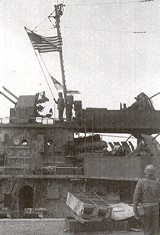
Transfer of Z29 to US Navy
|
On 8 May, VE Day, Patrick took Destroyer Z29 into Kaiserhaven inner harbour. The Royal Marines were to attend a formal ceremony the following day to transfer the ship to the United States.
Bremerhaven was the last of the official 30 AU operations in Germany. Other sites were still examined but the Germans had destroyed most of the documents and equipment that would be of interest to Allied Intelligence.
Patrick returned to England on 24 May and appealed to the Admiralty for an opportunity of returning to Norway. Roads had been built during the German occupation and the wreck of the Tirpitz was to be inspected. His real intention, however, was to find his sweetheart, Bjørg, and eventually they were reunited at Vestbane train station in Oslo. They were married on 26 June and returned to Edinburgh.
The full story of his wartime experiences, 'From Arctic Snow to Dust of Normandy' by Patrick Dalzel-Job is published by Nead-an-Eoin.
|
Arctic snow and the dust of Normandy. |
|
This page: onwards into the Reich. |