Merchant Naval Seaman Christopher Tulitt
"...I was beginning to feel like a 'Jonah'"
 |
Joining the Merchant Navy - the sinking of the City of Athens. |
 |
The sinking of the City of Canton and audio clip |
 |
This page: the sinking of the City of Adelaide and inventory. |
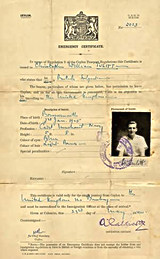
Inventory of the Donation
- substantial collection of photographs
- three books on Seamanship and Nautical Tables
- National Service Certificate
- Navigators and Engineer Officers' Union Membership book
- two books of calculations showing the working out of the ship's position
- five charts collected from the lockers of the City of Canton lifeboat
- tape-recorded
Chris returned home on board the Highland Chieftain and had a month's survivors' leave before joining the City of Adelaide in November 1943.
On meeting the Mate, Lambert, his first words to me were to the effect that he had been right through the war so far and seen nothing, so if there was any trouble on this trip it would be all my fault. Another chap joining the ship was McKay, the Third Engineer from the City of Canton who had been an especial friend of mine on that ship. However when he spotted me as he was about to come up the gangway he said "Oh no! I'm not sailing with him again!" He did - but I was beginning to feel like a 'Jonah'.
The ship sailed through the Suez Canal, down the Red Sea and across the Arabian Sea to Bombay and then on to Karachi. Disaster soon struck:
We sailed from Karachi in ballast for Freemantle on the West Coast of Australia in the middle of March. Mac, the Third Engineer, and I had decided to build what he called a 'Sharpie' - a type of small sailing boat used around his native island Magee on the east Irish coast near Belfast. Our 'Sharpie' was taking shape in the after-well deck by the 30th March 1944. It was still light when the torpedo hit the ship amidships on the port side and the ship started to sink! 'Sparks' was already sending an SSS signal when the submarine (Japanese submarine I 8) opened fire with its main armament and we could tell from the flashes from the gun that he was forward of the beam and therefore could not be fired on by our 4 inch gun on the stern. The ship was obviously silhouetted against the western sky and when the shells hit, being in ballast, she sounded like an old tin can. So much for our 'Sharpie'! Meanwhile we were all abandoning ship with the shells raining down into a reasonably calm sea and darkness falling fast. We didn't see the ship go down but later in the darkness we could hear a diesel engine as the submarine cruised around the area presumably looking for the lifeboats, although he didn't use a searchlight. We were relieved when the noise of the diesel engine died away. . .
The six lifeboats had managed to keep together and we roped up for the night with the motor lifeboat towing, so come first light when it was pouring with rain at least we were all together. I looked across to Lambert, the Mate, sitting at the tiller of his lifeboat wearing an orange woolly hat and when he looked up at me I made a rude gesture, in view of his remarks on my first joining the ship. It continued to pour with rain on that Friday - through the night - and on through the following day - so at least we were not short of water. The lifeboats sailed in company during the day and roped up at night with the motor lifeboat towing. Palm Sunday dawned brighter and the sun came out and by noon we were sailing WNW towards the Chagos Island some five hundred miles distant, having been sunk in position approximately 12 degrees south - 80 degrees east.
About mid-afternoon a Lascar in our lifeboat said "Sahib - ship!" and sure enough there she was, hull down to us in the lifeboat. I lit a distress flare, which went off okay but showered me with burning particles and burnt holes in both my shirt and myself, although I didn't notice it at the time. Our Captain, Richard James Ross-Rickets had done a good job in keeping the six lifeboats together and the ship saw our signals and altered course to pick us up. Despite the problems of going alongside a ship in a small boat in a moderate sea we all managed to get ourselves up the scramble net put down over the side of the ship. We now identified the ship as the 'Carole Lombard' - an American Liberty ship named after the famous film star. The ship was on passage to Colombo from Freemantle and had been on a reciprocal course to ours. When she picked up our SSS signal she had altered course to port for a time before resuming her original course. We had made up that distance in the three days in the lifeboats but were very lucky to have been sighted by the American ship in what was almost the dead centre of the Indian Ocean.
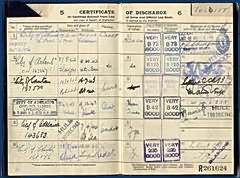
It was ten weeks before Chris sailed from Bombay, arriving home to hear the sad news that his sister's boyfriend had been killed on D-Day, landing with the 6th Airborne Paratroops.
When I went across to Poole Custom House to collect my compensation for loss of effects again the chap said I was making a habit of this sinking business. A month's survivors leave and mid-August saw me taking the train north to Birkenhead to join the City of Chester. Ellermans told me they were putting me on their newest and fastest ship and if I lost this one they would be very displeased!
Fortunately this trip was successful and Chris arrived back in Liverpool on 13th December 1944. Almost as interesting as Chris' time afloat, are the times he spent waiting for transport to return home as well as waiting for the cargo to be loaded or unloaded. For example, off Key West in Florida:
The fishing off the ship was exciting and the engine room turned out large hooks for baiting with lumps of meat. By using wire ropes and deck winches as fishing lines we were able to catch some very large fish for the crew. There were plenty of sharks and large manta rays about so when we went swimming over the side we had someone up in the wing of the bridge with a loaded rifle.
After the sinking of the City of Adelaide, Chris had a six-week stay at Pattipola in a hunting lodge belonging to Commander Palliser from the Ellermans shipping agents office in Colombo:
At the entrance the Tamil hammered on a hanging piece of angle-iron, whereupon a female figure with straggling grey hair appeared dressed in blue jodhpurs and checked shirt with a large hunting knife on her belt and a .45 Revolver at her hip. This was the Commander's wife, Mrs Palliser. We found out later that she had had quite an adventurous life being a Rough Rider in an Australian circus. She welcomed us and explained that we were in an unpoliced area and that was why she was armed. . .At 6200 feet we experienced some spectacular thunder and lightning storms accompanied by torrential rain. One day we walked the sixteen miles and back to Nuwara Eliya along the railway line. On another day we hiked up to Horton's Plains Rest House and returned on the railway, on the footplate of an engine, with driver Carson from a Railway Halt some miles from Pattipola. We suffered badly from the attention of leeches that day and spent the time waiting for the train touching their backsides with cigarette ends to make them withdraw their heads from beneath the skin on our feet and legs.
Chris' next three trips were less eventful although he unfortunately contracted malaria in 1945. In February 1946 Chris was discharged from the Merchant Navy due to this condition. Post-war he trained as an architect.
The Second World War Experience Centre is very grateful to Chris Tulitt for his agreement to reproduce extracts from his recollections.
|
Joining the Merchant Navy - the sinking of the City of Athens. |
|
The sinking of the City of Canton and audio clip. |
|
This page: the sinking of the City of Adelaide and inventory. |