El Alamein and Torch 1942
"The conditions under which my gallant
troops entered the battle were so disheartening that there was practically
no hope of our coming out of it victorious".
Field Marshal Rommel
 |
This page:overview of the Battles. |
 |
Experiences in El Alamein. |
 |
The Torch Landings. |
The Second Battle of El Alamein in October 1942 was a turning point in the Desert War, which had previously entailed swift advances on both sides covering hundreds of miles, followed by retreats and the building of new defensive lines. The Batttle of Alam el Halfa in August had been significant. Rommel's forces had launched an attack against the Allies' defensive positions at Ruweisat Ridge, Alam Nayil and Alam el Halfa, yet the air attacks by the Desert Air Force and the increasing numbers of Grant tanks had taken their toll on Axis armour and troops. By 2 September the attack had failed, although Montgomery did not follow up with a concerted counter-attack, despite pressure from Churchill, as he felt his forces were not yet sufficiently prepared. His memoir relates; "I had decided that in building up the Eighth Army for what lay ahead I would concentrate on three essentials: leadership, equipment, and training". In preparation for the battle, Montgomery ordered increased patrol activity and mapping of the Axis positions. The Allies also had a numerical advantage in manpower, tanks, guns and aircraft. The Eighth Army comprised three Corps - X, XIII and XXX, with four armoured divisions. The forces also included Australian, Indian, New Zealand, South African and Free French units. The Plan relied on a night assault with moonlight to see the extensive minefields, so the date was fixed for 23/24 October. Lt General Montgomery decided that the Axis forces would be attacked simultaneously on both flanks, with the major assault by XXX Corps in the north, under Lt General Oliver Leese and diversionary attacks in the south by Lt General Brian Horrocks' XIII Corps. XXX Corps would force two corridors through the minefields to allow X Corps, commanded by Lt Gen Lumsden, to pass through and hold off the Axis armour. The attack would open with a massive artillery barrage. Despite eventual success, it was by no means an easy victory and at times the stiff opposition gave cause for serious concern, as well as the extensive minefields and ensuing congestion. Yet by 3/4 November Axis troops were withdrawing and had suffered the loss of 4 German and 8 Italian divisions. The victory was a tremendous relief to the Allies and particularly Churchill, who was under pressure at home and abroad to produce results. By 23rd January 1943 the Allies had reached Tripoli and quickly opened up the harbour to receive much-needed supplies, while Rommel's forces retreated into Tunisia.
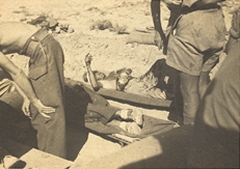
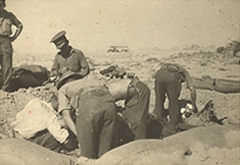
We are honoured to display photographs from the papers of Arthur Pullan, who served in the RASC firstly during the campaign in France in 1940 and then in North Africa. Arthur was an ambulance driver and recorded his experiences of treating the wounded during the Battle of El Alamein by camera, until the conclusion of the campaign in May 1943. Arthur also served later in Italy.
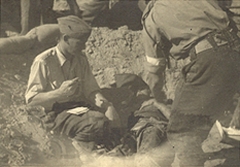
MO giving injections after Stuka raid
|
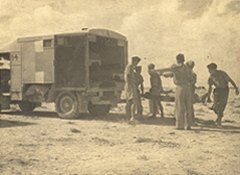 Loading the wounded into ambulances - Alamein |
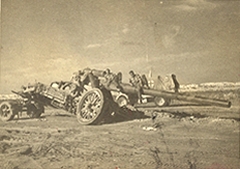
Bug Bug Nov 1942 German 210 mm gun |
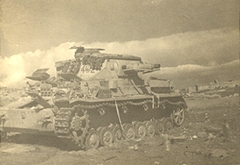
Knocked out Jerry tank - Alamein |
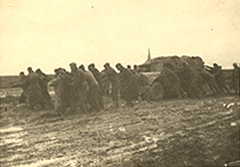
Martuba track Nov 1942 - Stuck in the mud. This is where we did about 5 or 6 miles a day |
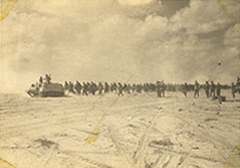
Rounding up the prisoners at Alamein Nov 1942 |
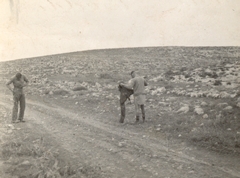
Martuba Wadi - Nov 1942 - Flea hunting after visit to abandoned Italian camp. |
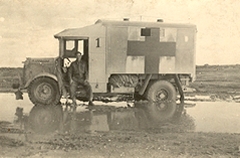
South Sidi Rezegh - Dec 1942 - after a 10 minute shower in the desert. |
|
This page:overview of the Battles. |
|
Experiences in El Alamein. |
|
The Torch Landings. |