Not the Image but Reality: British POW Experiences In Italian and German Camps by Peter Liddle & Ian Whitehead
"Preparing for the night was little more than rolling in our blanket and shivering."
 |
Capture and initial captivity. |
 |
This page: life in the camps. |
 |
Work and discipline. |
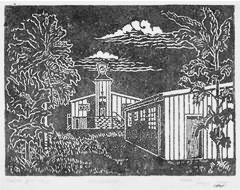
The intervention of the Church produced some improvement in conditions for Sell and the other inmates of Campo Concentramento P.G. 21. A Roman Catholic prisoner was the only man allowed out of the camp, in order to attend Mass. He managed to give the priest an indication of their conditions and through him word reached the Vatican. A Papal Nuncio inspected the camp and, after expressing astonishment at the men's attire, 'gave an imperial rocket to the commandant'. The result was an improvement in supplies, including the distribution of Red Cross clothing parcels, which contained a great coat, battledress, two vests, two pairs of pants, a shirt, two pairs of socks and a pair of boots. Within the camp, enterprising individuals had also begun advertising their skills as tailors, offering for example to transform a blanket into a suit or three Italian kitchen cloths into a kilt. One 'firm' took payment on a points scheme (5 points for a good pair of socks, 4 points for a pair with one hole, 3 points for a pair with 2) whilst another listed "mouthfuls of hot rice including Weevils, licks of jam ration, [and] cheese as possible means of settling the account".
The men did their best to entertain themselves. At Christmas, various cocktails were created from whatever illicit alcohol the men had been able to get their hands on, and members of the Entertainment Committee treated them to a show by some ' Ladies'. In the natural run of camp life, the men devised games that usually succeeded in annoying the guards. For example, in one bungalow a giant game of snakes and ladders was painted on the floor, with a forked-tongued Mussolini at the head of the snake. The Italians painted it out and posted a sentry to prevent its reappearance. Various clubs and societies were organised, educational programmes were established and those with musical talent put on concerts and opera recitals. Particular excitement was caused by the organisation of a cricket match:
The enthusiasm is fantastic and we all form into groups to produce something as instructed by the committee. The ingenuity to improvise by skill, theft or bribery from the Ites provide many morale boosting episodes. Some volunteer for the Cooler to thieve the boots from some off duty guard taking his siesta from which the balls are to be made. An Orderly is bribed to get two white coats for the Umpires. The Whites are made from sheets spirited from the QM Store. The Roller, Screen and Pavilion are fabricated from bed boards, frames and cardboard. The broom handles suddenly shorten into stumps and bails. Finally the Commandant and his Officers lose the paint earmarked to paint their quarters and Mess.
When the day of the game arrived, the Italians were initially apprehensive of what was afoot. As the match got under way, however, there was no attempt to intervene. Concern rapidly turned into bemusement. The Commandant was moved to the simple conclusion: "Dimenti - Dimenti, tutti Dimenti".
Such entertainment and leisure pursuits were a feature of life in many Italian and German camps. It is also quite wrong to presume that concert parties, plays, orchestras, art and language classes and craft skills were restricted to officer camps. In the Centre there is full documentation of what must clearly have been simply superb dramatic productions and other cultural activities at Stalag VIIIB, Lamsdorf, in Silesia which had its own school with forty three tutors, a 500 seat theatre, a symphony orchestra, a dance band, international football, cricket and athletics. Macbeth and Twelfth Night were produced at the theatre with a leading actor, a future star of stage, film and TV screen, Denholm Elliot, in major roles. There was also even a carnival with Canadian soldiers dressed as Red Indians with shaven heads, imitation tomahawks, war dancing and whooping and a space man in his space ship with an entourage of metal-clad spacemen and girls, the metal from cans in parcels.
Of course a good deal of improvisation might be necessary unless exceptional circumstances allowed for the hiring of music and instruments, costume and other needs. A French officer helped Alistair Bannerman in some of his needs at his officer's camp. He made furniture out of Red Cross boxes:
Long Johns served as knee breeches, wigs were made out of newspaper and glue, a sort of papier maché. It was for 'School for Scandal' and it was a great success. I remember at the end I couldn't hear any clapping but it was because it was so cold everyone was wearing woollen gloves.
The most serious 'sport' of all was that of attempting escape. Harry Sell noted that there were:
so many tunnels in course of construction that it is a marvel that any of the buildings remain standing. The detection of them is a full time job for the Security Officer and we keep two men and a boy busy cementing up the holes they find.
However, by the middle of 1943 his Italian captors were increasingly preoccupied with their own fate, "becoming more interested with what kind of a smashing they will get should the War pass through Italy". The mood of the Italians dramatically transformed: "We want to be your friends, we did not want to fight, O the terrible Tedesci". The inmates of P.G. 21 greeted Italy's surrender in September 1943 with wild rejoicing. At last they were free men again: "BATHS - FOOD - CLOTHES - FREEDOM. No more Filth, Lice, Hunger, Cold, Wet or restrictions or torments."
The instructions issued to the POWs were to sit tight, accept the cooperation and protection of their new Italian allies and await the arrival of British troops. German troops, however, arrived first. The years of captivity were not over for Sell. He tasted freedom but was recaptured by the Germans. He was held at Marisch Trubau and later at Brunswick. In captivity, he continued to engage in a battle of wits with his captors, hiding radios and planning escapes. He was also exposed to further examples of maltreatment, but found the Germans less easy to ridicule than the Italians, seeing the latter as "a Comic Opera lot" by comparison.
When the POWs were transferred to Germany they were often provided with a shocking insight into the realities of the Third Reich. James Witte writes that his first destination was a transit camp, at Jacobstahl, which had previously been a Jewish extermination camp:
We were housed in the same barracks as were the Jews and slept in the same tiers of bunks. The lavatory was a pole over a pit which was once cleaned out by the inmates with their bare hands. We were not, however, subjected to such terrible indignities. The German guards - badly wounded soldiers from the Eastern Front - were quite decent and as shocked as we were with the place. We sat on some mounds to eat our midday meal, a thin mixture of Kohlrabi soup... when one of the Guards told us we were sitting on dead Jews ... We leapt to our feet in horror .... And each morning we watched a melancholy procession of Russians carrying corpses to a lime-pit and tipping the bodies in unceremoniously. Fortunately we were not at Jacobstahl very long.
Ernest Hall was sent to a German processing camp, Stalag IVB. On his arrival he was struck that it was rather like a concentration camp, though potentially how much it resembled one only became apparent to him after the War:
We had to strip and take a shower in a vast communal shower chamber where we dried off under jets of warm air pumped from outlets in the ceiling. It was only after the War that I appreciated how easily that shower chamber could have been converted into a gas chamber.
The German processing of prisoners involved delousing them, taking their photograph and fingerprints, inoculating them and having them medically examined. Clarence Thackrah, recalled:
we had our hair cropped with a machine used to cut horses' hair. We were lined up and worked in threes - one turned the handle, one manipulated the cutting head and one had his head shaved. This device, with inexperienced lads, was a dangerous weapon. It wasn't only the hair that was cut. Then we undressed, our clothes were thrown into the delouser, then we went under the shower, then walked through the door of the shower room and two Russian girls with a bucket of thick brown disinfectant gave you a dab under each arm and a nice splash on your private parts, all sense of modesty long gone. The final act was an Italian doctor, for inoculation and vaccination.
This was a less than hygienic procedure, which left some with hugely swollen arms. Following the medical examination, the POWs were issued with a fresh British uniform, supplied by the Red Cross, and assigned to a camp.
There was a superficial uniformity to the camps in Germany: a wired enclosure with wooden lookout towers holding perhaps searchlights, machine-guns and armed personnel, a grid-like pattern of wooden huts raised above the ground, bunks in tiers of three with a narrow corridor from end to end perhaps with a central enclosed stove, outside the barracks, ancillary buildings for both guards and camp facilities, a delousing hut, fuel and vegetable stores, a hospital, recreation area, punishment barracks etc, but the similarities hide individual features - the nature of the ground and its suitability for escape tunnelling - sand, soil, clay, even stone, the proximity of woods, river, rail and road and, of course, the Swiss frontier or indeed other frontiers which potentially held some measure of opportunity for continued evasion. Officers' camps could be as described above but also in old buildings, castles, forts adapted for a new purpose.
Of all his time in captivity Robert Lee remembers Stalag IVB as the lowest point, the most degrading, but the routine at Stalag IVB of course mirrored that of the camps. Phil Darby has written:
The camp was divided into two halves by an axis road which ran the full length of the camp. End-on to this were the accommodation huts, separated from the road by a wire fence. There were probably forty of these, large, close together and very decrepit. These, in turn, were grouped into smaller compounds to separate the Russian, French, Dutch, Belgians and British personnel; the conditions under which the Russians lived were well below those of the other nationalities, and little better than total squalor. Provision was also made, in a small compound, to enable men, forced to work in local industries, to return for redeployment. The RAF compound was at the end of the axis road and housed about fifteen hundred men. It was to this that I was taken.
My first impression was very depressing. Everything looked, and was, very run-down. The entrance to the hut was at the opposite end to the road and a short distance away stood the latrines unit. Beyond this was an open space which we used for exercise and the Germans for counting and haranguing. Inside, the bunks were arranged in units of six, three tiers high, with a narrow central aisle. There were probably ten sets of these bunks in each hut, together with a small stove and a few tables. I was allocated a top bunk, halfway along the hut, from which I could survey everything that was going on. The disadvantage, however, was that a visit to the latrines at night required a ten-foot descent in total darkness, and a corresponding climb back after the perilous exercise of negotiating the various obstacles and bodies which littered the floor. It was a journey never undertaken lightly.
Darby's memories cover the distribution of food, the shortage of food, the hunger, the cold and the consequences:
Food distribution and the curfew at darkness were rituals we grew to accept. The food - bread and potatoes - was issued to the hut in bulk and divided up by a team that had accepted the responsibility. Fortunately, the scheme had been devised before I arrived and was usually in loaf form and, on most occasions, it was a case of one between seven or one between twelve, as the calculations decreed. Much the same applied to the potatoes, which by the time we received them were little more than 'mush', and of course, that is what they were called. I doubt very much whether without the supplement of the occasional Red Cross parcel, the rations would have been sufficient to sustain life over a lengthy period.
Indeed, we were all becoming painfully thin. A corollary of this was that with the low temperatures and inadequate food we were not able to hold our water and every night degenerated into a continuous procession to latrines. We also learned that when we were in a weak state any rapid movement would cause a black-out. To sit up in bed in a hurry would precipitate a rapid return to the horizontal. Fortunately, we were able to see the funny side of each other's problems.
In the winter of 1943/4 we were very, very cold and weak. Few of us possessed any clothing other than that which we were wearing, and how to avoid spending the night shivering was a problem which beset us all. Anything which could insulate us from the cold was somehow applied to our bodies. Preparing for the night was little more than rolling in our blanket and shivering - 'synchronised shivering' it was called.
Needless to say, much thought was devoted to this problem. There was a stove in the hut, but insufficient fuel to keep it alight for more than a few hours. Other than burning the beds, which was sometimes proposed, the alternative was to acquire more coal from the fuel dump situated near the main entrance. To this end, the 'fuel fatigue' was devised. Each night a party of six men, with faces blacked and wearing such items of dark clothing as existed, would leave the hut, traverse the whole length of the camp, burrow through the wire into the fuel compound, fill their bags and return to base by the same route. The following night a different six would go, use the same hole in the wire, and generally repeat the exercise. It was just as well that the fuel dump was sufficiently large to ensure that the coal was not missed. We knew we were taking outrageous risks to remain warm, but the instinct to survive was strong."
|
Capture and initial captivity. |
|
This page: life in the camps. |
|
Work and discipline. |