Operation Husky, the Invasion of Sicily - July 1943
"I am under no delusions as to the
stern fight that lies ahead"
From Montgomery's diary notes on the eve of the invasion of Sicily.
 |
This page: overview. |
 |
Air and sea assault. |
 |
The land campaign. |
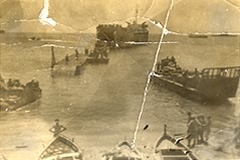
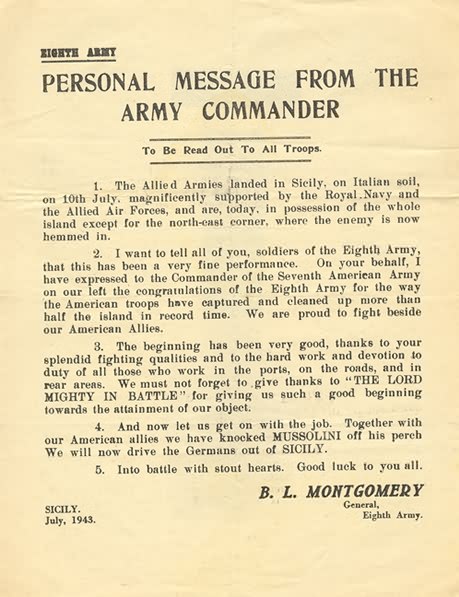
The decision to invade Sicily was agreed by the Western Allies at the Casablanca Conference in January 1943. 'Operation Husky' was to be a combined amphibious and airborne attack scheduled for that summer under the supreme command of General Dwight D. Eisenhower.
The Allies began air attacks on targets in Sicily and Italy in the early summer of 1943. They also attacked the Italian island of Pantellaria, which surrendered to the British 1st Division who arrived there on 11 June.
The Allied convoys concentrated near Malta on the 9 July and headed for Sicily's southern beaches. The careful planning of the landings was slightly hindered by a storm, which slowed down the landing craft. The Italian defenders believed such weather conditions would deter any attempt of an invasion and were on a low state of alert.
The British 1st Airlanding Brigade mounted in 137 gliders, were the first to land. They were to seize the Ponte Grande Bridge south of Syracuse. These landings were, on the whole, unsuccessful. Of the 137 gliders, 69 came down in the sea, drowning some 200 men. A further 56 landed in the wrong area of Sicily and just 12 reached the target area and managed to take the bridge. The US paratroopers had difficulties too, the pilots were inexperienced and dust and anti-aircraft fire resulted in the 2,781 paratroopers being scattered over an area 80km radius.
The main amphibious landings involved three British divisions in the east and two US divisions in the west, all supported by heavy fire from off shore warships.
The British did not meet strong resistance from the Italian coastal troops and were able to bring tanks and artillery ashore ahead of schedule. By the end of the day 13th Corps had taken Syracuse and 30th Corps had secured Panchino.
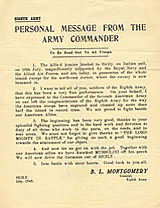
The US divisions had a far more difficult landing, with stiff resistance from the Italians and German air attacks. Later in the day the Hermann Goering Panzer Division, with it's 56 ton Tiger tanks, joined the defence, but the US 2nd Armored Division and US 18 Regimental Combat Team landed in the evening and the Americans managed to stand firm against the fierce fighting. Eventually, naval supporting gunfire forced the tanks to disperse.
The sudden appearance of so many paratroopers gave the appearance of a much greater invasion and the Axis defenders called for reinforcements.
By 12 July, the British had captured Augusta and Montgomery decided to head northwards, to the east of Mount Etna, to take Messina. The Commander of the US 7th Army, Lieutenant-General George S Patton, unhappy with this change of plan, was to fight westwards, towards Palermo. The Americans advanced well. They captured 53,000 prisoners and also the port of Palermo on July 22. This enabled the US 9th Division to land there, instead of on the southern beaches, and was valuable for receiving Allied supplies. Alexander ordered Patton to advance to Messina.
Meanwhile the British Eighth Army was making slow progress. The German paratroopers, with 88mm anti-tank guns, were a formidable enemy and the mountainous Sicilian countryside was hard to negotiate. The Highlanders fought hard for Biancavilla and the XIII Corps eventually took Catania and then Paterno.
The Canadians of Lord Tweedsmuir's Hastings and Prince Edward Regiment managed to take the hill town of Assoro by scaling a cliff and taking their enemy completely by surprise and advanced to Leonforte, which fell to them on 22 July.
By August, the invasion of Sicily was almost complete. The race for Messina continued; the British were helped greatly by airborne forces landing ahead and saving bridges from destruction by the Axis troops. On 17 August, the US 3rd Division entered Messina at 10am, just 50 minutes before the arrival of the British Army. The Germans had been evacuated, but had left huge amounts of weapons, ammunition and fuel. The historic city of Messina had been ravaged by Allied bombs and after the invasion, by shells from the Italian mainland.
Operation Husky was a success. The Allies achieved their goal - the 'soft underbelly' of Europe had been exposed and the Mediterranean could be fully used as a sea route. The cost of casualties was high, though less than anticipated. The Allies lost more than 16,000 men and estimated that 164,000 Axis troops were either killed or taken prisoner.
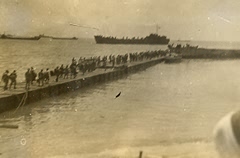
Reloading with Italian POWs bound for North Africa from the papers of Jim Williams. |
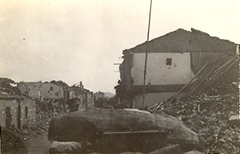
Sicily in a mess. August 27, at the end of the campaign. From the papers of H.L. Barter. |
|
This page: overview. |
|
Air and sea assault. |
|
The land campaign. |