Kindertransport
"On that same day I had a Red Cross letter that my parents were sent to a concentration camp..."
 |
Overview. |
 |
This page: Clive "Teddy" Teddern. |
 |
Ken Ward. |
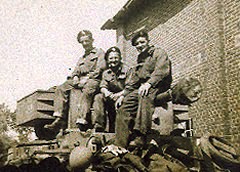
Teddy was born in 1923 in Hamburg and was raised in a liberal Jewish household. His father was a doctor in general practice but in 1934 new German racist laws deprived him of his practice.
As a schoolboy, Teddy experienced some discrimination but remembers the majority of the teachers and pupils were very sympathetic towards him. He was forced to leave school after Kristallnacht although he remained in contact with some of his school friends.
In 1939, Teddy came to Britain with the kindertransport.
I went to Scotland, to Edinburgh, because at that time I had a cousin living in Edinburgh and he made contact with a family with whom I came to live, and this was possibly the unhappiest year of my life. (This Jewish family) were practising, orthodox in a rather superstitious fundamental way and they objected very strongly that I did not come from the same background... and I was constantly taken to task because my parents didn't practise Judaism the way they felt it should have been practised and therefore my parents were wicked people and it was their fault that the Nazis had come to power, and I had to live against this background...
Teddy had learnt some English at school in Germany, and although he had initial problems understanding the Scottish accent, he soon became fluent. He enjoyed school and was treated very well by his classmates but in May 1940 he was interned, as were all 'enemy aliens'.
Those under eighteen were sent to a camp at Lingfield Racecourse.
It was a camp for German sailors, German seamen. Now the camp itself was large, spacious, and accommodation and everything was good. It was May. It was lovely weather. We were together with Nazis and there were some clashes. We were with an agricultural school with 46 or 48 boys who were training to go to what was then still Palestine, and we integrated with them. The group itself had arranged some sort of classes and instructions which we joined in. By and large it was, to me, a holiday and a liberation because I was not under this constant pressure and antagonism, which I experienced in Scotland... I made lots of friends. It was very companionable.
Teddy estimates there were about a thousand interned at the camp and that just five percent were Jewish. Most of the other internees seemed indifferent to the Jewish boys although there were antagonistic Nazis and equally there were those sympathetic to their situation.
When Italy joined forces with Germany, all the internees in the camp were taken to Liverpool by train.
(We were) put in a ship and sent to Canada... There were just a few of us - twenty of us roughly - amongst 2,000 or more Nazis. The recently arrived Italians and our friends from the agricultural school remained behind. There was pushing and shoving, not really hard, but certainly we were in constant fear. There was one man who put himself in charge - a German civilian - who gave us a very, very hard time. We were continually threatened with being thrown overboard and that the ship would turn round and sail to Germany because the war was over. Also there was a political mutiny in which one German was shot and killed. We had no sleeping accommodation. We just slept.
The Duchess of York had been a luxury liner before the war and the journey took five days. On arrival in Canada, they were divided into four groups and Teddy and the other Jewish internees were taken to a camp in Northern Ontario. They were accommodated in wooden huts with separate chemical toilets and the conditions were quite comfortable.
Obviously we lacked freedom, we lacked privacy, and the boredom was there, but amongst the other people in our little group we made friends, we had company. We kept ourselves busy, my friends and I we made bottle ships and things like that... I could correspond with my parents because we had prisoner of war mail, and the huts were warm - smelly but warm. We were provided with warm clothing, and as regards food it couldn't be better. We were on Canadian Army rations and they weren't bad.
In January 1941, Teddy and his group were sent to a camp simply for refugees with more relaxed discipline. In June, the British Parliament questioned the status of the Jewish internees and sent a representative of the Home Office to interview and select any suitable and willing to return to Britain to join the services. Teddy wanted to enlist but he was too young. He was sent back to Britain unconditionally and told he could join the services when he was eighteen.
Back in England, Teddy went to stay in Oxford with an aunt and found work in a local shop. After the attack on Pearl Harbor and America's involvement in the war, he attended the Army recruiting office and in March 1942 he joined the The Pioneer Corps and started training at Huyton, near Liverpool.
After training he was sent to Bicester.
They sent me to Bicester to where they were building a huge ordnance depot and we were involved in the construction of that because the Pioneer Corps were ex-convicts, mentally retarded and foreigners. I was in a company of doctors, lawyers, artists and so on. The atmosphere was still basically German. The language was mostly German and we were an alien company.
After Bicester I was sent to Long Marston, near Stratford-on-Avon... That's when we were told that combatant units were now open to us and we put in our applications and I put mine in for the Royal Armoured Corps... then on 8 August, when Italy came out of the war, on the same day I had a Red Cross letter that my parents were sent to a concentration camp. Everybody was rejoicing except me.
That was the last communication I had from them... they were sent to a camp called Theresienstadt in Czechoslovakia. I always lived under the impression that when the war is over I will go back to Hamburg and in my rather immature mind I always felt we will go back, things will be back as they were. We will pick up where we left off except I wouldn't have to go back to school - I was living in a dreamworld.
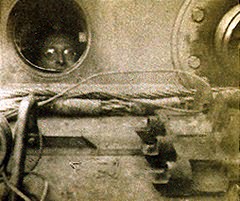
In December, Teddy received his transfer to the Royal Armoured Corps and began training as a tank-gunner at the 55th Training Regiment in Farnborough. He was completing his training at Barnard Castle on D-Day. He and his crew were sent to Newhaven and sailed to the newly built Mulberry Harbour.
Teddy was Cromwell trained and was sent as reinforcement to The 8th Hussars. They experienced heavy shellfire at Falaise and continued the advance towards Holland. They encountered heavy German resistance at the Nijmegen Corridor, but there were no casualties in Teddy's squadron.
(In) January 1945, it was freezing cold and we were in the tanks overnight then in the morning we were supposed to advance on Schilborg. C Squadron was planning to do the old-fashioned cavalry charge, and we were all very glad about it - glad that we were not C Squadron, that is - and it was done with Commandos (Royal Marine Commandos) riding on the back of tanks but by that time the Germans had withdrawn so there was no serious resistance. But we also had some very serious fighting at the time in that area, in that sector. My troop, we were in a sort of farmyard and out Troop Sergeant's tank was knocked out. The Wireless Operator was killed and the Commander, the Sergeant, was severely wounded.
(On another occasion) We were caught in the farmyard and cut off because the damaged tank was in front of us so the only way out was actually going through the building itself, and what we didn't realise was there was a German 75 SP waiting on the other side which hit us, but at such an angle that it knocked a whole big piece out of the amour without penetrating it... as it was so aptly put, our gun was remodelled to fire round corners.
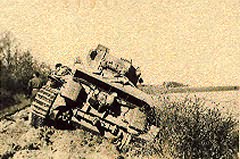 'A' Squadron Cromwell during the thaw in February 1945. |
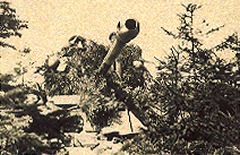 Camouflaged 8th Hussar Challenger tank. |
(There was) German armour all around us and we spent the night in slit trenches and during the day in the farmhouse. We didn't suffer many casualties, but we were relieved by The 11th Hussars, The Cherry Pickers.
Teddy attended a gunnery training course in Belgium for two weeks and rejoined his Regiment for the Rhine Crossing.
The day I crossed into Germany was 29 march at 3pm, which was one hour short of the time I left Germany in 1939 - 29 March, 4pm. (We went across) on a Bailey bridge. The first town we came to was Wesel and it was still on fire.
When we advanced into northern Germany - the Luneberg area - I knew that very well because we had friends there and used to spend holidays there. Like a fool I shot off my mouth and said, "I know the area like the back of my hand". So when there was anything interesting going on, I was volunteered, and one of the instances was when some Belgian officers came up to us. They were from a German prisoner of war camp. They gave us a location and it was decided that we would send a troop of tanks out to liberate them and a number of half-tracks to bring them back. Of course, obviously since I knew the area, I was on the Troop Leader's tank... we took a number of prisoners but by that time they had been abandoned. My Troop Leader insisted I dismount with him to go to all the various houses to see what we could find, which wasn't my idea, but I mean we had to go.
Teddy was in Hamburg when Germany surrendered.
Hamburg was declared an open city and we were the first British troops in there. My Troop Commander again he wanted me to take him to the best known photographic shop in Hamburg, for reasons of his own. We found, liberated, a small German car. We drove about in that, and I also drove to the house where I spent my childhood, which, of course, was no more. It was completely destroyed in the firestorm. I have still got a tile which I broke off of what used to be our kitchen, and then we drove along to a place outside Hamburg, but when I was told the transports were coming back. I went to Hamburg several times. My unit was very, very helpful and very supportive and generous and understanding... and when the transports came back I was there, it was then that I heard. Well, out of 3,000 people, 600 came back and some of them knew my parents and told me that they were sent to Auschwitz and, of course, very few came back from there.
I insisted on carrying out normal duties, and I was expected to, and I think that was the best thing to do. I had enormous sympathy and support from everybody but I was not given any exceptional treatment. I wouldn't have wanted that. I mean, everybody knew what had happened to my parents and I had to accept that.
There were times when it really hit me. For instance on the occasion of my birthday, for instance... (and once) in a farm, with a new born calf, somehow it was my friend because the calf was separated from it's mother and so I could identify with it, somehow. But I just carried on with soldiering.
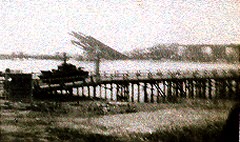 8th Hussar Cromwell crossing the 'Friendship' Bridge
built by the Red Army to replace the destroyed Autobahn bridge
on the motorway to Berlin, Summer 1945. |
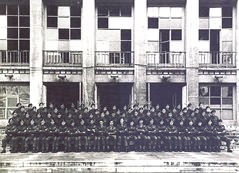 'A' Squadron outside 'Haus des Deutschen Sports' on the Olympic
Games Complex where we were billeted in Spring 1945. |
(I stayed in Germany until) 1947. I was due for demob in 1946, but I signed on for another year. I had nobody to go back to.
When I came out of The Army, not everybody was waiting for the war heroes to return and I found some antagonism towards someone who was not British born.
Because I was depressed, I took a job in a pharmaceutical firm in the warehouse, no prospects, just loading up. By that time I was married and my first child was on the way, and I think I couldn't have got anywhere if I didn't have my wife's wonderful support at the time. Because I was repressed I was pottering about with bits of wood and I found I had a talent there.
When I got some restitution money from Germany I thought I could use it to pay (to train to become a woodwork teacher.) They didn't make it easy, but my father-in-law, who was very astute in that respect, he went to Germany several times and he dealt with it very efficiently. If it hadn't been for him we wouldn't have got anything. I mean I was compensated for my parents' death with two hundred pounds each. Admittedly it was a lot in those days, but even then I thought it was not exactly a fair assessment.
I went to Auschwitz two and a half years ago, and just on one day trip. In a way it was traumatic, in another it laid a few ghosts. I used to have nightmares before that and guilt - a terrible feeling of guilt... I stood in the actual gas chamber in which my parents died, or at least as far as I know they died. I think its quite on the cards that my father died on the transport but I am glad that I went. I also went to Israel and I went to Yad Vashem, the memorial gardens and the eternal flame there, and again I felt my parents' presence there.
|
Overview. |
|
This page: Clive "Teddy" Teddern. |
|
Ken Ward. |