Operation Pedestal - August 1942
"The sweat poured out of us from a combination of physical action, heat and fear"
 |
This page: Operation Pedestal overview & general experience. |
 |
On the aircraft carrier Victorious and cruiser Kenya. |
 |
On the cruiser Manchester and HMS Ledbury. |
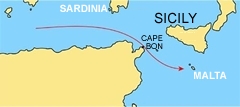
In August 1942 the situation in Malta had become so perilous, due to the lack of fuel and food, that a convoy of fourteen merchant ships headed through the Straits of Gibraltar to deliver much-needed supplies. Protected by a large fleet including battleships, aircraft carriers, cruisers and destroyers, hope was high for a successful passage. However losses mounted and it was only after a tremendous effort that the oil tanker Ohio managed to reach harbour. It was enough to ensure the islanders were able to continue until further relief could arrive.
The covering force comprised the battleships Rodney and Nelson, together with the aircraft carriers Eagle, Victorious and Indomitable, the cruisers Phoebe, Sirius and Charybdis and fourteen destroyers. Operating as close escort were the cruisers Nigeria, Kenya, Manchester and Cairo, with another force of destroyers. HMS Furious, a further aircraft carrier, carried Spitfires to help in the defence of Malta and these were flown off the carrier some distance from the island.
Mr T A Currie described life on board ship while on constant alert for attack:
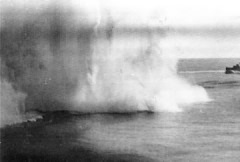
We slept in our clothes with a half-inflated lifebelt around your chest. We only washed our hands and faces and we slept at every opportunity. While in areas where enemy action was likely and ships were being sunk regularly everyone was in a constant state of half cocked. By that I mean that even before the alarm bells were sounded the crew would be ready because any unusual sound or movement to the ship created tension. I used to sleep on a mess deck stool which was about fourteen inches wide and six feet in length. I would wedge myself between the mess deck table and an ammunition slide, my pillow the inside of a steel helmet. If we heard say during the night a sudden hurrying of feet from the deck above, around the four inch gun, we would half raise ourselves waiting for the shattering clamour of the alarm bells. Then if the usual ship noises continued unbroken we would slowly relax into a half cocked sleep. When the alarm did crash out the whole mess deck leapt into a jumble of action with men running to their places at action stations.
He also described his role during an 'umbrella barrage' in protection of the merchant shipping participating in an earlier convoy to Malta:
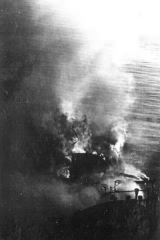
The umbrella barrage was designed to put a barrage of high explosive shells into the air over the merchant ships. All the escort ships aimed their guns at a set elevation and the fuses of the shells set to explode over the ships. Our ammunition was passed up and down below by ammunition teams consisting of cooks and stewards and off watch stokers. My job along with others was to load the shells into the breech. Before loading a shell it had to be fused. This was done by rolling the shell on to a fusing machine. The fusing machine turned a handle and this turned the nose of the shell to determine the range the shell would explode so when the order was given, "umbrella barrage. Commence, commence, commence", this was the sequence, fuse, load, wham, fuse, load, wham. There was no time to gape about. Just grabbing a shell. Rolling it on the fusing machine. Slamming it into the breech and to hear the ringing clink, clink as the rim of the cartridge tripped by two levers which caused the breech block to slide shut with a metallic clunk. Then almost immediately the breech recoiled and ejected a red hot cylinder. It leapt out with shimmering ringing clank after the gun had given its deafening crack. Soon the deck was littered with hot brass cylinders and two other men had to keep clearing them away with a thing that looked like a pitchfork. Sometimes we were burnt when one touched our bare ankles. The sweat poured out of us from a combination of physical action, heat and fear.
Mr T Currie would like us to mention that he is still a member of the British Ex Services Campaign for Nuclear Disarmament.
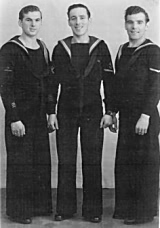
Photo taken while serving on HMS Anguilla 1944/45
Serving on board one of the aircraft carriers, HMS Indomitable, was Laurie Conlon:
I joined her on 26 August 1941 and believe me to join a carrier is really a challenge in finding your way around. Which ladder to climb, or passage to take, what level deck etc. It takes a while before you can get from A to B by the quickest route. I was Leading Seaman of 23 Mess, 1st Starboard Watch and my abandon ship station was No 52 Carley Float.
HMS Indomitable formed part of the carrier support of the convoy to Malta:
On day three Indomitable was the main target of Junkers 87 dive bombers. We received direct hits and damage from near misses. We buried 47 shipmates and returned to Gibraltar. I saw a gun crew dead at their posts including a pal of mine from South Elmsal, Yorkshire and Lt Cunliffe Owen, a well-liked daring young pilot was lost too.
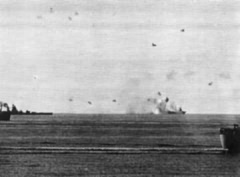
HMS Indomitable during Operation Pedestal. L Conlon |
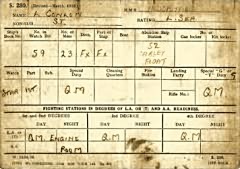
Laurie Conlon's record for HMS Indomitable, showing his additional job as Quartermaster. |
|
This page: Operation Pedestal overview & general experience. |
|
On the aircraft carrier Victorious and cruiser Kenya. |
|
On the cruiser Manchester and HMS Ledbury. |