The Russian Convoys - July 1942
"Waterlogged lifeboats and rafts are frequently seen"
 |
Overview & general experience. |
 |
This page: PQ17 - Journal of a Midshipman. |
 |
PQ18 - Two Yeomen of Signals. |
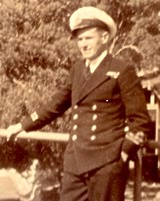
The interviewer of Lieutenant Commander Hill, Lt Richard Campbell-Begg, joined HMS Norfolk in June 1942 as a midshipman serving in the Transmitting Station. His job was to set into the control table information regarding the target's estimated course and speed, in order that the guns could be positioned correctly for firing. His letters home, together with the Journal notes that all midshipmen were required to maintain, form an impressive record of the progress of convoy PQ17 until the ships were ordered to scatter:
Journal. We arrived back at Scapa Flow on 23 June after exercising with our friends, the Swordfish aircraft, on the way. Rumours were circulating that something 'big' was afoot with various possibilities being mooted. We were off to open a second front in Norway, going to replace cruisers sunk in the Mediterranean but most probable of all escorting another convoy to Russia. It turned out to be the latter and early on the morning of the 29 June we proceeded to sea, our destination Seydisfjord in Iceland. We arrived there on 30 June and oiled. The cruisers HMS London, flying the Flag of Rear Admiral Hamilton, USS Tuscaloosa and USS Wichita were already there and we were to form the cruiser covering force for the Russian Convoy PQ17.
At 1am on 1 July 1942 our small fleet proceeded to sea. There were the four 8-inch cruisers escorted by the destroyers HMS Somali, USS Wainwright and USS Rowan. Our job is to cover the convoy PQ17 against German surface attack.
Journal, 2 July. We have been steering steadily on a course which has now brought us northwest of Bear Island. Occasionally we have sighted the convoy and have been able to see the top works of the nearest ships sheltering in a smudge of smoke on the horizon. All day we have been passing wreckage from previous convoys and possibly from this one. Waterlogged lifeboats and rafts are frequently seen. This afternoon five enemy aircraft were seen flying above the convoy at a great distance. 'Repel aircraft' stations was sounded but third degree of readiness was reverted to half an hour later when the planes had disappeared. A signal has been received to the effect that heavy German vessels have left their bases and are at sea. This afternoon we oiled the destroyer Wainwright but had to desist because of a submarine alarm. Oiling resumed half an hour later.
Journal, 3 July. Early this morning the American cruiser Tuscaloosa veered off at speed signalling that she was being torpedoed. A little later she resumed station rather sheepishly. The 'torpedo' was, in fact, the fog buoy towed by the ship ahead which had appeared on her starboard bow whilst zigzagging!
Later on this evening we were picked up by two German Blohm und Voss reconnaissance aircraft which circled us for a few hours before being driven off by anti-aircraft fire from the London and then ourselves.
Journal, 4 July. We have been passing icebergs all morning and were picked up by another German reconnaissance plane which has been shadowing us ever since. Someone or other has been credited with sending the German a visual signal asking him to 'circle in the opposite direction as you are making us giddy' whereupon the pilot acknowledged the signal and obligingly turned his plane in the opposite direction. On another occasion, when the relief plane had been picked up by radar, a signal was supposedly sent saying 'your relief is on his way' and gave the bearing and distance. This brought the response 'thank you' from the German who flew off homewards.
During the latter part of the afternoon we were closed up at 'repel aircraft' stations about six times and then the ship went to 'action stations' when the convoy was observed to be under air attack. Three ships were seen to be hit and one plane brought down. . .
Later in the evening there was a report that German surface vessels were close to the convoy. The convoy was ordered to scatter and then the cruiser covering force together with the destroyers from the convoy's close escort, proceeded to the west at high speed. With merchant ships breaking away from the convoy in all directions and signal flags flying from the yardarms, the cruisers steaming at speed in line ahead with the destroyers from the convoy taking position in line on the port quarter it all looked an awesome spectacle.
We thought we were about to bring the German Fleet into action until it soon became apparent that this was not the case but that we were withdrawing and leaving the merchant ships to their fate. Dreadful. The Norfolk's Walrus seaplane was in the air at the time and permission to stop and recover it was refused. She was lucky. She landed near a merchant ship which was one of the few to make it to Russia and we were able to re-embark the crew on a subsequent visit.
Journal, 5 July. Today we continued our withdrawal westwards but at a slower speed. We are receiving signals from individual ships of the convoy, 'am being bombed, torpedoed', etc and requesting assistance, and of course there is no assistance available. During the day we oiled three destroyers, HMS Wilton, HMS Fury and HMS Keppel (Captain D, Jack Broom).
|
Overview & general experience. |
|
This page: PQ17 - Journal of a Midshipman. |
|
PQ18 - Two Yeomen of Signals. |