Godfrey Talbot: The Voice of the Desert and the 8th Army.
"There was a huge audience at home"
 |
This page: overview & general experience. |
 |
Includes diary extracts and audio clip. |
 |
Glories, grand occasions and generals. |
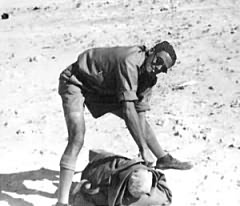
Godfrey Talbot became famous overnight from his 'eye-witness' accounts of the (2nd) Battle of El Alamein. In the last interview that he gave before his death in September 2000 just short of his 92nd birthday, he talked to the Second World War Experience Centre about his wartime experiences. To complement this interview, his family is now handing over to the Centre his manuscript diaries, together with some of the many letters he received from ordinary men and women in Britain, transcripts of some of his better known broadcasts (the full list of recordings being with the BBC Archives) and a series of wartime photographs.
Godfrey's son David has joined the Centre's team as a volunteer interviewer and has already "captured" significant documentation by this means as well as making, in his father's memory, a very generous contribution to the Centre's funds.
No war in History has ever been so extensively, and so exclusively (there being no television) reported on radio as that from 1939 to 1945. Previous conflicts, of course, had had their newspaper correspondents, famously W.H. Russell on 'The Charge of the Light Brigade' and a young Winston Churchill during the Boer War; but radio did not arrive until the 1920's, so the Second World War gave British war reporting both its baptism and its subsequent evolution, as techniques of recording and reproduction improved.
The dispatches of Godfrey Talbot belong, technically, to the early phase of war reporting: there were formidable problems to overcome. Most were recorded from "Belinda", a thirty-hundredweight converted army truck, which Godfrey memorably described as "large and fat and friendly-looking; a bit slow, always over-burdened, long suffering but great-hearted". The recordings were made on acetate disc: tape-recording had not yet been invented, and the problems of recording onto disc in a sandy desert almost insurmountable.
There was a huge audience at home for the reports that Godfrey sent back about the only major permanent British land victories in the middle years of the war. He had to report, as best he could in confused situations, both accurately and speedily what was happening. Often the broadcasts were impromptu, as the following two extracts show:
Godfrey Talbot watches British Tanks move into Battle -1/2.11.42
(opening noise of tanks, recurs during broadcast at intervals)
This is Godfrey Talbot recording in the desert. The sound you can hear now is the sound of British tanks moving into battle. It's the night of Sunday/Monday November 1st/2nd and it's the early hours of the morning, and now on this desert, with the sand clouds whirling up behind each vehicle, British tanks in large numbers are moving into battle.
Shells by the thousand are being pumped into the enemy, and now here we are at the side of one of these desert tracks watching the armed might of the 8th Army go forward to engage the enemy. The moon, just half a moon, is shining down here, and overhead there is not only the moon, but the flares that have been dropped which are shining down on the desert and illuminating this battlefield. Tank after tank is going past, just as I speak now.
One can't see very clearly, because of the fog, it is indeed a fog, but a fog of sand, very soft here, and each tank as it goes past throws up a great cloud.
(noise of tanks, shells, guns etc. . .)
Godfrey Talbot describes Christmas in the Desert with the 8th Army - 19.12.42
(soldiers singing 'The First Noel' rather untunefully)
Well, that carol came from some of the men of the 8th Army sung from the borders of Tripolitania. We're here, we've just pulled off the coast road that goes along towards Sirte and ultimately to Tripoli, and over by our recording truck have come one or two men, led by a corporal. I can see him there, in his greatcoat and tin hat, playing a clarinet, as you've just heard, and they've been having a bit of a sing-song, and we've recorded this bit of it.
As a matter of fact, they've been singing all kinds of songs - we had a bit of difficulty in getting them to sing a carol at all, and I don't want you to get the impression that the 8th Army is just having a nice picnic, going gaily singing carols up the coast road.
They're not at all. They're far too busy fighting this war, and a grim enough business it is, and all this sand and dreary desert, very little time for singing at all.
We are at this moment a good way behind our forward troops, who certainly won't be singing tonight, and Christmas, although it will be celebrated and remembered in the desert, to be quite honest, won't be an affair of plum puddings and crackers and parties, for the men of the 8th Army.
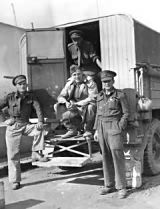
Broadcasts like these had to be sent all the way back to Cairo, often being roughly handled or transported on the way. Then they had to be looked at by four separate censors, Army, Navy, RAF and Egyptian Government, all of whom could make crude cuts that might damage the rest of the disc. Next, Egyptian State Broadcasting sent them by commercial beam radio to London, where reception might, or might not, be reasonably good. The whole dispatch was then re-recorded and available for broadcasting.
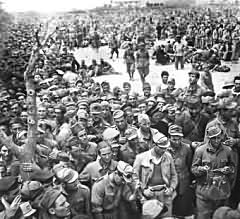
Godfrey's diaries record his pleasure when, for the first time, one of his recordings led both the six o'clock and the nine o'clock news. His voice became known, literally in every corner of the British Isles, and indeed far beyond - as he was later to discover when he was surrounded by tens of thousands of jubilant Italians in the Piazza Venezia in Rome in June 1944.
Vesuvius
In addition to the impromptu descriptions that formed a large part of his output, there were many more measured, more considered pieces, not all of which were about the war. Perhaps the best of all was his description of the dramatic eruption of Vesuvius in March 1944, where he first tells his employers:
Hello BBC. This is Godfrey Talbot talking from Italy at 11.00 hours GMT on Friday, March 24. This is radio dispatch number three. Its title is VESUVIUS CLOSE-UP. It will last about seven minutes.
The language in the report is so rich, so varied, that it is almost impossible to select extracts from it that do full justice to the scale of what he was recording: here is just some of it:
The story of Vesuvius has been eclipsing Italian war news. The volcano is in full and frightful eruption, the biggest for many years and still going on. The sight of a lifetime is this burning mountain, pregnant with incalculable consequence. It's hard to believe the thing, even when you see it. If it were peacetime, this eruption would be the leading story of every newspaper, and people would be flying from all over the world to see Vesuvius.
Great rivers of lava have in the last few days poured down the mountain. In some places the red-hot streams have been 200 yards wide. They look like coke or cinders; they crackle and glow, and their trails of fire, as well as the erupting cone on top, can be seen bright and fierce for many miles. The molten lava, completely engulfing houses and vineyards on its way, carries great boulders with it.
And over all is a great pall of smoke and dust and ash and sulphurous vapour, starting at the mountain top four thousand feet above the bay of Naples and spreading far and wide. No burnings of war, no block-buster bombs, have ever set up such darkening clouds as these, thousands of feet high.
You have heard how hillside villages have been evacuated before destruction and how one of them, San Sebastiano, has been engulfed. But you can't conceive the awful inevitability of this tide of lava until you've stood there and seen it coming in a hot red-and-black wall 40 feet high, and have seen stone houses sag and crumple silently under that tide - substantial houses full of life and people a few hours before collapsing like tissue paper and disappearing for ever before your eyes.
I've just been into San Sebastiano and stood in a house in the centre of the village, before which one stream has unaccountably halted and cooled. . . The house has all the marks of hasty evacuation: drawers pulled out and contents strewn wide; windows open and curtains torn and blowing; and a half drunk glass of wine still on the table...
Beneath the still-spouting and rumbling Vesuvius, we entered the famous ruined city of Pompeii and walked among the ancient pillars with handkerchieves held to our faces as the grit poured down. Somebody reminded us that it was in just such an attitide, with handkerchieves to faces, that many of the inhabitants drew their last breaths when this city was overwhelmed and buried by this same volcano nineteen hundred years ago.
And from walking through that place as the outpourings of Vesuvius beset it once again, we came into Naples - and saw that one of the cinemas was showing an Italian version of the old film, 'The Last Days of Pompeii'... That's all now from Godfrey Talbot.
Early Career and the Diaries
The value of these old recordings is, of course, immense, but what of the diaries that are being progressively transcribed and handed over to the Centre? Four little leather-bound books into which Godfrey wrote every day, often in very difficult conditions, and not intended for publication, such as might be those of a politician or general. They were, however, the most basic of raw material, on which broadcasts could be based, or, should he be asked subsequently to write his memoirs, highly useful aids to recall.
As schoolchildren are now taught, diaries are vital primary material giving inner thoughts at the time, not garnished subsequently by what the writer might wish to add, or embellished by hindsight. These ones were not written with the public in mind, and therefore can be seen as more honest, more truthful than any material intended for a wider audience. This is their attraction - but the downside is that the handwriting can only probably be decyphered and transcribed by one who knew it well, a member of the Talbot family.
So, what sort of background did Godfrey Talbot have? What was his family, and how did he suddenly emerge as that vital link between the 8th Army and their own families at home?
He was born in the village of Walton, near Wakefield, descended on both sides from strict Methodist stock. His mother's father 'Walker the Talker' had indeed been a leading Methodist New Connection Minister, and his own father a Methodist lay preacher. So, the ability to talk could perhaps be said to have been inherited. So too was the work ethic, though this did not manifest itself at Leeds Grammar School, which he left at sixteen after, to use his own word, an 'anonymous' career there.
His true education, he once said, came at the Yorkshire Post, where in two years he worked himself up from office boy to junior reporter. Of his colleagues he later wrote:
They wore hats and waistcoats and watch-chains; they wrote out their reports by hand with fountain pen or 3B pencil. I was sharply rebuked and told to hush when I brought my new portable typewriter into the room and started clattering on it. No such sound had been heard in the room before, and it disturbed the snoring after-lunch nap which one of the old gentlemen ritually took, chin on chest and moustache blowing, in the armchair at the head of the table.
A steady but unremarkable rise in his chosen profession now followed, though it was a feather in his cap to be first Assistant Editor, then Editor, of the weekly Manchester City News in his early twenties. However the paper was a loss-maker and had to be closed by the Manchester Guardian management which was in control. Godfrey then moved sideways, first to be a reporter on the Daily Dispatch, still in Manchester, and in 1937 in that same city he joined the BBC, North Region, as a Press Officer. When the war came two years later his employers summoned him to London.
By now in his early 30's, there was nothing to indicate that his career was soon to be transformed. One of several news sub-editors at Broadcasting House, he also began to do some radio reports himself. Even so, the sudden decision to send him to Egypt, to replace Richard Dimbleby - already becoming well-known - was surprising.
The little leather-bound diaries begin with the journey out. Since the Mediterranean was in 1942 dominated by Germany and Italy, he had to go by ship to West Africa, and then fascinatingly, by flying-boat in a series of hops across what was then known as the 'Dark Continent' and by stages up the Nile: it took 42 days in all, and Godfrey was amazed by some of what he saw.
Although an experienced reporter, he had hardly travelled, and certainly not worked, outside his home country before, and he writes with the reactions of a typical white Englishman of that era in what we would now categorise as most politically incorrect views to meeting with peoples of different cultures and darker coloured skins. There are frequent references to the 'natives' and their noisy habits, or to 'Gypos' and even 'Wogs' - such references were, of course, as common then as are certain swear-words used by people of all races today.
Egypt and the Desert
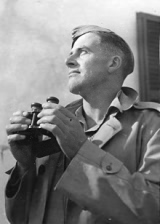
Arriving in Cairo, Godfrey was plainly somewhat in awe of the already sophisticated Richard Dimbleby, though the latter was not yet out of his twenties. He later wrote of him that "He had a houseboat on the river and hobnobbed with Generals. . . he was more a Rajah than a reporter". Moreover the decision to replace Dimbleby with Talbot was not popular with BBC employees in Cairo: Godfrey's diary for Monday, August 3 reads:
Went to BBC office. Odd atmosphere. All wondering in secret what I'll do and how I stand. Saw a fat Bumble (Richard Dimbleby's nickname) at lunch...
A week later, on August 10, things had not improved:
I've now been in Cairo one week. Still feel rather depressed about things. Veiled hostile reception and all the office and the city a web of intrigue. Why can't people be more straightforward?
At last in late August, with Dimbleby having departed in a welter of farewell parties, the red tape was finally cut through, and Godfrey, plus engineer and two drivers, was allowed by the Authorities to see something of the war from the depths of the Egyptian desert, not far from the front lines.
Almost immediately he met General Montgomery and the Air Officer Commanding, a New Zealander, nicknamed 'Mary' (i.e Maori, though he wasn't one) Coningham. The diary entry on Sunday, August 30 gives two vivid, contrasting descriptions:
Evening. Called on Monty, 8th Army Commander, he in shorts and jersey. Doesn't smoke or drink. Keen and lean. Was relieving nature before seeing me for minute at his truck door. He was homespun but not unpleasant. Difficult to prolong the interview, though he talked of the good of broadcasting and going off and recording the men.
Then to AOC Air Vice Marshal 'Mary' Coningham, in a lovely trailer, carpeted, even his tent was, and electric lit, and clean and polished. Phones, desk, cupboards, divan. He talked cordially a lot about plans to go forward. Then his phones started ringing and cryptic remarks came. Coningham's grin and cheery manner changed to serious talk of 'plans' and 'shows' and numbers of squadrons and moving this and that. Turning to us, he said, 'Looks as though the ball is about to begin'. It was fascinating to see the thing beginning, and to be with the big boy giving orders.
The following day, the diary confirms that the Battle of Alam el Halfa, Rommel's last attempt to break through, had indeed started. The fighting, however, was well to the south of where Godfrey and "Belinda" had been allowed to go, so much so that the next day, Tuesday September 1, when the struggle was reaching a peak, the diary records that they had "a quiet night". Godfrey's autobiographies have little to say on this particular battle.
|
This page: overview & general experience. |
|
Includes diary extracts and audio clip. |
|
Glories, grand occasions and generals. |