The Warsaw Ghetto and the Warsaw Ghetto Uprising
"The Germans had expected some opposition but were taken aback by the aggression and determination of the ZOB..."
 |
Warsaw Ghetto and Uprising |
 |
This page: Janina Bauman |
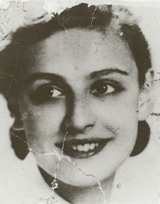
Janina Bauman, née Lewinson, was born in Warsaw in 1926. Her family was Jewish, though not particularly religious, and they lived outside the Jewish area of the city.
Janina's father was a surgeon and a Polish Army reservist. He was attached to a military hospital during the German invasion, was captured by the Red Army and taken to Kozielsk, officers' camp. His family received just one letter before he was killed in the Katyn Forest massacre.
When the Siege of Warsaw began on the 1st September 1939, Janina remembers having to shelter in the cellar from the constant bombing and shelling. By the end of the month, Warsaw was defeated and she soon saw German troops marching along the street.
'[we had been denoted as Jews] since I was just 13. I had to wear a band, a white band with a blue star. It started at 13 and I was just that. My sister was still not obliged to wear it, she was just nine.'
'... we already knew what was going on, what had been done in Germany to the Jews before the war, and we expected something awful to happen to us and we expected all the time that we would be locked in a Ghetto. It was not sure. There were rumours during the first months ... everybody feared it, and some people tried, some Jews tried to run away to the other side, to the Russians. It was not so hard to get through the 'Green Border'. So some people ran away but we stayed. We didn't run. My grandmother was seriously ill. We couldn't move.'
Janina, her mother and her sister Sophie were forced to move into the Jewish Ghetto. They spent 26 months there. At the beginning it was not too bad for them. Although they lived in a very small and crowded flat without a bathroom and the food was in short supply, the girls could continue with their education attending lessons with little circles of other girls working with teachers in their private homes. It had to be kept secret since secondary education was forbidden in occupied Poland.
'On my way to the classes, which took place in one of the girls' flat, I walked along the street strewn with dying people and with corpses lying on the pavements covered with newspapers, held down with bricks. There were thousands of people in the Ghetto who were homeless. Usually they were people who were brought by force to the Ghetto from small villages and small towns around Warsaw. These people had nowhere to live and had nothing, so they lived in the streets begging for food and died on the pavements from starvation and infectious diseases such as typhus. So I walked along the street and I saw these people all the time. Whenever I could I gave some bread to the begging children but yet I must say I got used to it somehow.'
Janina joined 'Toporol', a small agricultural school for young people. Small patches of ground, upon which houses had stood prior to the Warsaw Siege, were made into vegetable plots. The produce was to be given to the Jewish Council's kitchens for the starving. Janina thoroughly enjoyed Toporol, especially being in the fresh air and watching her little plants grow.
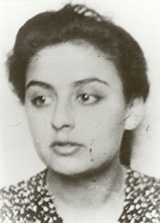
Life began to change. Food became scarce and expensive and Janina spent many days searching for enough food for her family and housemates. Sophie was hit by a heavy German truck whilst crossing the road. She was taken to the busy, overcrowded hospital where she was treated for concussion and injuries to her left eye and foot. Fortunately, she made a good recovery.
The residents of the Ghetto gradually learnt of the fate of those taken to concentration camps. Occasionally someone would escape from 'the transport' and eventually return with this shocking news. Janina cannot remember seeing any Germans in the Ghetto, the aktions of deportation seemed to be worked by Ukrainians, Latvians, the Polish police and the Jewish police.
'The Jewish people they collaborated out of fear, not for pleasure, out of fear. They were always blackmailed by the Germans, "If you don't bring 15 people today, your wife will go and your children and your parents will go. I am not trying to defend them because some of them were really awful... they didn't survive. They all went, only later."
Towards the winter of 1942/43, after the first big 'aktion' of deportment, Janina remembers seeing leaflets calling Jews to fight and defend themselves. The second 'aktion' began in January.
'Young people were preparing themselves to fight. They really believed it and they prepared themselves and later they fought... When the second aktion of deportation began in January there were the first battles. There were young people fighting against the Germans for a very short time, only 6 days. It was meant to finish us I think, but the Germans, they fled after this short fight with the uprisers.'
Janina very much wanted to join these members of the Jewish underground, but had no idea how to contact them. She later approached the AK, the Polish Peoples' Army but was disappointed to learn that Jews were not accepted.
Life was becoming increasingly dangerous in the Ghetto, and on 25 January 1943, Janina, her mother and Sophie escaped with the intention of hiding in the Aryan areas of Warsaw. Their first shelter was with a big family in a large elegant apartment. They were restricted to one heavily carpeted room with heavy curtains at the windows and were not to approach the windows. Food was brought into the room for them and they used the bathroom early in the morning and late at night. The family's cleaning lady was aware that the room was occupied but she never saw them.
Later they stayed with a young couple, very much involved in the Polish Resistance. During daylight hours Janina, her mother and her sister hid behind a wardrobe. It was dark and uncomfortable for three, but their hosts were very kind. They fled when the husband was arrested by Nazis.
'I spent about 2 years hiding on the so-called Aryan side beyond the Ghetto walls. It was, all the time, hiding - running away - looking for somewhere else to hide. I was unbelievably lucky. We were even spotted by a German... it was in the transit camp from Warsaw to other places where we stayed. We were sent to this Pruszkow transit camp and we were spotted as Jews by a German soldier. Again we were lucky because he wanted to just shoot us on the spot, but then he probably thought he had to ask the permission of his senior, and he left us promising he would be back in a moment to do with us. Suddenly a man appeared, I don't know where from, as from heaven itself. A strong Polish man. He said, "run away with me!" and he took us to a hiding place in the camp and we survived again.'
Still hiding in Warsaw during the Uprising in 1944, Janina became very ill with TB, which she had contracted whilst living in the Ghetto. They were concealed with other families in a cellar, and were most grateful to their neighbours, who were very kind and brought food for them.
Poles in Warsaw were very aware of the progress of the Russian Army and could not understand it's apparent reluctance to invade the Capital. They became used to the constant sounds of guns firing from the far side of the River Vistula, and Janina remembers some people attempting to contact them, swimming across the river.
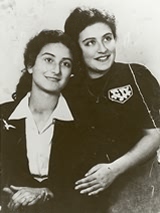
After the 1944 uprising, Janina and her family were deported to the South. They found shelter with an old woman and her son, a priest. They remained there until the Russians arrived.
'There was a very short shelling and the Germans went away and the Russians came. On the same night I went to the shed to bring some wood, some timber for the fire... and I saw a German soldier. Not so much him as his coat. I went to my hostess... and told her, reported excitedly -"You have a German!" She said, "very well. Take him some food, he must be very hungry." I went there and he was invisible. He hid among the wood but when he smelt the food he came out and [he was] a young boy, he was my own age or even younger, frightened to death and terribly hungry. He started eating and I looked at him but I felt nothing. Not hatred, not satisfaction or pity. Nothing ... This incident for me marks the end of the war.'
After the liberation, Janina, her mother and sister returned to Warsaw and lived there for many years. The Red Cross later confirmed her father's death in the Katyn forest. Sophie and her family left for Israel in 1957 with her mother. Janina worked in the Polish film industry as a translator, researcher and script editor until she left Poland with her husband and three children in 1968 and resettled in England after three years in Israel. She worked as an assistant librarian at a comprehensive school and, on taking early retirement, wrote her biography 'Winter in the Morning', published by Virago (1991) and the story of her life in post-war Warsaw, 'A Dream of Belonging.'
|
Warsaw Ghetto and Uprising |
|
This page: Janina Bauman |