Key Figures of D-Day
"One must not judge everyone in the world
by his qualities as a soldier: otherwise we should have no civilization."
Field Marshal Erwin Rommel
 |
General Omar Bradley, General Dwight D Eisenhower. |
 |
Prime Minister Winston S Churchill, Field Marshall Bernard L Montgomery. |
 |
This page: Führer Adolf Hitler, Field Marshall Karl R G von Rundstedt. |
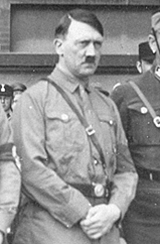
Führer Adolf Hitler 1889 - 1945
Born in Braunau in northern Austria, Hitler joined the Bavarian infantry in the First World War and attained the rank of corporal.
As leader of National Socialist Party he assumed total power of Germany 1933 determined to restore Germany to greatness. In 1937 made himself Commander-in-Chief of the armed forces.
In 1944 Hitler and his Generals had believed the Atlantic Wall to be impenetrable. Mistakenly he believed an attack would occur in May in the Pas de Calais region. When the attack failed to materialise, he left Berlin for Berchtesgaden. On the night of 5/6 June, staff did not awaken him with early reports of the Allied landings and by the time he gave consent for the deployment of his mobile troops, the invading armies had secured the Normandy Bridgehead.
Hitler agreed to meet Rommel and Rundstedt in France on 17 June to discuss tactics - he took little interest in their proposals, insisting the continued bombing of London with his new 'miracle weapon' the V1 rocket would cause the evacuation of the city and thus collapse the Allied war effort.
Hitler's reserves were hindered by Allied air attacks and sabotage executed by the French Resistance. Hitler called another meeting with Rundstedt and Rommel in Berchtesgaden and relieved them of their commands. He then focused his attention on the war in the east and moved to The Wolf's Lair at Rastenburg, East Prussia.
Field Marshal Karl Rudolf Gerd von Rundstedt 1875 - 1953
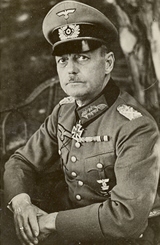
A veteran of the Eastern and Western fronts in the First World War, Rundstedt was called out of retirement in 1939 to plan the invasion of Poland and command Army Group A. The following year he was appointed to command the same forces in the campaign to invade France, and was responsible for persuading Hitler to halt the Panzer divisions outside the Dunkirk easing the escape of the British Expeditionary Force. In 1941 he commanded the advance into the Ukraine but was relieved in December after a disagreement with Hitler.
He was recalled again the following year and made 'Commander-in-Chief in the west', directed to strengthen the Atlantic wall defences. He was responsible solely for defending the coasts of Western Europe against invasion with largely second rate troops, the elite forces were moved to fight in other campaigns.
In November 1943, greater priority was given to the defence of the West and Erwin Rommel was appointed as Commander-in-Chief of Army Group B.
Rundstedt assumed the Allied landings would take place between Boulogne and Normandy during May 1944 and was taken by surprise when the assault began in June. He spent much of D-Day persuading High Command to release Panzer Group West keeping two Panzer Divisions further inland. It soon became apparent that the Allies had established a bridgehead and Rundstedt and Rommel pressured Hitler at Margival, on 17 June for permission to withdraw from Normandy. Hitler refused and within weeks replaced Rundstedt with Field Marshal von Kluge.
Captured by the Allies at the end of the war, Rundstedt was charged with war crimes in 1948 but was released the following year without trial due to ill health.
|
General Omar Bradley, General Dwight D Eisenhower. |
|
Prime Minister Winston S Churchill, Field Marshall Bernard L Montgomery. |
|
This page: Führer Adolf Hitler, Field Marshall Karl R G von Rundstedt. |