Company Sergeant Major Stanley Elton Hollis VC
"I was proud to be a Green Howard."
 |
Landing on Gold Beach. |
 |
This page: the assault on Normandy. |
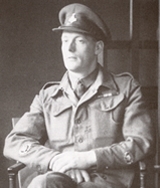
By this time I was in charge of 16 Platoon. Lieutenant Kirkpatrick of the 2 Commando had been killed. He had his arm broken on the beach and he had walked about until now, which was about two o'clock in the afternoon, with a broken arm, and he was killed just outside the village. I took 16 Platoon over and coming through this village Major Lofthouse ordered the different Platoons to search and clear out different farmhouses along the road. This was the particular one he picked on for me and 16 Platoon to come in and clear. We came in the gate. The house was locked , so I broke the door down. I went up the stairs into the various bedrooms and I burst into this bedroom here and there was a small boy about ten or eleven years old, and I just saw him disappear round the corner a couple of minutes since. He is now the owner of the farm, and he must have been pretty frightened. I was covered with blood and he was, he must have been, terrified. I am convinced he thought I was going to kill him. Anyway there was nothing in the house. I came down again and I decided to have a look to see if there was anything round the back of the house - and if we go round now through the alleyway I will just have a look. And there didn't seem to be anything going on out here, and this is where I was, I think, the most frightened I have ever been in life.
I looked round this corner and straight away a bullet knocked this lump of stone off the wall. I was very lucky to get away with that. I saw two dogs in the gap in the hedge. They were dancing about wagging their tails, jumping up and down at somebody, and I knew full well we were forward troops so I knew there were no mates of ours that were there. On closer inspection I saw a field gun, or what appeared to me to be a field gun, so I went back and told the Company Commander what I had seen. He told me that we would see what we could do about it, but before I went back I told seven or eight of 16 Platoon to dash out across here and engage in whatever was in that hedge. Just open up with Bren guns and shoot that hedge up. Well, they ran out of here and immediately all seven or eight of them were killed - stone dead straight away. Well, I thought "there is not much future here", and I went back, as I said, to report to the Company Commander, and he said to me "well get a PIAT gun and a couple of Brens and crawl forwards through the patch of rhubarb" which I had described to him. The rhubarb then extended from the end of this track right to the tall trees to a depth of almost these apple trees. So it was quite tall. Well, I got my PIAT gun and Bren gun - I had two Bren guns - and the three of us crawled, crawled through this rhubarb to the forward edge. We got to the forward edge of the rhubarb and I poked the PIAT gun through and had a shot. Well, as was usual with me, I missed, and then the field gun fired and blew the top off this house here. You see it's got a new chimney and things put on. Well there was bricks and masonry flying all over the place so I thought we better get out of it and leave it to somebody that was better equipped than we were to deal with it.
So I crawled back out, walked up the road to join the Company about a hundred yards up the road and told Major Lofthouse what it was. He said "Well, we will leave it and let somebody else deal with it". Then we heard a terrific racket coming from here and somebody came and told me that the two Bren gunners I had brought in were still in the rhubarb. They were pinned down and couldn't get out. I said to Major Lofthouse, "well, I took them in, I will try and get them out." Well, I came back with a Bren gun and I waited until - behind this wall here - until there was a lull in the firing and I ran straight out across there and straight ahead for the Bren guns. We quietened them down and I was able to shout to these two lads to get out and come back and join me, which they were able to do, and we came back and rejoined the Company.
There was C Company on the left and A and B on the right. We advanced up here and when we got here there was a tank, and the tank went on ahead of us up the hill. It was pouring down and the lane was in a hell of a mess. It had been churned up by tanks, and as we were going up here - Seventeen and Eighteen Platoon on this side, Company Headquarters behind the tank, Sixteen Platoon with myself on the left hand side going up here. We heard a lot of banging going on either side. We couldn't see, of course, what was going on, but we knew someone was catching it. And then as the tank got to almost where you can see the light patch where the sun would shine through as if it was shining, the tank stopped. Well, we were crawling up here by then and we started getting casualties from somewhere up at the top - small arms and machine gun. And if we just walk up to where that patch of light is, the tank had got here, why I don't know. Maybe he could see over this hedge and see there was a tank knocked out in that field and could see it there and he knew what was going to happen down there. I think that must be why he stopped. He wouldn't go any further on.
It was also here that I committed an unpardonable sin. I had been all day back at the orchard where we formed up getting the troops fully equipped with ammunition and seeing everything was right and making sure everybody had as much as they could carry and still be mobile. Well, we got here and we were down on our hands and knees and I could see that the firing was coming from this tree up there that you will see ahead of you and this side of the lane was getting casualties. So I was laid dawn here and I could see these two Germans who were getting up, firing a burst down that side of the lane and then getting down. I watched them for - I suppose it was only a few seconds. It seemed quite a long time. They would bob up, fire and get down. Bob up, fire and get down.
So I thought, "well, we will have to see what we can do about it", and I turned round to the chaps and I said "I am going to have a try at this". So I felt in my Bren pouch for a grenade and when I put my hand in I had a pair of socks and a shaving brush in me doings - in me Bren pouch - and this after I had made sure that everybody had their equipment and ammunition. Anyway I turned round to the chap behind me. You know "for Christ's sake give me a grenade", and I waited until I got the rhythm of what they were doing - bobbing up and down and shooting. Bobbing up and down and shooting. And then the last time they bobbed up I threw this grenade and I could never throw a grenade like the Army taught you. I used to throw them like a cricket ball. So I threw the grenade. The Germans saw it coming and got down. Well I followed the grenade up straight away. I ran right behind the grenade. When it landed I hadn't pulled the bloody pin out. Now, of course, the Germans didn't know that and they kept down waiting for it to go off. By the time they had realised it wasn't going to go off I was on top of them and I had shot them both in the hole. If you go up there now you will see the hole that they were in.
When we arrived at this point my Company Commander came to me and said that he would take two Platoons up this hedge and I was to take what was left of 16 Platoon - by now about fourteen or fifteen men - up this hedge. It's a double hedge, a ditch in the middle - ideal cover. So I took my Platoon up here. We were crawling all the time in the water. It was pretty uncomfortable, and when ... we could hear a lot of fire coming from the top - not at us because they didn't know we were there. We got up to where, roundabout where, the cow is in the hedge and I called everybody forward with the automatic weapons - the Bren guns and Sten guns - and we opened up with everything we had on that top hedge from where we were in this ditch, and I would like to think we caused a few casualties because the firing immediately stopped. There was a tank in this field that was in good order. It was running about alright and Major Lofthouse sent a runner across to me to say that we had to come back to here. On the way back to here I and Sergeant Major Moffat - and he was B Company Sergeant Major - picked up one of our Captains, a Captain Bolo Young, he was a very good officer and we put him on this tank. He had been badly wounded and he was brought back through this gate and taken away back there. We had completed our job. We had done what we set out to do. We had quietened the thing. Whether we had killed anyone or not we don't know but at least we had either shifted them or we had knocked them off - one of the two.
We came back here (and) rejoined the Company.
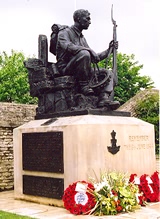
Well, you must understand that I came from Middlesborough where everybody is connected with Green Howards in some way or other. The families, they are all connected to The Green Howards and, of course, The Green Howards are the be all and end all of The British Army, and I was proud to be a Green Howard. The best moment in my life, the proudest moment of my life was when I was made a Sergeant Major. There is nobody better than me in the Army then when I was made a Sergeant Major. Apart from that all these fellows were my mates. We had been, I had lived with them. Apart from the fact of being in the Army I had lived with them in civvy street before. We knew, well, everybody knew everybody else, and there wasn't only me doing these things there were other people who were doing them as well and the things I did. If I hadn't done them somebody else would have done them. There is no doubt about it. It was just a case of not who would do it, it was just when it was done, and it would have been done by somebody else.
The announcement that Stan Hollis had been awarded the Victoria Cross for bravery in Normandy on 6 June 1944 was made in The London Gazette on 17 August 1944. The last paragraph of the Citation reads,
|
Landing on Gold Beach. |
|
This page: the assault on Normandy. |