Corporal John Best
"(we) were ready for action and believe me, we got more than our share."
 |
This page: Pantelleria, Sicily and Training for D-Day. |
 |
D-Day and North West Europe. |
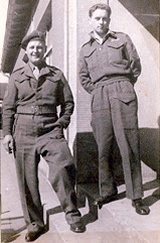
John Best was born in Leeds in 1924, the son of an engineer. He left New Farnley Council School in 1938 and began work in a drawing office.
In August 1940, John's father entered his son into the Merchant Navy. Within weeks John had passed a written examination in Hull but failed the physical examination as he had trouble distinguishing between the coloured lights.
My father was disgusted, largely I think because he couldn't accept the fact that his son couldn't pass a medical and he let me know about it about five times a week.
My home was in a village where I had lived all my life, it was about five miles from Leeds and was truly rural, there was only one bloke who joined the Navy and a few in the Army and the Air Force. The Royal Marines were an unknown quantity except for the fact that they were reputed to be the toughest of the lot. Perhaps it was because of all the aggro I was getting from my father that decided me to have a go. I never said anything to him but I thought, "I'll show the old sod."
John made an appointment to see the Recruiting Sergeant with the intention of joining the Royal Marines for twelve years. He was weighed and measured and at 5ft 7ins was too small to be accepted so it was suggested that he joined 'for hostilities only', hoping to transfer to the regulars if he grew another inch.
My papers came a week after my eighteenth birthday and they included two meal vouchers, a one way ticket to Lympstone in Devon, and I was to take a case large enough to take all the clothes I was wearing as they would be returned to my home after I was kitted out.
The training was very tough. The trainees spent much of their time marching and cross-country running often wearing and carrying their full kit. They also practised boxing, which John had never experienced before. He became sick of being beaten and he asked the PT Instructors to teach him to fight. He soon became a competent boxer although he stopped fighting when he lost his front teeth in the semi-final of a competition.
Everything we had done at Lympstone had one objective and that was to instill in us all a pride in belonging to the Marines.
When the recruits had completed their initial training, they chose between land service or sea service. John wanted to go to sea and continued his training, learning seamanship at Portsmouth Dockyard.
We arrived in Portsmouth barracks and along with other blokes were formed into a ship's crew of fifty men and were issued with two suits of blues and one hammock. Life in Pompey barracks was quite a shock to the system, it was like a prison in appearance and the food matched it perfectly... We spent a month there, marching down in the morning and back to barracks at night. We had to learn everything there was to know about the different guns that would be mounted on the ship we were about to join. Because of my engineering background I had been selected 'Gunners Mate' (the Gunner would be a CPO -Chief Petty Officer), I had to be able to maintain, strip and repair every type of gun, even in the dark. The instructors were excellent but wouldn't stand any nonsense, one word out of place and you were running around the field carrying a damned great shell. At the end of the course I had to pass an examination, which gave me no trouble.
John's training ended with a final 'toughening up' course at Fort Gormer.
Three weeks of merciless training under expert sadists.
At Deptford Creek, near London, John became the Gunner's Mate on a Landing Craft Flak, a flat-bottomed ship intended for inshore support.
We were there to sort of gel as a crew, and then we went just before Christmas to Gibraltar. I think it took six weeks in a flat-bottomed boat. We had no fresh food at all, that is no bread, no potatoes, no fresh meat, no milk, nothing. It all came out of a tin and it was horrible. The two highlights of the day used to be the issue of rum and the issue of limejuice. We lived and slept like sardines in a tin and when the ship was rolling in bad weather many of the crew were seasick until they became accustomed to the motion. Imagine if you can, forty men in hammocks, the rest sleeping anywhere, the ship rolling, blokes moaning, retching, farting and cursing... Eventually, when we reached Gibraltar and it was like reaching heaven, all lit up and bags of food and ale and fruit.
From Gibraltar, they headed for Malta and arrived in Sliema Creek during an air raid.
You could see very little for the thick, greasy, foul smelling smoke that covered everywhere, but finally we were anchored in the middle of the Creek and were ready for action and believe me, we got more than our share.
One night there was an explosion in one of the gun pits and I climbed in, it was a bloke called Tex, all six feet of him, he was slumped over the gun breech. I pushed his harness forward to release him and he fell on top of me with half his head blown away. I couldn't get out from under him and his useless loader was too busy being sick but eventually the Gunner was in the gun pit and we got the body out. They took it away to the Petty Officer's Mess, which doubled as our sick bay when in action.
John and his crew were sent to assist in the Invasion of Pantelleria on 11 June 1943, John's 19th birthday. The island was quickly secured but the allied ships were under constant attack from Stuka bombers and many craft were hit. Morale suffered, and eventually John's LCF (now packed with survivors from wrecked ships) was given the order to return to Malta. They entered the Grand Harbor and appreciated 'a hoot' from all the ships docked there.
The ship went in to dry dock for repairs and we were taken to the Island of Gozo for rest and recuperation whereupon about a third of the crew deserted and some of them we never saw again. Those that were caught we returned to the ship as punishment and the crew was brought to full strength with volunteers from the survivors.
Preparations began for the Invasion of Sicily. The day before D-Day, all personnel were taken aboard an aircraft carrier and told a 50% casualty rate was expected. The men were lined up according to religion and blessed accordingly.
All hell let loose as we approached Sicily but we had our brave allies the Yanks with us and they were living up to their reputation, "Bomb everything and you're bound to hit a German or two." Going in to shore, we noticed what looked like a lump of wood sticking out of the water, as we got nearer to the shore more and more was revealed until we could see that they were gliders... And as you went closer in you could see more until you could see nearly all the gliders and you could see the blokes inside that had been drowned. It was terrible and we went right to the shoreline and all we did was fire at planes. I don't know how many days we were there.
They gave support to the Army as they landed and pressed forward. The LCF suffered no casualties and they returned to Malta.
After Sicily came the Invasion of Italy but by now we were hardened to anything and simply took the invasion in our stride. It was another job to us and after the initial assault was over and the troops were well ashore and going inland, we tied up alongside a jetty and were immediately besieged by starving kids and women. We had nothing to give except tins of potato flakes, tinned cabbage and soya beans but we did the best we could.
Although they were given orders to return to England, one of the engines needed to be replaced so the crew spent a few days in Sfax, Tunisia before bringing the ship back to England.
After seven days leave, John reported back to Portsmouth Barracks and returned to Lympstone Camp. The crew was then separated. John passed a driving course in Wales to find he had been selected to train on a new amphibious vehicle, the DUKW.
These were great big vehicles with about eight huge wheels. The trick was you drove the vehicle onto the sand, pressed a lever which deflated the tyres, you then put it into drive, entered the water, and off you went into the wide blue yonder. I have never laughed so much in all my life, you could turn the wheel but b**** all seemed to happen.
In April 1944, John answered an appeal to experienced Gunners for 'Hazardous Service' and was sent to Cardiff for training and preparation. John's father now a Staff Sergeant in the REME and attached to The 4th / 7th Dragoon Guards was also training for D-Day.
|
This page: Pantelleria, Sicily and Training for D-Day. |
|
D-Day and North West Europe. |