Corporal John Best
"It was early morning and ships were everywhere, some sinking, some badly damaged and shells were flying all over the place."
 |
Pantelleria, Sicily and Training for D-Day. |
 |
This page: D-Day and North West Europe. |
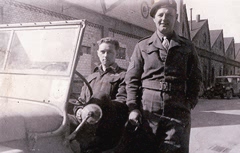
It is a matter of record that without the 'Mulberry Harbour' it extremely doubtful whether the Invasion of Europe could have succeeded but nowhere have I read, or even heard mentioned, the men who risked their lives or in some cases lost them, sailing these floating bombs to France. Twenty-five of us were taken by a truck to a restricted area near Cardiff and put aboard a large merchant ship, on its side was painted a large number '1'. It had four anti-aircraft guns mounted forward and four aft. We were taken to a mess deck where a Naval Lieutenant was waiting to address us. He explained that we were now aboard a 'Block Ship' and that no one would be allowed off the ship under any circumstances. All watertight doors had been removed and the ship was rigged to explode when a plunger was operated on the bridge. At this point, the explosion would blow out the bottom of the ship, which would then sink to the ocean floor in a predetermined position to start the Mulberry Harbour. There was a Merchant Navy Captain plus a Chief Engineer and a skeleton crew of Merchant Navy layabouts (who were in it for the money). We found that they were receiving treble pay danger money whilst we were still on two shillings per day. The ship was more or less a sailing hulk but two ships boats had been left for our use when the time came for us to leave the ship just before she was blown. A Naval Officer would be put aboard later and he would be in charge, until then we were under the orders of the Captain.
We would sail the following day around England and Scotland and our arrival at the embarkation point for the invasion had to be spot on. Our job was to protect the ship from aircraft; one near miss, we were told, would be enough to fire the charges. We would be the first ship to go down... During our pleasure cruise I had been chatting to the Chief Engineer and he told me some rather alarming news. He said, when the ship was being stripped, no care had been taken in the engine room with regard to stability and it was his opinion that when the charges were blown the ship would turn turtle. I said, "you're kidding me," and he replied, "kidding or not, I shall be the first b*** on that boat and I don't care who gets left." I was to remember that.
The beaches on D-day were unbelievable. Of course it was early morning and ships were everywhere, some sinking, some badly damaged and shells were flying all over the place, from our battleships, etc. out at sea and coming the other way from the Germans. Planes were everywhere, but you couldn't tell one from another, so we just let fly at everything. About four miles out, we had picked the Naval Officer up and everything was set, or so we thought. Whilst we had been on the guns, the Merchant seamen had quietly b**** off. They had got the ship in position but there was no one to drop the anchors and so the ship had drifted nearly 90 degrees out of position. I think the Naval Officer panicked because there was a large explosion and the ship stopped. Whether we hit a mine or an obstacle I don't know, all I know was that the ship was sinking and we had nowhere to go. The ship started to roll to port and some of the lads were on the ship's side. I told them what the engineer had said but of course it was a case of panic stations, so I told George to stay with me at the ship's rail just in case. Suddenly there was a great rumble down in the engine room and the ship started to roll starboard, the lads were trying to scramble back up (some made it, I reckon,) but George and I waited and then jumped and swam like hell to get away before the ship could land on top of us.
Despite the engineer's boast, he had been left behind along with the Captain and the Naval Officer, but I never saw any of them again so I don't know what happened to them. When the ship had settled down (on its side) George and I went back and found a hammock each to float on. We had taken all our gear on deck earlier ready for getting away but we hadn't any time to look for it. In any case, it was hopeless, there was wreckage, oil and everything you can imagine floating around so we dog paddled away together. We intended to try and stay together but it was too difficult, the water was very cold and after a while the hammock became waterlogged and sank so I had to find something else to float on. I managed to climb onto a hatch cover and there I lay, frozen to death. I was so cold I could not think straight and all I had left was trousers and a shirt. The tide was going out and we were going with it - I really thought I had bought it. After what seemed like days, suddenly there was a ship slowing down and I hadn't even seen it. It was a huge LST manned by Americans. They dropped a scrambling net over the side but we couldn't make it so a bloke climbed down and hoisted me up whilst another bloke got George. We later realised it had been nearly twelve hours since the ship had gone down. The crew couldn't do enough for us, hot showers and wonderful food soon brought us back to the land of the living, but I was never to feel the same after that experience.
We landed in London in the early hours of D-Day plus 1 and even at that hour there was quite a crowd to greet us. George and I came down the gangplank dressed like Russian admirals and were taken to a kind of hospital where they kept us for (24 to 48 hours). They pronounced us fit to travel and sent us to our home division which was Stonehouse Barracks, Plymouth. We were the first ones back after D-Day and also the first two Marines ever to enter Plymouth Barracks without a hat. They treated us very well, a full issue of new kit and no duties for seven days. Of course it was too good to last.
On board the LST was a Sergeant Major in the REME acting as a Co-ordinating Officer, and he wore the 4 / 7 Dragoon Guards shoulder flash. When John asked him if he knew his father, he was amazed to discover that very ship he was standing on had landed his father that morning. He asked the Sergeant Major to let his father know that he was safe.
John was sent from Plymouth to Dalditch Camp, which was very tough. Trained to drive DUKWs, he was retrained, with the emphasis on harbour work, and joined a Naval Party bound for Europe. John was allocated a 3 ton Bedford truck and a relief driver.
We drove that truck from England to our final destination, which was the port of Emdon. We roamed around Belgium and Holland working as necessary, always keeping a few miles from the front. Every town and city seemed to have been knocked flat and where the locals lived, God alone knew. We were billeted in some very strange places but wherever we were, as soon as the grub was up, the women and kids would be there rummaging through bins. Many times we gave our food away to the children, it was heartbreaking to see them.
Slowly the war was winding down and we were now in Germany and everything seemed to change somehow. Thousands of German soldiers had packed in and were trying to make their way home (if they had one left) and coming the other way were the refugees... It seemed to me to take a long time happening, but slowly all the German servicemen were being rounded up and put into camps before being interrogated. The camp would be a large one surrounded by barbed wire and guards, with huts for the people doing the interrogations and quarters for the guards. There was nothing for the prisoners to do except cause trouble, and they were pretty good at that.
Eventually they moved into Emden. The town had suffered heavy bomb damage and the harbour was full of sunken ships, the Naval Party inhabited the only craft still afloat, a German U-Boat Rest Ship.
John became the Naval Commander's personal driver, and spent his free weekends searching for his father. A draft chit arrived, for John and another marine to drive DUKWs in Lake Beale, in India. They were very reluctant to go but travel problems delayed their return to Britain and they were too late for the draft.
Returning to the M/T School, John was given a job in the Drafting Office and promoted to Corporal. He enjoyed the work but when he received a request for a Corporal and two drivers from NP 1745 in Germany, he decided he would go.
He quickly settled into the routine and resumed his search for his father. The Commander allowed him to spend a weeks leave in Germany and John headed towards Berlin.
I gave it three days but there was just too much ground to cover, so I slowly made my way back. I had noticed for quite some time a peculiar kind of smell and the further I went the stronger it got until it was almost overpowering and then I saw it. I still cannot believe what I saw that day, it was like a very large village of wooden huts, a village with inhabitants from hell. I saw three single decker buses full of matchstick people dressed in grey striped pyjamas, I went across to have a closer look and they were like skeletons, they never moved at all. I went through the gates and there were Americans everywhere, also there were bodies everywhere, some were piled high and others just lay scattered about. Suddenly a voice shouted out, "What the hell are you doing here?" and an officer approached and suggested I got the hell out of there. "You don't want to see this, son." He said, "This really is hell on earth, how can anybody do things like this? Everywhere we go we are finding bodies, I still can't take it in." He was nearly in tears except that he was also nearly out of control with rage. "Any guards we have found we have shot, but what good will that do compared to all this?" I went back to my jeep and just sat there, looking at it. I still couldn't take it in; it was huge and full of bodies. In my shock, I had forgotten about the smell but suddenly it hit me and just about made me sick. I learned in the town that the place was a concentration camp called Buchenwald.
With the disbanding of the Naval Party, John was sent to Minden to be the driver for the Commander of Naval Forces in Germany. Before he left, he helped raid the stores and gave the food to the women and children of Emdon.
The Commander's personal car was an armour plated Mercedes Benz, formerly the property of Herman Goering. John hated the work and soon requested alternative duties. A sergeant was found to drive the Commander and John was put in charge of some ration trucks.
During this period I was, of course, still looking for my father but with no success. I had one last tour round Hanover and Bremen but I made sure I never went near the American sector wherein lay Buchenwald, I was still having nightmares about it. In one camp a REME Sergeant told me that all major repairs to vehicles were now being done at a concentration depot in a place called Bielefield, perhaps he was there, he suggested. I couldn't believe that he could be so near to Minden but the first chance I got I was off and believe it or not I found him. He was in charge of a large workshop and he just walked out cleaning his hands on an oily cloth. He put his hand out (the clean one) and said, "Now then lad, how are you?" He told me that the Sergeant Major I had met on the ship had indeed seen him after D-Day and had told him I had been picked up. We had quite a few good nights in the Sergeant's Mess before I was sent back to England for de-mob.
John was de-mobbed at Plymouth after just over four years service. He still values the independence and high personal standards instilled by the Royal Marines.
When I joined up I was soft, and they hardened me up. You had to stand on your own two feet and there was nobody you could turn to... I had never scrubbed a floor, or darned my socks, or washed a shirt - nothing. Well, you had all that to do in the Marines and, of course, you would be fifty, sixty men in a hut with maybe two irons and your gear had to be immaculate every morning even if you spent all night doing it, which many times we did... During my service I made many friends and had some happy times and some very sad ones, but I shall never regret my decision to be a Royal Marine.
|
Pantelleria, Sicily and Training for D-Day. |
|
This page: D-Day and North West Europe. |