Lt Derric A Breen RNVR
"A bright old boy in a blue serge suit, a suit resplendent with brass buttons, told me that the Navy was with its back to the wall and that it needed telegraphists."
 |
This page: training and Atlantic duties. |
 |
Coastal duties and Freetown Escort Force. |
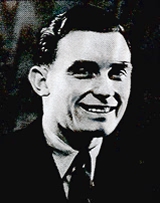
Derric was born in December 1919 and grew up in Chopwell in the Derwent Valley with two brothers and a sister. His father had died a month before Derric was born and his mother worked hard to provide for the family. Derric was at the City of Leeds Training College when he heard war had been declared, but was initially undecided as to what course of action to take, as his political convictions led him towards an abhorrence of war:
I grew up as a pacifist; as a socialist; wearing the white poppy of peace instead of the bloody red reminder of Flanders' fields. . . Like all young people, I thought I could change the world, in my case, by writing very left wing articles in the College magazine. . . The only conclusion I reached was that I could not fight, not a matter of would not but a matter of could not.
Once war had been declared, Derric's College was evacuated to Scarborough and he stayed at College until he went for a service medical in Leeds in May 1940:
A bright old boy in a blue serge suit, a suit resplendent with brass buttons, told me that the Navy was with its back to the wall and that it needed telegraphists. He was convincing, at least he convinced me. I came out from the interview with my decision made. . . The Army might have kept me waiting but the Navy worked on a more urgent timescale and before the week was out, I had my orders to report to HMS Royal Arthur at Skegness. . .
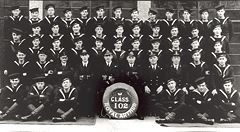
The powers that be put me in class W102, which was a Telegraphist training class. It was a high pressure training situation for the intention was to push the usual RN training course of 18 months into just over twenty weeks, in addition to giving us a thorough training as an infantry battalion and a role in coastal defence. . . During the day we sweated at morse and Fleet signalling in the lecture rooms and in the evening went down to the beaches to guard against invasion.
With training complete, Derric went to the Signals School at Portsmouth in November before being drafted to HMS Egret at Rosyth the following month:
It was high water and she lay alongside, shining in her coat of North Atlantic grey: I saw her as a thing of beauty, neat, compact and to me so big.
Derric's introduction to the morse aboard Egret came as a shock:
this came at me through a maze of static, distorted but also more choppy and disjointed than any morse I had ever heard. It took me only a few minutes to realise my limitations as a wireless operator: I also, in the same brief period, developed a determination to make the grade; to be of use as soon as was possible.
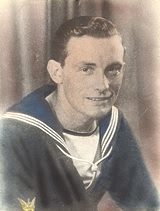
HMS Egret sailed down the East Coast at the head of a convoy and Derric went to look at the Thames Estuary as Egret steamed in toward Sheerness:
I've never forgotten that sight, it was appalling; wherever I looked, I could see the skeletons of dead ships; masts, stems, sterns and, here and there, a lonely bridge protruded from the water. It was like walking through a graveyard, through a graveyard in which a careless sexton had neglected to see that the dead were properly buried. This, then, was the war at sea, the war the Press insisted we were winning. . . We plied the East Coast convoy route for some two months in which period I became a decent sparker, played soccer for the ship; and began once more to do a little boxing at which, I found, I was surprisingly good. . . I found the process of becoming a sailor, as distinct from a telegraphist, a complex one. First of all, I had to become a competent working telegraphist and coder while at the same time, I had to come to terms with life in that tightly knit and sometimes suffocating community which is found in a ship at war.
Although the work side was the major element of day-to-day life, Derric still found time to play pranks on his shipmates:
A favourite was to emerge from the Office and sit quietly on the mess deck, ignoring questions, being absorbed in inflating and putting on one's life-belt. . . It took a bit of inflating and this task we did with bitterly sour faces, while the more nervous of our shipmates watched the procedure with increasing concern, convinced that the fighting tops of both Scharnhorst and Gneisenau had hove into sight. It was a game which could only be played at rare intervals and to a carefully selected audience, but I've seen a lot of people go white at the time.
By now, the situation facing convoys crossing the Atlantic was becoming desperate; and Egret was called on to strengthen the Escort Groups heading out from Londonderry. As the convoy entered the Pentland Firth, Derric witnessed his first storm at sea:
Out of this welter of breaking waves we would stagger to a crest; from this peak we could most often see the whole of the convoy. There were, however, times when we staggered to the crest, only to find that the entire brood we were protecting had themselves disappeared into a trough. Again and again, Egret buried her bow into an unheralded monster and she staggered to a standstill in a chaos of breaking furniture and straining gear. We were in waters which had been known to rip the turret from the deck of a battleship; our 1250 ton cockleshell was in a fight for survival.
Having seen out the storm, Egret sailed into the Atlantic at the end of February 1941:
We went out to find ourselves in a nightmare which did not end with waking and the dawn. Indeed we sailed into a nightmare without end. We found a world in which ships about us went up in flames; in which the sea was covered in the burning fuel of tankers; in which ships carrying explosives simply disappeared. Worse than all these, struggling to provide some kind of screen for those ships ploughing stubbornly on, we could not stop for our dead and our dying, the living in the boats and in the water, were beyond our aid. Britain's survival depended upon our pushing each convoy through, no matter the cost. . .. Even then, the struggling escort forces sank six submarines: to our joy, these included the three great Aces: Gunther von Prien, Schepke and Kretchmer; each of these were reported to have sunk 200,000 tons of shipping. There may have been some who mourned their loss, we did not.
To complete our joys Scharnhorst and Gneisenau were loose and having missed us by passing hull down over the horizon had gone on to sink 27 ships in the convoys behind us.
The storms took their toll on both men and ship:
Cups, saucers and plates went in the first days and as a way to eat we resorted to the Nestle's milk tin. . . What however was the real agony, was the never ending, muscle crippling, effort to hang on to something, to find a corner in which to wedge, so that for the odd minute the strain might come off legs and arms.
As the U-boat attacks intensified, Derric now worked in a two watch shift-pattern:
We grew more and more weary, the struggle to keep awake becoming increasingly unbearable. The W/T office was a small haven of warmth and freedom from the water which seemed to be everywhere in the ship. . . To keep awake, we smoked non-stop, one after another.
Storm damage meant that Egret had to return to Liverpool for repairs, then a quick return to the Atlantic:
Our last trip was to escort an "OB" convoy on its way from UK to America, taking it to some 40 degrees west, where we picked up the inward bound "HX" convoy bound for Loch Ewe and Liverpool. Throughout the trip, we collected messages telling us that the Bismarck and probably the Prinz Eugen were at sea, with the likely intention of breaking out through the Denmark Strait. . . For us this was the clap of doom, we were escorting a 4.5 knot convoy and should the Germans break free, there would be butchery among the lightly escorted convoys, spread out like honey for bees, along the thousand miles of ocean. We told our convoy the good news and set about working them up to the highest speed of which they were capable. We worked them up to six knots and there was some hope that the break-out forces would pass to the west of us. Dawn found me on watch, reporting to the bridge, that we had the first enemy reports from the Hood and Prince of Wales and the news that a major action was imminent. For a while there was signal quiet and all seemed to stand still. At last the key chattered again, it was Norfolk, with a brief signal, "Hood sunk in position...proceed to search for survivors". It was in addressed to the destroyers puffing up from behind and was in fleet code - I did not need a signal book to decode it. Nevertheless, so great was the import of the message that I checked it against the code before sending it up to the bridge. Immediately the voice-pipe whistled - it was the Navigator, demanding I check the signal. I did so for the third time, but that didn't alter anything. She was gone. It took time, however, for the full import of the signal to be digested. Then the engines kicked up and over and, like a sheepdog, we set to work herding and chivvying our convoy, scraping another half-knot out of them while we rode shotgun.. The convoy routes were in a shambles as escorts girded their loins to make some kind of an effort to give our convoys the chance to run. In the last analysis, we might be able to do no more than to lay a smoke screen to cover them before going down to the heavy guns. Meanwhile we ran for it. Some convoys turned back to avoid the danger area, but those like us with our heads in the trap could do no more than whip 'em up and keep running. Through the 25th and 26th we ran for it, learning the shadowing cruisers had lost touch. We searched the horizon with eyes sharpened with dread.
The 27th brought the news that Bismarck was down and that Eugen had made a home run. We staggered on - both we and the ship were very near the limits of endurance.
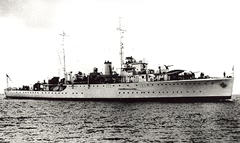
Egret returned safely to the UK for a six week re-fit and then joined a new Escort Group, the 44th, on escort duties to the Gambia:
An ocean convoy was a sight to behold. To economise on escorts, bigger convoys were now being sailed at 10 day intervals. Imagine 70-80 ships in a dozen columns, each column spaced 1000 metres from the next and each ship in the column spaced 500 metres from the one ahead. It was an awe-inspiring sight, impressive and martial, but displaying its own vulnerability as the mass of ships showing a seven to eight mile front steamed along at 4 to 5 knots, extending backward for 3 to 4 miles. Round this 30+ square miles of vulnerable shipping our six escorts tried to keep a wall against attack.
The convoy was open to attack by air, U-boat or surface raiders. On Egret's return journey three FW 200s appeared:
Tommo and I had a rifle apiece and a pocket full of 0.303. We let go at the head-on targets and our firing was lost in the staccato blasts of 0.5s, strip Lewis guns and whatever else we could muster. . . The haze cleared and I looked around me, a merchant ship was belching smoke and falling out of line. We went in and took off six terribly wounded men, caught when the big cannon swept their decks. . . From the Foyle to the Gambia and back again, we ploughed on through the early bitter winter of 1941, with the sea and the war taking its steady toll upon us. I spoke with men, only to be told that a few days later they were in sick bay, then to learn that there was another flag-wrapped bundle to go over the side. To us, Tuberculosis was a swift and deadly killer, a killer which struck silently and quickly and spared not.
The 44th Escort Group carried out a series of successful runs, yet:
Feelings were running high between the escort groups where those who sank submarines, were given media adulation and showered with decorations despite their losses. The great U-boat killer was Captain Walker of the 36th Escort Group. It was a situation which required the Admiralty to carry out a delicate balancing act. Given twenty Walkers our losses would be such that we would lose the war; given twenty escort groups like the 44th and the U-boats would continue to gather in strength. As I say, it required a balancing act, and many escort groups felt that this was not being done. There was acrimony and a lot of bitter feeling between the various escort groups.
|
This page: training and Atlantic duties. |
|
Coastal duties and Freetown Escort Force. |