Lt Derric A Breen RNVR
"We worked like slaves, dragging bodies, unrecognisable as men, coughing, wheezing things, covered in fuel oil."
 |
Training and Atlantic duties. |
 |
This page: coastal duties and Freetown Escort Force. |
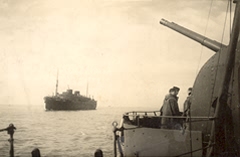
Having survived another journey, when Egret's engines broke down midway, Derric was drafted to HMS Victory and then to King Alfred as a prospective Officer Cadet. On leaving the ship, Derric was handed a small attaché case filled with white tropical chocolate, bacon, eggs and tinned fruit. He would later lose many of his good friends from Egret when she was sunk in August 1943. The Officer Cadet training began at Mowden Girls' School at Hove, then on to Lancing College:
Oddly enough, it was a little while before I realised that our numbers were being gradually whittled down. Make a mistake and Bang! a Tilly back to the depot and a quick return to the big war. We played at plotting a ship using a wheeled platform upon which a pelorus was mounted. Around the oddly shaped field were set out symbols to signify lighthouses, buoys and headlands. Using the compass and plotting table we steered our "Chariot" through the maze of nautical hazards. This, to me, was fun. The top 25% were allowed to go to either destroyers or Coastal Forces. I had set my heart on small boats, where with luck, there would be a chance of a command of my own.
Having passed his examinations, Derric set out for the Royal Naval College at Greenwich:
I walked up the steps into the Painted Hall and stood in open-mouthed awe. The Hall was quite beautiful: the painted walls and painted ceiling, the long rows of rich wooden tables, the silver Nelson Column candlesticks on the tables and the array of shining silver. It was an introduction to a more generous way of life, a more gracious way of life, a way of life which was to bring me much joy. . . We went off to Whale Island, His Britannic Majesty's Gunnery School, HMS Excellent. Time on Whaley was spent between the parade and the weapons teachers.
The last stage of the training was undertaken at Fort William. Derric caught the overnight train from Euston which stopped at the tiny station of Rannoch Moor:
The platform was covered in trestle tables upon which rested pots of tea. Well, not really pots of tea. We drank out of half jam-jars which had been cut in two, by the time honoured method of half-filling with oil and then applying a hot wire round the circumference. Not very elegant, yet serving the purpose. In the bitter November day, we drank it there on the platform, freezing hands wrapped round the "mug" and overcoat buttoned tight under icy chin. How grateful we were to the Scots women who had turned out on the bitter day to help us on our way.
Derric learned to handle the Fairmile 'B' as well as Higgins and Elco MTBs before his posting to HDML 1157 on the Isle of Bute. On arrival, he found that no CO had yet been appointed and there were no signs of a crew.
The New Year brought my new CO, Sub-Lieutenant Basil Knight, avuncular in appearance, clear of skin, rather short, the epitome of the pre-war city business gent, a man to be remembered. . . We began the never-ending task of working up, slowly at first, meeting and dealing with the endless problems endemic in getting a small ship ready for war. In such a small ship, multi-role training was essential. Gunners must be able to start and run the engines and motor-mechanics at a pinch must be able to man a gun and fight it out. The telegraphist, like the rest, must be able to man a gun and steer a course. The Cox'n at least must be able to use a chart and lay off a course for home. There was no guarantee that Basil or I might always be in a state to do this.
The crew began a series of anti-submarine exercises before heading for Newport. Here Derric learned that HDML 1157 was destined for Algiers but he would not be on it. Instead, he had been appointed to RML 516 attached to the 61st Rescue Flotilla as No 1 to Lt Tony Bone RNVR:
ML 1157 never reached Algiers - the City of Melbourne in which she was embarked was sunk in the Bay of Biscay by a FW200.
We were always busy at Portland: young men like these, were not prepared to restrict themselves to Air Sea Rescue; there had to be another facet to their work; it had to be something which was more like their idea of Coastal Forces. These additional tasks, usually consisted of defensive patrols, outside the shipping routes and between the merchant ships and incoming enemy light forces.
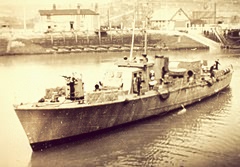
The crew adopted a similar role after returning to Newhaven:
It was a ghostly game of tag in which our intention was to give cover to the ships which used the dark to make the risky passage through the narrows of the Straits of Dover. . . One of the nicer things about 516 was that she was adopted by the chorus of Ivor Novello's show 'The Dancing Years', which was currently running at the Adelphi. . . one member of the crew, in strict rotation, was in London for two weeks, a guest of the girls, who wined and dined him and looked after his creature comforts.
The main role of the crew was in Air Sea Rescue, and one particular rescue is recalled vividly in Derric's memoir:
That night, we were briefed, that the following morning would see a Fortress attack on a major German industrial target (Stuttgart). . . We motored quietly out past the Seven Sisters and took up station well off Beachy Head. . . It was not a good day for the USAAF, for what came back from Stuttgart was a series of gaggles of Forts, not in any formation but each struggling to get home. . . Then we saw, what must be ours, a Fort flying at about fifty feet, too low to clear the Sisters. A high altitude Spitfire wallowing like a drunken sailor was hanging on his tail and willing him on. . . She came in low and I heard Tony telling him the bearing on which to ditch. . . About 200 yards on our port bow, she struck and began to settle. . . A quick count of heads, unless they were carrying extra bodies, everyone was out. . . I went over the side, it was summer but Oh! that first shock of cold water coming in through my clothes. . . At last they were all in. All that is, save one. He had drifted helplessly downwind. We tried passing a rope to him but no joy, he was far past that state. I went back into the water. . . I grated up and down against the hull, no longer feeling the bumps or the cuts, just the cold and the all consuming weariness. At last we had him on the deck, I gave him a shot of Omnopon and helped him clear his screaming ears.
Derric's next move was to the Coastal Forces Commanding Officer's course at Ardrishaig and at the end of the course he was appointed to command HDML 1388. It was then that the news arrived that Tony Bone and his friend Jock had been killed, another blow. It was Derric's first official command:
Consequently I flitted between elation and apprehension. . . The crew were very green, so unhappily was No 1. My job then, was to teach them. I recalled Basil Knight and Tony Bone and how they had taught me. . . As soon as was possible, we sailed North on our way to Ardrishaig for our working up period, prior to going abroad.
After dark, in the Tees Bay, disaster struck as 1388 became hard aground on Heugh Point at the foot of the steep cliffs. Having abandoned the launch, Derric was further distressed to discover the Fleet Auxiliary Vessel's Signals Recode book was missing. He swam out to the boat to recover it from the wireless office. At the Court of Enquiry Derric was found not to be at fault for the loss. His next command was of HDML 1391 and he was then drafted to HMS Pict in Freetown as First Lieutenant:
Pict was a mess, water contaminated, crew's quarters and bedding filthy beyond belief, no awnings and all gear and running equipment in need of repair. That, however, was only part of the problem. There had been a time when the Freetown Escort Force had been a first class operational unit. Now we, a handful of Arctic trawlers, a whaler or two and some very old and down at heel corvettes, were the front line force.
When the ex-whaler HMS Southern Pride was wrecked on Hooper's Patch, Derric commanded the seaboat taking off survivors:
I lost the wind in my left ear - no stars, no moon, Pict lost far behind in the dark and no sign of the wreck. The making tide was sweeping us far into the bay - ahead the surf roared as it pounded the reef. The a second of wavering light. We had found her; now for the fun!
She was a strange and daunting sight as she sat four square on the Patch, sitting like a ship at sea, yet as each sea surged past she did not lift to the swell. They swept over and along her.. with this wild sea there was a good chance we would end up washed onto her deck - a hard burst of rowing - we hit with a shattering thump and the animal whine of a broken plank..
In the dark bodies came over the side - three, four, five - then on the crest of a surge we were gone and over the Patch and helpless in that churning sea. We flogged hard at the oars to get her under control - three staggering swirls, then the power of four big strong men on those 14' oars brought her around.. but how long would Pride last and how would she go. I didn't see her lasting until morning and orders or no orders, we would be going back to the Patch. The surf was getting up and next time it wouldn't be so easy.
With a (mostly) fresh crew, Derric took the seaboat out again.
In the ghastly light of the starshell, we gulped and went in stern-first, stemming hard as the seas swept along Pride's upper deck. The survivors were coming over the side into the water, little groups of desperate men, two or three at a time..
We worked like slaves, dragging bodies, unrecognisable as men, coughing, wheezing things, covered in fuel oil - limp and exhausted men - yet with a joke and a word for the sweating, gasping men in the boat. . . I took my weary carcass below, into what only a few hours before had been rather a well kept wardroom. No longer, it was full of men, men still reeking of fuel oil and coughing up that burning fluid. I joined the gang and set to with pounds of butter to clear ears, noses and the delicate membranes of the eye.
In July 1944 he was involved in another rescue of passengers and crew from the Dutch ship DS Bodegraven. This small liner was sunk by U547 (Niemeyer) when a long way off its known route, and finding the survivors proved difficult:
The second afternoon of the search saw us well to the westward - dawn next day would see us just about on the furthest possible position. So much for our skill, because to the north and west of us the sea drift was two knots in the direction of land and there - because Bodegraven had unbeknown to us cut the corner - were the survivors coming through their second day of purgatory.
Up on the wing of the bridge I was physically comfortable, but deep inside me something felt wrong. At first, only a grumble and a nag. As the afternoon wore on, however, my faith in our calculations remorselessly ebbed away. The inner message was simple: "North", it said. It seemed madness. A madness which should not be allowed to throw away the lives of those enduring on the boats and rafts, but by now it was beyond ignoring and I whistled down the voicepipe to the CO in his cabin. His response was immediate, so he too was lying awake mulling over the problem: "Yes, we could make a limited foray to the North if I wanted to investigate a possible sighting - but be back on the basic search line before dark"
We ran out steadily, getting further and further from our so-carefully planned search line.. Damn it, give it another fifteen minutes, then the hell with it; hunch or pain - I was giving no more. The glasses swung, routinely and without hope or expectation. The fifteen minutes passed then, in what was really a gesture of finality and farewell, I kept on looking as I conned her round. As we turned, she rolled a little and lifted to a gentle swell. There! Knifed above the horizon, clear and black in that crystal clear air - seen for but a moment but no doubts - it was the peak of the triangular sail of a ship's boat. Against the odds we had found them.
The survivors helped with work duties aboard Pict.
I came up the hatch from the wardroom to be greeted not by my normal single line of men off watch, but by two lines. There, lined up on the port side were the male survivors. Forward came the senior Dutch rating, who saluted and reported most formally: "Dutch Marine, reporting for duty, Sir". They had obviously spent some time smartening themselves up and looked pretty good for a group of men who had climbed over the side the previous day wrapped in flags or bits of bunting. There are times when one's pride in man takes away the ability to express feelings in words. I looked at the Dutchman and paid him the highest compliment I could. I drew myself up to attention, returned his salute and instructed him to carry on, saying they were now crew and would go on the tot strength for rum.
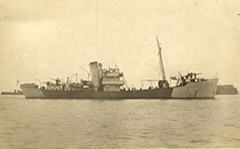
On arrival at Freetown, the Bodegraven survivors threw a party in gratitude for their rescue. Then:
The struggles over, I got down to the job of being a First Lieutenant and the Herculean task of making Pict clean, shipshape and into a fighting unit which would give us a chance of surviving the war. The task of a First Lieutenant is basically a very simple one. He is required to present to the Captain a ship and crew both in all ways equipped and ready to fight, a simple prescript which calls for endless work, lots of tact and on a number of occasions sheer robbery.
After a short spell of ill-health and admittance to the 51st General Hospital, Derric set about getting the Ship's Company fit with early morning runs and football. At the same time the process was started of building up a West African Navy. The heat and humidity took their toll on health:
We all suffered from peripheral malaria, stomach upsets, sweat rashes and of course, dhobi itch.
At last came the end of the war:
All over the Northern Hemisphere, submarines in droves had hoisted the black flag and surfaced to surrender; but here there were no U-Boats and even the end of the war passed us by. I have often since, watched the throngs celebrating in London. It wasn't like that for us; we were drained and exhausted; perhaps even too far gone to be able, then, to realise that at last it was over.
Derric returned home at the end of July 1945 and his memoir reflects the difficulties faced by so many, in coming to terms with the changed circumstances:
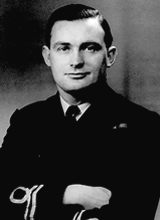
I came home in 1945 to what seemed to me to be an alien world in which my lost friends, wrecked marriage and weary mind were of little consequence. For a long time I found study impossible and concentrated on picking up the strands of teaching again and enjoying the physical and social pleasures of Rugby football. I also rejoined the R.N.V.R. in which I was to serve until retirement. All these started me on the road to recovery but eventually researching and writing the book together with help from my wife Joan and son Andrew completed the job.
In 1970 I gave up teaching and after a year at Newcastle University joined the North Regional Examinations Board as R&D Officer. There I spent twelve very happy years before eventually retiring in 1982.
In 1992 I had my left leg amputated and have since had to come to terms with the consequent loss of mobility. My old friends, who survived the war are still in close contact. Now all in our eighties we are restricted to corresponding by telephone. We are still close.
|
Training and Atlantic duties. |
|
This page: coastal duties and Freetown Escort Force. |