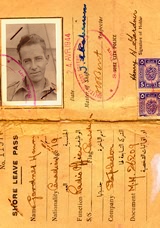
Sr R/O Henry Hamor Gardner
"On our third day in port we were lined up to be vaccinated against smallpox"
 |
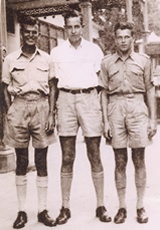
This page: on board SS Tweedsmuir Park. |
 |
On board SS Noranda Park. |
The
war could not have been fought without the steady flow of supplies
transported to every theatre of war on merchant ships. Ask yourself: how
did all the military personnel get to those war zones? How did they get
their food, smokes, boots and clothing? How did all the military equipment
get there? Everything from a carton of cigarettes to one thousand pound
bombs was carried on merchant ships.
From the Foreword to 'East of Suez'.
Hamor was born in 1924 in Toronto, Ontario, after his father joined the Ontario Provincial Police Force. As the baby of the family, Hamor attended six elementary schools and two different high schools and he and his sisters coined a phrase for each first day at a new school; it became known as 'Stare Day'. He then worked for nine months at the Toronto shipyard prior to enrolling in a full time radio operators' course at the Radio College of Canada. Hamor graduated in December 1942 and joined the Montreal Merchant Navy Manning Pool. He then sailed as a radio operator for the Park Steamship Company Ltd, on board the Tweedsmuir Park, Kelowna Park, Noranda Park and Willowdale Park. A copy of his memoir 'East of Suez' is on loan to the Centre and covers the period November 1943 to May 1945. Here we are pleased to feature extracts from the memoir, which is an interesting and often entertaining look at life in the Canadian merchant navy:
It was mid November 1943, when Buck Lassaline arrived back on board the S/S Tweedsmuir Park at Saint John, New Brunswick. I had returned the day before. We had been on leave for a couple of weeks after a rather rough trip to Hull, on the east coast of England. Jack Waines, our Chief Radio Operator had told me earlier that the word Karachi, had been seen on a large crate being lowered into number four hold. It had to be better than heading over to Blighty again, especially that time of year. We reflected on the horrendous Arctic storm that had decimated our convoy south of Iceland, on top of the U-boat alerts during a spell of good weather. We had thought we were old salts before experiencing that blow. We were sea sick for several days.
We were going to miss this North Atlantic winter. Those of us who had been home on leave were happy to be clear of land again. Except for Peter, the Lancashire lad; Captain Robinson, the mates and engineers were Yorkshiremen. All had been at sea since the beginning of the war and had their fill of dodging U-boat attacks. A trip to their home port in Britain was a rarity. Escorted by a couple of old, four stack destroyers from the moth-balled U.S. fleet, our convoy was soon across the Gulf of Maine and around Cape Cod. We ended up anchored at Hampstead Roads, off Norfolk, Virginia, awaiting the arrival of dozens of other ships to form up a convoy destined for Gibraltar.
The Tweedsmuir Park swung at her anchor for ten long days. There was no shore leave. Poker games went on almost continuously, many took to shooting craps, books were read avidly, and letters written to the folks and sweethearts back home. The waiting game finally ended. We were on our way. Crossing the Atlantic at that latitude is usually an enjoyable experience from a weather aspect. Our ship was just another one in a large convoy spread out from horizon to horizon. It is much like being in a huge crowd where you don't know anyone. You have the feeling of being alone, yet being in a throng.
We seldom knew what might be going on miles away on either side of the convoy where the escort vessels prowled. When the "karrump" of depth charges could be seen, heard and felt shaking the ship we didn't know if they were onto a submarine or a whale. Eighteen days after departing Hampstead Roads we were again at anchor, only this time in the lee of Gibraltar. In less than a day we were part of another convoy beginning a tricky run through the Mediterranean. Many of the ships in this convoy were destined for Italian or North African ports. Although the Italian campaign was well underway, the Mediterranean was still a bit dicey. A west bound convoy we passed lost two ships to aircraft in one attack. We had smoke screens laid down a couple of times. A few U-boats were still prowling around the Med, but what stirred up the gastric juices more than anything else was the threat of mines. That is what we were doing on Christmas Day, 1943. Playing follow the leader through a large mine field off the island of Malta. The known mine fields were bad enough, the unknown mine fields and drifting mines were a constant worry as we headed east for Port Said and the Suez Canal.
The Tweedsmuir Park needed bunkering at Port Said. Large coal barges were tied up three abreast on either side of our ship. Four extremely long squared timbers were hoisted into place, running from the central barges on either side up onto our port and starboard bulwarks where the bunker hatches were located. It was late in the afternoon when the bunkering began. Canvas and woven baskets were filled with coal, then hoisted onto the shoulders of men, women and a few children. They had dumped six hundred tons of coal into our bunkers by the time dawn broke through.
That prodigious output of work by the descendants of Egypt's pyramid builders may have been commonplace to them, but not to young, wide-eyed Canadians. Observing those workers made a lasting impression on me.
All the time bunkering was going on, a lot of business was going on over the side of the ship. Dozens of bumboats were continuously jostling for good positions, especially around the stern. With New Years Eve looming large next day, and with no booze available on board, negotiations for Egyptian Rhum quickly took precedent over souvenirs. I wangled two bottles for a pair of torn pants I was going to toss overboard.
Next day we steamed through the northern section of the canal and anchored overnight in the Great Bitter Lakes. Out of Suez and south through the Red Sea, a rivalry developed in the stoke hole between the three watches. As a result of some loud mouthed bragging, bets were wagered about which watch could log the most knots. The betting was simple. The losing black gang had to buy a round of drinks next time ashore. Each time I had to go into the boiler room to get distilled water for our wet batteries, I marvelled at the stamina of those men. Standing well out of their way, I would watch as they stoked those giant boilers with unending amounts of coal. An even worse job in my mind was that of the coal passer. Those poor devils knew no peace, there was no real respite for them except when they fell into their bunks, exhausted beyond belief. There was one passer to each watch, and his job was to keep the stokers well supplied with coal.
We proceeded south through the Red Sea, anchoring at the port of Aden for a few hours. It was primarily for the captain and Jack Waines to go ashore to be briefed by the Royal Navy about submarine activity in the Arabian Sea. Jack received instructions about keeping watch on certain frequencies to receive updated information.
Off we sailed alone through the placid waters of the Gulf of Aden, skirting the desolate appearing shores of southern Arabia. Further eastward we sailed past the foreboding cliffs of Muscat and Oman. Our relatively routine life on board ship ended when we arrived at Karachi, our first port of call where we were to discharge cargo.
We were outward bound for Bombay two days later. On our third day in port we were lined up to be vaccinated against smallpox. An epidemic was raging in central India. The only time Canadian merchant seamen were given "shots" against specific diseases was when their ship happened to in some foreign port where a preventable disease was on the rampage. These vaccinations did some good, but in many cases they were too late. After about a week's hunting, an oasis was found in the heart of an exclusive residential district of Bombay. It was an impressive looking establishment surrounded by a high brick wall. We were to learn this establishment was, under normal circumstances, the private domain of British army officers. With so many of those privileged few being engaged in more serious pursuits fighting a war in Burma, the rule was bent for us.
The truth of the matter likely lay in the fact that business was slow. Hidden speakers carried modern, western dance music continuously. If no guests were present upon our arrival, we never had long to wait for the young hostesses to appear togged out in a variety of appealing evening dresses. Dancing was free, almost. You were expected to treat your dancing partner to a drink or two. Whatever was in their drinks they were expensive. They may have been drinking coloured water.
It was correspondingly expensive to do more than dance or drink. A short time upstairs cost thirty rupees. If an all night stay was desired, it cost one hundred rupees. On a radio operator's pay of $109.00 per month, I doubt if many Sparks made it up those wood panelled stairs to sample the mysteries above. We made three visits to Madam Susan's during our two-week stay in Bombay. She got to know us, and welcomed us like we were her own sons back home for a visit. There must have been something about Buck and I that brought out the motherly instinct in such women. Many fascinating hours were spent out on the verandah with Madam Susan. We discussed the world at large, but our own personal lives in particular. We enjoyed those quiet, interesting evenings with her, and also with her entourage.
During our stay at Bombay, the port sports director talked us into playing soccer against a team from a British merchant ship. Few of us had played soccer except for half-hearted attempts at high school. It sounded like fun, let's do it. We had no proper gear for playing any sport. We were a ragtag gang of odd balls when we tumbled off a bus at the designated playing field. The Brits were togged out in flashy uniforms, and obviously had been doing this sort of thing for some time. They had known ahead of time what to expect from a bunch of colonials. They accepted us as we were in our mix of work boots, running shoes, work a day shorts or long pants, and shirts of many styles and colours.
Introductions over, the local officials got the game underway. And what a game it was! We weren't used to racing all over the place after an illusive ball. We soon had an argument over the use of substitutes which is a no-no in soccer. We played on using subs, ignoring the referee's whistle. The Brits finally okayed the idea after seeing how out of shape we Canucks were when it came to playing their game. What a relief it was when the game came to an end. The score was somewhat lopsided in the Brits' favour.
That game was played on a Sunday. We managed to struggle through two more games, one on Wednesday evening and the third on Saturday. We lost again on Wednesday but we were getting better. By Saturday we were in various stages of pain with blistered feet and cramped muscles. My legs were so badly knotted with charley horses I couldn't run. Having tried different guys in goal, it was decided to give me a shot at that position hoping my legs would loosen up.
How we won that last game goodness only knows. Maybe the Brits felt sorry for us. I did make some good saves, but most of the credit belonged to a gang of young kids who crowded around the back of the goal net. They knew their soccer, and heeding their advice, I was stopping shots from all angles. They cheered the crazy Canucks when the final whistle blew. We treated them to sweets from one of the many vendors spotted around the park. The Brits were good sports, although they may have looked upon the three games as practice rather than competition. The week had turned out to be a lot of fun, once our aches and pains subsided.
With ship's business done in Bombay, the Tweedsmuir Park set sail for Calcutta. The leg to Colombo was one of the rare times we steamed in convoy while out east. Our naval escort consisted of two seagoing, Indian Navy tugs. We hoped they had a few depth bombs on board if push came to shove.
Canadian merchant ships did not sail unarmed. In fact, ships like the Tweedsmuir were very well armed. Each ship carried ten, Royal Canadian Navy gunners. We had large guns mounted fore and aft. Browning machine guns were located on the second deck on either side of the bridge. We had a vicious weapon on the afterdeck. It was a rocket launcher. It was designed to fire five rockets at a time. When these small rockets were fired, they trailed fine steel wire for hundreds of yards in the hope of snaring a dive bomber or perhaps an aircraft wanting to launch a torpedo.
Nothing untoward happened as we steamed south in so far as subs were concerned. The convoy dispersed as it neared Ceylon (Sri Lanka), when most of the ships headed for Colombo. We kept on toward the south of the island.
Almost every night, when radio signals carried tremendous distances, we would pick up war time distress signals . . . SSSS SSSS SSSS. The transmitting operators sometimes had time to give the ship's position, some were thousands of miles away in the Indian Ocean. It was something else altogether when such signals originated from ships in the Bay of Bengal or Arabian Sea. There were few, if any, naval patrols, and no air patrols except near Ceylon. If a ship had been hit somewhere ahead, we could only cross our fingers, lower the cumbersome torpedo nets, and sail on pretty lady, sail on.
Dragging those steel nets through the water suspended from booms stretching out on either side, did provide a measure of safety from torpedoes. They also cut a ship's speed down at least two knots. Park ships were rated as ten knot vessels, in reality it was more like nine. A decision to lower the torpedo nets was never taken lightly. It was a slow and difficult job for the deck crew.
While sailing on our own in those waters, we often sighted a drifting lifeboat or life raft. It never was taken for granted they were empty, even when no sign of life could be seen through binoculars. Depending on reported sub activity, we would steer out of our way to bring the boat or raft alongside to see if it was empty. Each time this occurred it left us wondering what had happened to the men who had been in them, and to their ships.
Eleven days after leaving Bombay we sighted the approaches to the mouth of the Hooghly River, one of the main tributaries of the mighty Ganges River. After a wait of more than one hour, a pilot boat came alongside and a Hooghly River pilot climbed aboard to con our ship up the ninety-mile run to Calcutta. Ocean vessels usually tied up at the Kiddepore Docks. After considerable pushing, shoving and other manoeuvres by harbour tugs, our starboard side was warped up to the crumbling concrete dock. The mates made sure all rat guards were securely in place on each of our hawsers, not wanting any of those super Calcutta beasts on board.
The ruckus of docking was hardly completed when the port doctor made his way to the skipper's office. He and his assistants wanted to conduct a "short arm" inspection of the crew before any of them were permitted ashore. The crew was lined up and duly examined, no venereal disease was found.
Dysentery paid us a visit. For the best part of a week I did not stray far from my bunk. I would no sooner lie down in a state of utter exhaustion when I would have to struggle to my feet, and stagger to the head located on the far side of the ship from our cabin. The port doctor tried talking me into going to the hospital. I managed to dodge that suggestion. I had visions of being left at Calcutta. We had discharged our cargo of war materials, and taken on more crates of tea and bales of jute. We took our leave of the Kiddepore Docks, and soon were downbound in the grip of the Hooghly River's current. We were outward bound for Canada.
It took the best part of six days for the Tweedsmuir to reach Colombo. Once again we were dock side, only in a much better looking harbour than Calcutta. Colombo has one of the prettiest harbours to be found anywhere. It looks like it is more or less man made, being completely enclosed on the west side by an impressive concrete breakwater.
Once clear of the harbour security gate the heart of the city was only a few hundred yards away. A walk up the main street led past many interesting stores including several dispensing jewelry. Although I did not know beans about gems, I did end up purchasing a few from Dean Ismail Sons. I managed to keep the receipt for my one and only dive into the gem market. It reads: 1 Garnet - 12 rupees; 1 Tourmaline - 8 rupees; 1 Topaz - 6 rupees and 1 Ruby -16 rupees. A total of 42 rupees, $14.00 Canadian at the time. It turned out to be a good investment.
A favourite spot to visit was the Crossroads Club. This service-oriented club was run by the American Red Cross. You could enjoy a pleasant evening dancing and taking part in other fun activities. I was there one evening when they had a pie eating contest. I always thought that I was a fairly good pie eater, but I was no match for the other contestants. I started laughing so much at all the antics going on that I couldn't eat worth a darn.
We enjoyed our brief stay at Colombo. In fact, many of us were a tad sorry to see the last of our cargo being loaded. Those thoughts soon dissipated when we were under way.
Our run to Aden went off smoothly despite the warnings given by the powers that be about submarine activity in the Arabian Sea. There still were a few distress signals coming through the ether during night watches, but thankfully, none in our neck of the woods.
We made a brief stop at Aden when the old man and Jack went ashore to check in with the Royal Navy blokes. Captain Robinson received orders to call at Port Sudan to pick up a small amount of cargo. On the return voyages from India, the managing companies of Canadian Park ships could arrange their own cargoes and therefore visits were made to a few odd ports. Outbound voyages from Canada were another matter. Those cargoes were exclusively war related.
A few days later we were berthed at Port Sudan on the west coast of the Red Sea. Our ship was a bit of a novelty. We were told that the Tweedsmuir Park was the first Canadian flag ship to call there.
The next port of call was Jidda, Saudi Arabia, then the Suez Canal, before docking at Port Said.
Within a few hours of our arrival a convoy of British army trucks appeared. They were lined up in neat rows on the dock waiting to be hoisted aboard one by one. We were going to have the company of a bunch of British army "Desert Rats." There were army vehicles of every description, from jeeps to five ton jobs.
Hoisting them aboard one at a time using our jumbo booms, and accommodating them on our limited deck space turned into an interesting operation. Each vehicle had to be securely fastened to deck lugs using steel cables and turnbuckles. There was little or no room left on deck by the time they squeezed the last of the lorries on board. Along with every truck came their crews; at least thirty Tommies would be sailing to Algiers with us.
With our coal bunkers topped off we finally got underway. The British soldiers were lined up along the railings to watch the proceedings. They were happy to be heading west after spending years in the North African desert. They reasoned that Algiers would at least seem nearer to home. The arrangement was for the soldiers to sleep in their vehicles and use their own rations . . . the best laid plans of mice and men!
The relatively calm Mediterranean began acting up on our first day out from Port Said. When the ship started doing a bit of pitching and rolling, many of the Tommies wished they were back on the shifting sands of the Sahara.
Our gunners were required to stand extra lookout watches on that run. The captain wanted a pair of eyes up on monkey island, to back up the seaman's in the crows nest. It was mine country and once again pulses quickened at the prospect of our steel plates brushing against a mine's innocent looking spines.
By the second day at sea the Tommies who wanted to eat were wolfing down ship's grub. The chief steward did not mind, he was keeping tabs on it and would send in the appropriate itemized account for the company to sort out with the military brass. We bid adieu to our soldier buddies. They were to stay around Algiers for a while before heading for Italy. They were a well-fed lot as they drove away in their lorries with their own rations still intact. It was around that time when reality began to sink in. The chief steward and local ship's chandler could not locate many ship's stores, at any price.
We steamed merrily along to Gibraltar with a group of ships destined to become the nucleus of an Atlantic convoy. The numbers increased substantially while we were swinging at anchor overnight in the shadow of Gibraltar's famous rock. Shortly after first light, we were on our way west across the Atlantic under the guardianship of the United States Navy.
We were at sea and had to make do with what food we had on board. We learned to appreciate that rice could fill the aching void even when excess pounds were slipping off our frames. We were nineteen days steaming from Gibraltar to Saint John. The meals really took a nose dive during the final week. I lost a good ten pounds crossing the pond on that trip.
When our convoy was approaching the United States, Captain Robinson had us signal the Commodore's ship with the Aldis lamp. The skipper wanted permission for our ship to break off with the vessels bound for New York so that we pick up some grub. Our predicament was emphasized in the message. The Commodore's reply? No. Proceed to destination.
We arrived at Saint John two days later. It was early evening and we had to lie at anchor for the night. The word of our plight was relayed to the ship's agent who had a crate of eggs and a dozen loaves of bread sent out by launch.
Many of us paid off the Tweedsmuir Park next day, to disappear to the far corners of Canada on leave after our seven-month jaunt. Buck and I shared the train journey to Toronto. We stopped over at Montreal for one day to re-register at the Merchant Navy Manning Pool. Buck continued on to the family farm near Goderich to resume chasing the local girls.
|
This page: on board SS Tweedsmuir Park. |
|
On board SS Noranda Park. |