Sr R/O Henry Hamor Gardner
"We were loaded to the hilt, including a full deck cargo, with everything from small arms, ammunition, bombs, tanks, trucks, crated aircraft to food, all destined for the Burma front"
 |
On board SS Tweedsmuir Park. |
 |
This page: on board SS Noranda Park. |
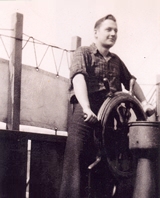
It was mid September 1944, when I checked in at the Merchant Navy Manning Pool in Montreal. When called up by the Manning Pool, I never knew what kind of ship I would be assigned to, or where it may happen to be. This time I didn't have far to go to find my new ship. The newly constructed 10,000 ton dry cargo vessel, S/S Noranda Park, was lying at the Dominion Vickers Shipyard in Montreal waiting for the balance of her crew to be signed on. I had the heady title of Chief Radio Officer for a second time. I had sailed as Chief Sparks earlier that summer on the ill fated, 4700 ton, S/S Kelowna Park. I boarded the Kelowna Park at the builder's yard at Pictou, Nova Scotia. Within a month the Kelowna Park was hard aground with her back broken. While climbing up the Noranda Park's gangway with my gear, I hoped for better times while sailing on this new ship.
After checking in with Captain Patchell, I soon was chin-wagging with my two junior operators. They were first trippers, whereas I was an old sea dog, one month past my twentieth birthday.
Joe McVeigh was from Orillia. He was in his mid twenties, and his six-foot build suggested he was no stranger to physical work. Tom Horn hailed from east Toronto. He had a medium to stocky build and a ready smile. I was relieved at the prospect of having two juniors who were enthusiastic and endowed with common sense. All of the senior mates and engineers, as well as the captain, were from the United Kingdom. They were long time employees of the Cunard White Star Line that been designated as the ship's operating company by the Park Steamship Company, a Crown corporation.
The fifth, or deck engineer, was a Canadian from Toronto. His name was Jim Baxter, and little did I know at the time how Jim was destined to play an important role in my future. I met his youngest sister Patricia in 1945. We were married in September, 1946.
There was plenty of work for the three of us to do while the ship was being loaded. Tom and Joe soon learned there were many little things about operating a ship's radio room not taught in school.
I drilled them on the tricks of raising and lowering the main and emergency aerials. The wet battery locker was another unknown even though they had been taught the basics of maintaining batteries. I enjoyed introducing them to the noise and heat of the engine and boiler rooms while showing them where to get distilled water for our wet batteries. Although the Noranda Park had oil fired boilers, the stokers still were a breed of men unto themselves. We also had a thorough inventory of tubes, spare parts, log books, tools to bring up to snuff before we sailed. Rumours about our destination began to fly thick and fast as our Plimsoll marks sank deeper into the murky waters of the St. Lawrence River. No doubt Captain Patchell knew well in advance, we only found out the day before our scheduled departure from Montreal. We were headed for India. We were loaded to the hilt, including a full deck cargo, with everything from small arms, ammunition, bombs, tanks, trucks, crated aircraft to food, all destined for the Burma front.
The majority of the ships in our convoy were destined for a run across to the United Kingdom in a larger convoy. These ships anchored in Halifax harbour. We were in and out of Halifax in a matter of hours, and on our way south alone. Due to reported U-boat activity off New York we headed into the Gulf of Maine en route to the Cape Cod Canal.
From the south end of the canal we headed for New York City via Long Island Sound. We were moored at one of the most remote spots imaginable. Getting to Manhattan involved a commuter train trip, a ride on an elevated railroad and finally a few miles on the Big Apple's infamous subway. In retrospect, I realize we were ordered to tie up at that isolated location because of the volatile nature of a sizeable portion of our cargo.
During our eight-day stay in New York City, I attended a convoy conference with Captain Patchell. These conferences were attended by the captains and senior radiomen from every merchant ship destined to sail in a particular convoy. This conference was under the auspices of the United States Navy. It was interesting to meet with your counterparts from other ships and exchange information about one thing or another. We Sparks were issued a new set of code books for deciphering messages. We were given a lot of other information pertaining to weather report transmissions, and details about communicating within the convoy by visual signals. For reasons which I did not find out about until a few weeks later, our ship was issued a new U.S. Army walkie-talkie radio. The unit was a novelty to us. The radio code books and other secret communication information we had on board ship were kept locked in a perforated metal box in the radio room. The USN officer briefing us ended up his spiel with a touch of dry, Yankee humour by saying, "And don't forget to throw your code boxes overboard before abandoning ship."
We sailed from New York on October 21st in a fairly large convoy. The Commodore of the convoy was a USN admiral. Convoy commodores sailed in merchant ships that were designated as such during pre-sailing conferences. Typically, such a ship would be relatively new and able to provide suitable accommodation for the commodore and his staff. This command ship normally sailed at the head of the central column of ships in a convoy.
Mid to late autumn must be the best time to sail across the Atlantic at that particular latitude. By then the hurricane season is almost past. Other than a few days of rolling seas we couldn't have ordered better weather. Like all first trippers to the tropics, Tom and Joe spent a good deal of their time between watches up in the bow. Playful dolphins were the fascination at the bow during the day.
Radio operators handled all of the visual light signals using either a hand-held Aldis lamp, or the large blinker light located up on the top bridge known as monkey island. About one week out of New York I was called to the bridge when the Commodore's ship started blinking us. The signalmen who sailed with the Commodore wanted to check out our recently acquired walkie-talkie. Having done a few practice drills on our own, it didn't take very long until we were on the air. We exchanged a few words and the test was over. I still had no idea why our ship was issued the walkie-talkie unit.
Lady luck continued to smile on us. Eighteen days after departing New York, we passed through the Straits of Gibraltar. We were barely into the Mediterranean when the Commodore's ship blinked us.
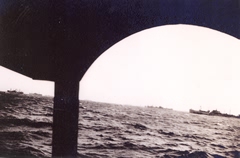
Up on monkey island, I gave him the go ahead. The message ordered us to break away from the convoy at a certain time and proceed to Oran. Our ship was to be the commodore's vessel through the Mediterranean. At Oran we were to pick up the British Commodore and his staff. What a let down when I showed the message to Captain Patchell. He gave it a cursory glance and said he had been expecting it. He had been given these instructions during the convoy conference back in New York. He was proving to be a tight lipped captain. Why we had been issued a walkie-talkie was no longer a mystery.
Our anchor had hardly reached the bottom of Oran harbour when a deeply loaded launch came alongside. Up our Jacob's ladder scrambled Rear Admiral Benson, Royal Navy, followed quickly by the rest of his staff. The Royal Navy radiomen took over our radio room. They had a lot of their own portable radio equipment. We were told to take a break. If they needed us for anything, they would give us a shout. We didn't need to be told a second time. Although attacks by aircraft and submarines were becoming infrequent at that time, they still posed a danger to ships in slow moving convoys. The threat of unknown mine fields was minimal, but this was offset by the increasing number of drifting mines. Hundreds of these deadly spheres were breaking free of their rusting mooring cables to drift aimlessly around the Med. The lookouts didn't dare nod on their watches.
We got to know Admiral Benson quite well. When he could manage it, he ate with us at our table. We enjoyed his company, and hearing about his experiences during his years of service in the Royal Navy. I had envisaged an admiral in the Royal Navy as being a stuffed shirt and full of his own importance. Admiral Benson was just the opposite. He was a down to earth sort of man. We were sorry to see him depart at Port Said. On the other hand, we were happy to see the Royal Navy radio operators vacate our radio shack.
There was no shore leave at Port Said. We steamed through the southern end of the Great Bitter Lakes next day. We lay at anchor off the port of Suez for half a day while the skipper did some business shore side with naval types. Underway again, we were soon out of the Gulf of Suez and into the Red Sea for a five days run to Aden.
The sea treated us well. The land far to the west did not. For the best part of one day we sailed through a whistling sand storm roaring out of wastes of the Sahara Desert. The air was filled with fine particles of grit which all but obliterated the sun. It was an eerie feeling to be in the grip of a sand storm while sailing down the middle of the Red Sea. It was around noon on November 24, 1944 when our ship dropped the hook into the waters of Aden harbour for an overnight stay.
The Royal Navy was in charge of all nautical matters pertaining to the war. They wanted to see the captain and radio operator. Leaving Tom on board, Joe and I accompanied the skipper ashore in a naval launch. We were given explicit instructions about communicating with Aden every second night. The times of our transmissions and the radio frequencies to be used were staggered. The navy brass was concerned about reported submarine activity in the Arabian Sea and wanted to keep close tabs on us.
There was no convoy system. We were to sail on our own to Bombay and take our chances using long, zig-zag course changes hoping to elude any submarine endeavouring to get an accurate bearing on our ship.
Away we steamed for Bombay and seven days of absolutely perfect weather with each day a duplicate of its predecessor. One lazy afternoon I was shooting the breeze with Aldo Contenti, the lead naval gunner, and a few of his cronies. We were sitting on the starboard side of number four hatch staring out at the placid Arabian Sea. All of a sudden we all did double take when an immense, grey, glistening shape emerged from out of the deep about a quarter mile away. It was a beautiful blue whale, up to fill its gargantuan lungs with air. It was an unforgettable sight. Speaking about it afterwards we agreed that for a fraction of a second after the whale hove into view, every one of us had thought it was a surfacing submarine.
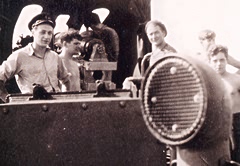
Our position reports to Aden went off without a hitch. Those naval operators were on their toes. We only had to transmit their call sign once, followed by our own secret call sign, to be given the go ahead. Approaching Bombay, the mates began asking questions about things I knew precious little about. They asked about lighthouses, pilot boats, harbour marker buoys and other matters pertaining to conning a ship into the confines of the Bombay harbour. The bits and pieces I dredged up from my scant memory weren't of much help to them.
My knowledge of Bombay was in demand from the captain on down for the first few days. Where was the best place to get a drink? Where could you get a good meal? Where there any good theatres in town? Where was the best place to meet ladies of night? (How would I know that?) Was there a good place to go swimming?
I let Tom and Joe have all the shore leave they wanted. They took full advantage of that freedom to make out like real tourists. They toured many of the city markets and learned to haggle like professionals. Joe and Tom found many bargains. Their shared locker space began to fill up. I escorted a few of the crew to take in the wonders of Madam Susan's establishment. The evening was enjoyably expensive. The hour I spent chatting with Madam Susan is fondly remembered. It was the last time I was to see her.
Meanwhile, the stevedores had been busy. They had unloaded a goodly portion of our destructive cargo and replaced it with tons of benign stuff like jute and tea. We sailed alone down the west coast of India. We stopped for a few hours at Colombo where the skipper was briefed by the naval authorities about what was going on in the Bay of Bengal.
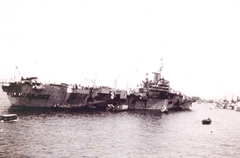
There was no shore leave at Colombo. Our luck was still holding. There were no reports indicating submarine sightings or ships having been sunk to the north. The all too familiar SSSS signal was heard almost nightly from ships in trouble hundreds of miles away in other waters to the south, west or east of our ship.
We arrived at Calcutta around noon on Christmas Day. After some tight maneuvering with the assistance of a couple of harbour tugs, we were snugged up to the crumbling concrete dock immediately ahead of the Riverdale Park, more or less a sister ship to the Noranda.
They weren't going to begin unloading until Boxing Day. When the usual port shenanigans were out of the way, the crew settled down to enjoy the day. True to tradition, the cooks and stewards managed to provide a great turkey dinner for all hands. We expected Captain Patchell to unwind a trifle and make a Christmas toast with some real liquid refreshment. We should have known better. He made the toast with apple juice.
Immediately after dinner, we picked up on a rumour about booze flowing like water on the Riverdale Park. It wasn't too long before we were spread out in the junior radio operators' cabin on the Riverdale enjoying their hospitality. The evening took on a rosy glow but Boxing Day morning wasn't quite so rosy for many!
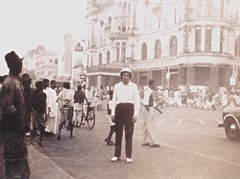
Similar to our Bombay arrangement, I let Joe and Tom have all the shore leave they wanted. They made the most of it by visiting here, there and everywhere in the city.
We were berthed at the Kiddepore Docks over New Years. By January 3, 1945, we had discharged all of the destructive hardware destined for the Burma front. We had taken on the usual cargo consisting of jute, tea and many other odds and sods of Indian products. We were homeward bound and glad to see the last of the Kiddepore Docks. We were three days south of the mouth of the Hooghly River, when Joe became sick. When he asked to be relieved from standing his watch we knew there was something seriously wrong with him. Joe's fever worsened as the ship inched southward. He slipped in and out of consciousness, and was in dreadful shape a few days later when we rounded the southern tip of Ceylon. Upon our arrival at Colombo, an urgent request for a doctor was relayed to the port authorities via visual signal.
Sadly Joe died from smallpox after being transferred to hospital. The remainder of the crew began fifteen days quarantine on board ship.
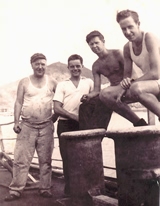
The quarantine was lifted on the sixteenth day and we proceeded to a long delayed berth. It was a welcome relief for all hands to be allowed ashore. Those of us closer to Joe didn't feel like celebrating. Tom and I tried to visit Joe's grave but we couldn't get through the red tape.
Our unforgettable stay at beautiful Colombo finally ended. The eight day trip to Aden was a blur to Tom and me, as we adjusted to the prospect of standing six and six watches until we arrived back in Canada.
On February 15, 1945 the Noranda Park pulled away from Port Said with a grumbling crew. The engineers had no success in locating the cause of our diminished speed. The problem had been getting progressively worse since leaving Colombo. We were dashing along at a speed a little above eight knots. On that eight day trip from Port Said to Algiers we sighted and destroyed three mines that had been seen glinting innocently in the bright sunlight. Each sighting was reported to Alexandria Radio giving its location and whether it had been blown up. We in turn received information relayed through Alex Radio about mine sightings made by other ships. There was no radar on merchant ships at that time. It was all down to human eyes, keeping your fingers crossed and a few well directed prayers especially at night and during bad weather.
We were in port for six days, then with the hatches battened down for the last time, we took our leave of Algiers and embarked on the last leg of our journey.
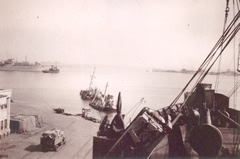
We made an overnight stop at Oran before proceeding to Gibraltar with a few other ships. At Gibraltar we stopped only long enough to pick up a Canadian DEMS officer who had been put ashore from another ship a few weeks earlier for a stay in the hospital. We upped anchor and joined a large number of ships destined to become a west bound convoy. It was March 5, 1945. We were heading home!
The convoy was rated at nine knots. During the first night it became clear to us that we were in a spot of bother. We couldn't keep up. We were doing our best. We were pounding away at our top speed which obviously wasn't good enough.
Around sunset a final signal was flashed to us from the rear escort vessel that had been keeping tabs on us. We were ordered to drop out of the convoy and proceed to Horta in the Azores and await further instructions.
We arrived off the town of Horta on the island of Fayal, on March 9th for what we figured would be for the first and last time.
Unfortunately it would take 2 further attempts, including meeting the full force of a frightening storm, before the Noranda Park joined a slower convoy.
Early next morning we sighted a small convoy heading west at a leisurely speed of seven and a half knots. Most of the ships were pre-war tramps that had somehow survived the war to that point. We didn't care. They all looked good to us. We flashed a "thank you" to our escort tug. We weren't jealous of its crew. They were heading back to Horta.
The following days were relatively uneventful except for the many zig-zag courses we had to steer when suspect sonar readings were picked up by the shepherding naval ships. Everything went smoothly until we were enveloped by an infamous Grand Bank's fog. That night we were creeping along through fog so thick it could have been cut into wedges and served on platters. Every ship had their navigation lights on which was a very rare happening during blacked out, wartime voyages. We were simply following the small stern light of the ship ahead and keeping a wary eye out for all other ships to port and starboard. It was about 2230 hours on that foggy night when I was blasted out of my chair in the shack by a crashing Morse code signal from the Commodore's vessel.
All ships emergency turn starboard forty-five degrees.
To say that all hell broke loose would be putting it mildly. Out of the dripping darkness loomed ship after ship of a fast, east bound convoy. Night lamps were blinking everywhere with blaring horns and piercing whistles sounding from every direction. Due to some quirk of fate which often holds a guiding hand over confused seamen, those lines of east and west bound ships meshed together like clockwork. The scene was like Christmas. There were red, green and white lights seeping through the curtain of fog, gradually becoming more distinct only to fade from view as ship after ship passed each other in total confusion. For a short eternity all of the captains and mates on watch that night must have aged appreciably. Then, it was over. Our little convoy was alone again. It took until daylight to get all the ships sorted out and looking like a respectable convoy again. We were left to guess how such a screw up could have happened. The naval brass kept such secrets to themselves. It was nothing short of a miracle there were no collisions, especially to our seemingly ill-fated vessel.
Our ship broke away from that mini convoy off Yarmouth, Nova Scotia. We steamed into the turbulent waters of the Bay of Fundy and were safely berthed at Saint John less than forty-eight hours after leaving Halifax.
I was not sorry to get paid off the Noranda Park the following day. The war in Europe ended the day after I arrived home from my voyage to India on the Noranda Park. It was a day of very mixed emotions for me. I took in all the hoopla down around the city hall where thousands of people were letting go and celebrating the end of war in Europe.
For some reason it all seemed wrong to me. I thought it should have been a time for quiet reflection. In retrospect, I realize that I had not adjusted to being home. It usually took upwards of two weeks to become used to shore life after being on a ship for months on end. In reality I was home, but in my heart I was still thousands of miles away, somewhere East of Suez.
Post-war, Hamor (his nickname is Hank) married Patricia in September 1946 and has two sons, Edward and Douglas. He has never lost his fascination for the sea and has passed this on to Ed, who also sailed as a radio operator for many years, while son Doug served as the RSM of the Lord Strathconna Horse Regiment. Hamor worked on marine radio beacon/light stations and coast stations until 1959 when he was promoted to the radio inspection office at London, Ontario. He then enjoyed a successful career in the administration of radio regulations. After early retirement Hamor sailed on two other ships as a 'Sparks', a chemical tanker and a bulk carrier, saying 'those were very brief flings trying to resurrect my misspent youth! I had been in the comfortable pew of blissful married life for too many years'. He and Pat are still very active, enjoying hiking and gardening.
|
On board SS Tweedsmuir Park. |
|
This page: on board SS Noranda Park. |