The Thai-Burma Railroad
"They relieved their anger and frustration by random beatings of POWs..."
 |
This page: overview, general conditions & personal experience. |
 |
Personal experience including health & medical conditions. |
 |
Personal experience including escape, punishment, 'Hell Ships'. |
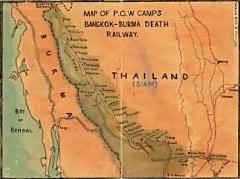
The initial military successes of Japan in Hong Kong, Malaya, Singapore, Burma and the Philippines, resulted in thousands of POWs becoming available for slave labour. The Japanese had not anticipated so many people being captured and little provision had been made, so life in the camps was a constant struggle for survival for the prisoners, without Red Cross parcels to bring the diet up to subsistence level.
Within the camps all aspects of discipline and welfare were governed by the Commandants who had ultimate power over the POWs in their charge. One of the first orders was that prisoners should sign a non-escape oath. Any attempted escapers would be executed in front of others as an example. Escape then, became almost impossible. Overall the death rate in the camps approached one in three. Prisoners were ordered to work to be entitled to 'extra' rations although the food levels were so low, comprising almost totally rice, that scrounging to survive became part of daily life. Their Japanese pay was used to barter when the opportunity arose, although its value kept falling and many had nothing left to trade, losing literally, the shirts off their backs. The mistreatment of the POWs was due largely to racial differences and the treatment was one of callous neglect, with a lack of food and medicines, as well as brutal punishments meted out for various 'misdemeanours'. The harsh discipline of beatings was reflected within the training methods of the Imperial Japanese Army. In their weakened state, many prisoners succumbed to the diseases attendant with malnutrition and lack of care: beriberi, cholera, dysentery, dengue fever and malaria.
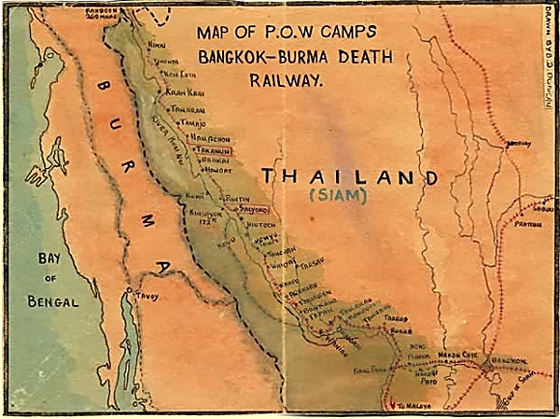
The plan for the railroad was to cover the 260 miles from Ban Pong, across into Burma and to Thanbyuzayat to allow the Japanese to service the Burma campaign. The terrain was ferocious for the slave labourers, from the low-lying Siam in the south, to high mountains, all within the jungle. The Japanese engineers had estimated that to construct the railroad could take up to five years; Japanese command ordered that it be completed in eighteen months, by hand. It was a formidable undertaking. After construction began, orders came to finish the railroad more quickly, so from then on the word most heard was 'Speedo'.
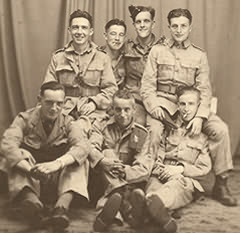
The numbers of POWs involved were around 61,000, although establishing accurate figures is very difficult. Almost half were British, 18,000 Dutch, around 13,000 Australian and 650 American. These numbers have been quoted in 'Prisoners of the Japanese', Gavan Daws (Robson Books, 1995). Huge numbers of Asian civilians were used too, treated just as harshly as the POWs and outnumbering them by as many as four to one. The tools available to the labourers to build the railroad were pickaxes and shovels, buckets and hammers. Most of the bridges under construction were of wood, with logs hauled by the prisoners.
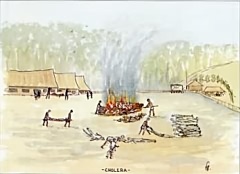
The medical care available to the prisoners was extremely limited and the medics resorted to ingenious methods to treat their patients. The pressure from the guards to send prisoners out on work duties even when unfit was continual, such was the determination to complete the railroad regardless of the numbers who perished. A major problem was the ulcers suffered while working barefoot on the railroad. A small cut could turn into an infected open ulcer in no time, the only treatment being to cut out the dead flesh before the infection spread further. Amputations were undertaken with crude tools. The conditions also led to a cholera epidemic. For six months cholera was an enormous problem with men falling prey to it in their hundreds. The deaths rose rapidly, particularly among the Asian workers. Dead POW cholera victims were cremated to try to stop the spread of the disease.
The POWs were desperate for news and many secret radios existed at the railway camps. The Japanese Military Police, the kempeitai, were greatly feared, but at Kanchanaburi it was the camp guards who meted out the punishment when a secret radio was discovered. One of those terribly beaten was Eric Lomax who wrote of his experiences in 'The Railway Man' (Vintage, 1996).
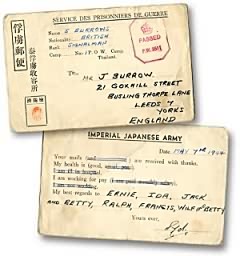
Extracts from memoirs held at the archive demonstrate the terrible conditions facing all POWs involved in the construction of the railway:
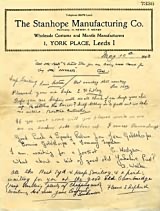
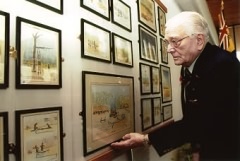
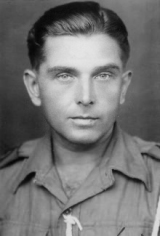
Fred Seiker was born in Holland in 1915. He served in the Dutch Merchant Navy after attending the Rotterdam College of Marine Engineering and during the war he served on the North Atlantic routes and between the Far East and the UK. In 1942 he became a prisoner of the Japanese after the invasion of Java and was transferred to Changi jail in Singapore. He was sent to work on the Thai-Burma railroad and was not repatriated to Holland until 1946. That same year Fred moved to the UK and has remained here since, pursuing a successful career in engineering. His poignant series of paintings depicting his experiences as a prisoner are displayed at The National Memorial Arboretum. He describes the type of work he undertook:
Our group was soon put to work on the foundations for the Kwai Bridge at Tamarkan. We were detailed to work on driving wooden piles into the riverbed for the foundations of the concrete bridge supports. I would like to explain how this highly complex and technical feat was executed. Several triangular wooden pole structures were erected which carried a pulley at the top. A stout rope was fed over the pulley.
One end of the rope carried a heavy steel ram; the other end was splayed into several leaders, which were held by POWs standing in the riverbed. Straight tree trunks were obtained from the surrounding forest, transported to the bridge site by elephants or floated from up-country downstream, where a Jap decided which ones were to be used for piling. The piles were hauled into position beneath the ram and we began pile driving, on the command of a Jap standing on the riverbank shouting through a megaphone the required rhythm at which he decided that piling should take place. You pulled in unison, you let go in unison. 'Ichi, ni, san, si, ichi, ni, san, si', on and on and on. Hour after hour after hour. Day in, day out. From dawn to dusk, unrelenting. On returning to camp at night it was often difficult to raise the spoon to eat the slop issued to us. Your arms protested in pain, often preventing you from snatching some precious sleep. And yet, come dawn you repeated the misery of the previous day. I often wondered about the miracle of the human body and mind. Believe me, it is quite awesome.
Other work involved building embankments from track level up to the top of the growing hill:
You carried a basket from the digging area to the top of the embankment, emptied it and down again to be filled for your next trip up the hill. Or you carried a stretcher - two bamboo poles pushed through an empty rice sack - one chap at each end, and off you went. Simple really. But in reality this job was far from easy. The slopes of the embankments consisted of loose earth, clambering to the top was a case of sliding and slithering with a weight of earth in attendance. This proved to be very tiring on thigh muscles and painful, often resulting in crippling cramp. You just had to stop, you could not move. Whenever this occurred the Japs were on you with their heavy sticks, and beat the living daylight out of you. Somehow you got going again, if only to escape the blows. Also, the soil alongside the track varied considerably, affecting the volume of earth an individual could move during a day. At the start of each day a Jap would decide the total volume of earth to be dug out that day. By the nature of things, some finished earlier than others. The volume the following day was fixed by the fastest time obtained the previous day, thereby increasing the total workload of the entire team. It was a truly 'no win situation'. If a team was running late, everyone worked on until the volume for that day was achieved. This meant that the Japs also had to stay behind. They relieved their anger and frustration by random beatings of POWs, sometimes resulting in serious injuries.
There was continuing, and increasing pressure to add sick men to the list of 'fit' to work:
The orderly who presented the Japs with his sick list was always, and I mean always, beaten up in a show of Jap rage. The poor, sick individuals were then dragged from the so-called hospital, and forced to turn out for work on the railway. Sometimes they returned to the camp that night, carried on a sack stretcher, dead! These were, by no means, isolated incidents: they occurred on a daily basis all along the rail track.
Fred Seiker writes graphically of the punishment he received on one occasion:
In one camp in the north of Thailand it occurred that it was my turn to raid the Jap cookhouse in the hope of finding something to eat. It was known to us that the Japs had confiscated a consignment of Red Cross parcels, which was their usual procedure. I was able to nick a tin of fruit. On my way back to my eagerly waiting mates, I was suddenly confronted with a glistening bayonet, followed by a kick in the groin. I was terrified. I was marched to the guardhouse with the bayonet in close attendance.
The ritual beating began. Several of them pounced on me all at the same time. When eventually the sergeant in charge of the camp appeared, he ordered them to stop. I could not have been a pretty sight; I certainly did not feel like one. He drew his sword and pointed it at my neck, grinning. He addressed me in broken English, from which I understood that stealing from the IJA was a serious crime, and would be punished by chopping my head off. At some point I managed to explain to him that I could not possibly be a thief by taking something that was mine in the first place. He did not appreciate the logic of my defence, and he ordered that I be taken to the punishment tree some ten yards in front of the guardhouse. I had watched many a comrade undergo the sergeant's favourite punishment and realised that it was now my turn. I was propped against the tree, my arms pulled back and tied at the wrists behind the tree trunk. My feet were tied together with barbed wire and secured to the tree trunk. After a few more punches in the face, they left me alone. The pain that lashes your body after a while, I must leave to your imagination. When morning broke they put a bucket filled to the brim with water in front of me and left me to it. A sophisticated torture if ever there was one. Parade was called, when it was explained that this was the punishment for stealing from the IJA, and that I would be executed later on. I do not remember much after that. As you are aware by now, the execution did not take place. The terror of it was, that you never knew whether it was an idle threat or an official statement. I came too in the 'hospital', with an orderly trying to pour water into my mouth.
The fear of cholera and its spread is clear in Fred Seiker's memoir:
Overnight the huts were filled with the dead and the dying. The Japs were terrified of this disease and hastily retreated to a safe distance up the road after barricading the entrance to the camp with X-shaped barricades and rolls of razor wire. We were instructed to incinerate our dead, not to bury them. Cholera strikes swiftly without warning. It is terminal in the absence of medication. Our medic's kit did not even contain an Aspirin tablet. Combined with the emaciated state we were in, the onslaught was terrifying. You could be OK in the morning and dead in the evening. Once dehydration set in, your place on the pyre was assured. I was one of a team attending the funeral pyre for a while, and depositing the bodies of my friends into the flames. This was a round-the-clock operation, 24 hours a day. It was particularly macabre and frightening at first. Bodies would suddenly sit up, or an arm or leg extend jerkily. But even this horror soon became a routine job.
The reaction, when it became apparent that the war was over for the Far East prisoners, was overwhelming:
After a while a few natives appeared, telling us with gestures and much excitement that the Japs indeed had gone during the night. Later we learned that the War had ended three days earlier on August 15th. We wondered whether the Japs had known. I cannot begin to tell you how this news was received by us. Some sank to their knees and prayed. Others just stood there, tears streaming down their haggard faces. A few were running around, wildly gesticulating and screaming. I could not grasp the enormity of what had happened. I had become a person again as sudden as it was ripped away from me all those years ago. I remember the feeling of triumph that swept over me. I had done it!
Post war Fred suffered with an enlarged spleen and liver and a permanent disorder of his digestive system as a result of the prolonged spells of dysentery. The physical problems were one aspect, but the mental battles faced by large numbers of the Far East POWs were harder to spot:
I had a little difficulty in adjusting to normal living and was treated by a psychiatrist for a while. Within a year of returning to normality I was ready to face the world again, and that is what I did. One incredible point I have in common with other POWs still alive, we still have nightmares after more than half a century of civilized living. It would seem that the brain does not forget, however hard one tries to wipe out certain events.
|
This page: overview, general conditions & personal experience. |
|
Personal experience including health & medical conditions. |
|
Personal experience including escape, punishment, 'Hell Ships'. |